
On The Trapline
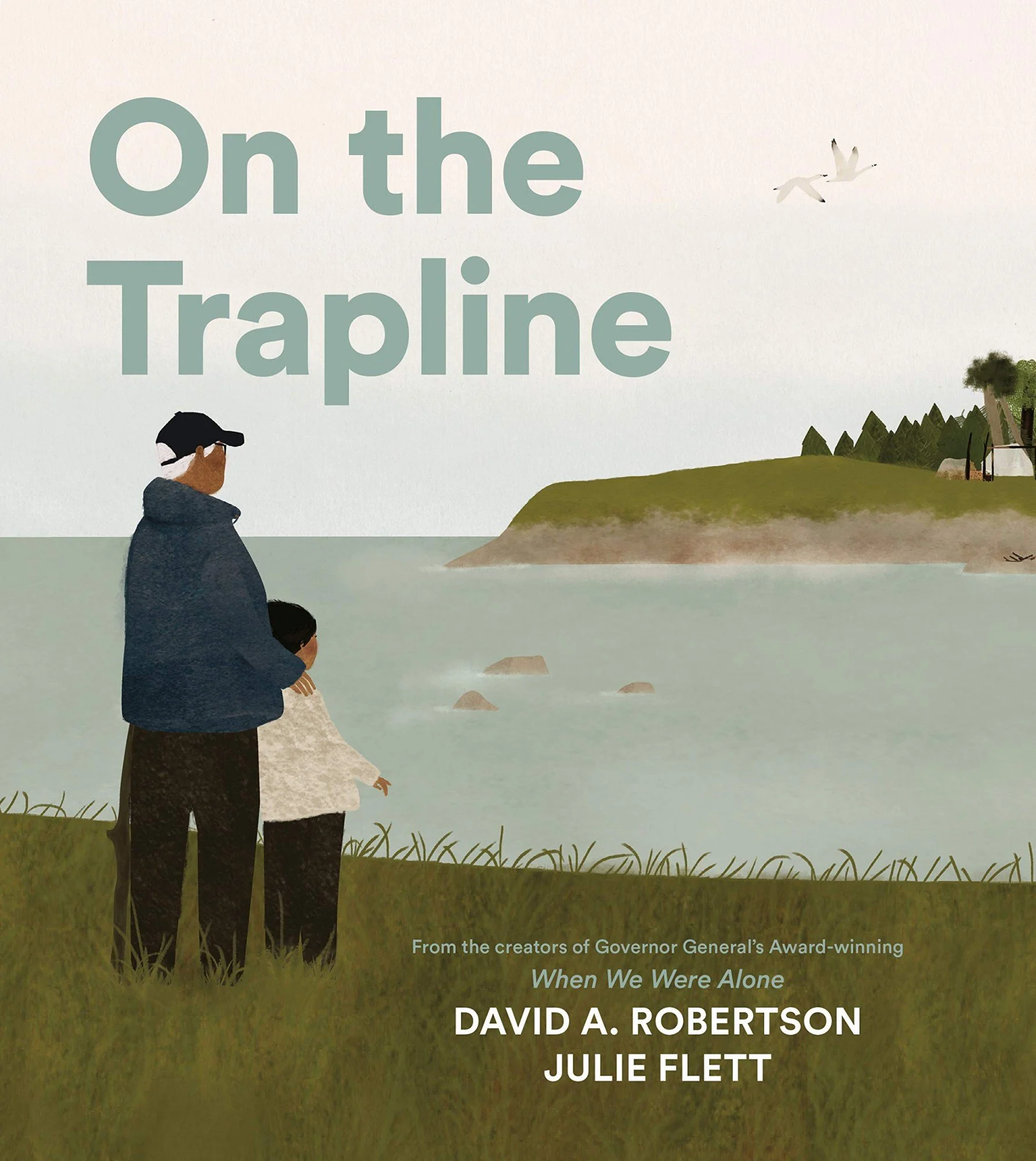
On The Trapline | by David A. Robertson | illustrated by Julie Flett
A boy and Moshom, his grandpa, take a trip together to visit a place of great meaning to Moshom. A trapline is where people hunt and live off the land, and it was where Moshom grew up. As they embark on their northern journey, the child repeatedly asks his grandfather, “Is this your trapline?” Along the way, the boy finds himself imagining what life was like two generations ago — a life that appears to be both different from and similar to his life now. This is a heartfelt story about memory, imagination and intergenerational connection that perfectly captures the experience of a young child’s wonder as he is introduced to places and stories that hold meaning for his family.
Distinctions: Winner, 2021 Governor General's Literary Award for Young People's Literature — Illustrated books.
Ideal for:
National Day for Truth and Reconciliation September 30
National Indigenous History Month June, National Indigeous Peoples Day June 21.
On the Trapline. Text © 2021 David A. Robertson Illustrations © 2021 Julie Flett. Reproduced by permission of Tundra Books, an imprint of Penguin Random House Canada Young Readers, a Penguin Random House Company, Toronto.
This spare and moving story of homecoming is narrated by a young Cree boy who is travelling with Moshom, his grandpa, who is returning to the trapline where he grew up, but which he has not seen in many years. Along the way, Moshom reminisces about his childhood. He shares cozy parts like sleeping in one room in winter his large family, or outdoors in a tent in the summer. He recalls swimming, chopping wood, making paper boats, and eating the sweetest berries. The words in Swampy Cree which punctuate his narrative reveal what his childhood was made of: family, north, swim, different, slowly, beautiful, tent, go outside, animals, berries, sharing, thank you, he remembers.
But there are other memories too: a school far away from the trapline where his Cree words were not welcome and he had to sneak into the bush to speak his own language. When his grandson asks him what it was like to go to school after living on the trapline, Moshom is quiet for a long time. Then he says simply, “I learned in both places. I just learned different things.” The silence speaks volumes and invites sensitive and attentive readers of all ages to wonder what kind of things Moshom learned at school, and how it came to be that so much time passed before he was able to return home with his grandson.
On the Trapline is primarily a story about going home, physically and emotionally, after being away for a long time. It resonates strongly with the biblical story of exile and return, but also other individual stories about being distant or alienated from family then eventually coming together again (e.g., Jacob and Esau in Genesis 33). It is also a story about mindfulness and attentiveness, especially to the details of the natural world. The narrator is wide open to the new world of the north and sees all sorts of things he compares to his own experiences growing up in a southern city. Most of these observations are gentle, calm, and nonjudgmental. The only exception is after his first taste of a Saskatoon berry right off the bush: “It tastes better than the fruit we get at the store.”
In a concluding note, author David Robertson speaks of his own experience of returning (as an adult) to the trapline with his own father, a homecoming for both men. Reconciliation, Robertson notes, is more than healing from trauma. “It’s connecting, or reconnecting, with people, culture, language, and community.”
Biblical Themes: homecoming (exile and return), belonging, family, intergenerational relationships, connection with the Earth, remembering, attentiveness and gratitude, repentance and repair
Making Connections:
All-ages Potluck: At each table, try to have people of different generations. Provide baskets of cards intended to spark conversation and storytelling: Where did you grow up? Where did you sleep? How was your home heated? Did you have brothers and sisters? Did you have your own room or share a space? What were your favourite foods? Did you help prepare them? What kind of games did you like to play? Who did you play them with? What was your school like? What kinds of things did you learn?
Storytelling Basket: At a similar event, either over a meal, or as part of an evening gathering, create cozy spaces for small-group storytelling and offer a basket of prompts on the theme of home: What makes a place feel like home? Where is home for you? Can you have more than one home? Have you ever been homesick? Did anything make you feel better? Have you ever come to a place that felt like home, even though you’d never been there before?
Tell Me a Story! Encourage the children in your congregation to interview an older relative (or an older member of the community) and ask some of the same questions. Perhaps they can share the interviews in worship, or as part of a display that the community can read.
Truth and Reconciliation: Read On The Trapline as part of a worship service or special gathering to mark the National Day for Truth and Reconciliation. Read and learn more about the impact of the residential school system on Indigenous families and culture, and the role churches played in that harm.
If there is a park or green space near your church, arrange a group walk led by someone who knows about native plants and animals. Include time for sitting quietly, looking carefully, using all your sense to take in what is around you. Conclude with a group prayer of thanks for all the beautiful things you noticed.