
Whimsy’s Heavy Things
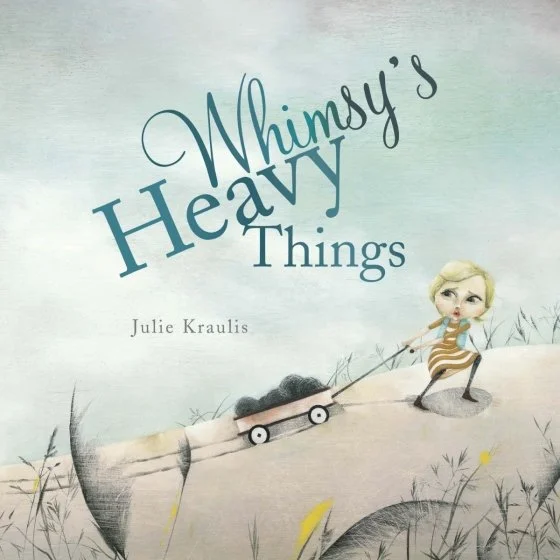
Whimsy’s Heavy Things | by Julie Kraulis
Whimsy's heavy things are weighing her down. She tries to sweep them under the rug, but she trips over them. She tries to put them in a tree, but they fall on her. She even tries to sail them out to sea, but they always come back. Eventually Whimsy decides to deal with the heavy things one at a time... and a surprising thing happens. With exquisite illustrations and delightfully simple text, Whimsy's Heavy Things is a sweet story about changing the things that weigh us down into the things that lift us up.…
Ideal for:
Mental Health Awareness Week October
World Mental Health Day October 10
Bell Let's Talk Day January 22, 2025
National Child and Youth Mental Health Week May.
Whimsy's Heavy Things. Text © 2013 Julie Kraulis Illustrations © 2013 Julie Kraulis. Reproduced by permission of Tundra Books, an imprint of Penguin Random House Canada Young Readers, a Penguin Random House Company, Toronto.

Whimsy is a young girl, pale and sad, with shadows around her eyes. The “heavy things” that weigh her down are depicted quite literally as massive dark spheres—a bit like bowling balls—she drags behind her everywhere she goes. Although it is clear to Whimsy that something needs to change, she has no idea what to do. Pretending the heavy things aren’t there doesn’t work. Neither does hiding them under the rug, hanging them from a tree, tying them to a kite, or trying to float them out to see in an inverted umbrella. Every scheme she has backfires and ends up causing her more pain.
Then an idea occurs to her: “Maybe I’m trying to deal with too many heavy things at once.” She breaks one of the heavy things into smaller pieces and turns these into marbles she can use with a friend. The pieces of another are planted in the garden and grow into a tree. The next one becomes steps that help her climb a wall and see beyond it. Fragments of the last she keeps as a reminder not to be weighed down by heavy things.
There are a lot of unanswered questions in this book: What exactly are the heavy things? Emotions? Events? What (or who) gives Whimsy the idea to break them into smaller pieces? How does she do it? And it is true, as the book claims, that “heavy things are just light things in disguise”? Perhaps this ambiguity will encourage further discussion. Whatever the heavy things are, most readers can relate to the feeling of being weighed down by something: worry, fear, grief, anger. Trying to manage these feelings by hiding, ignoring, or disguising them never works. Seeking support from friends and finding ways to make the unbearable a bit smaller and more manageable may be a way forward.
Biblical Themes: difficult feelings (sadness, grief, worry, anxiety), finding peace, consolation and comfort
Making Connections:
Biblical Stories of Struggle. Many biblical stories depict people struggling with their own “heavy things.” Moses doubts his abilities and is afraid to go where God sends him; Elijah collapses in exhaustion and a state of depression; Jesus throws himself on the ground and begs God to “let this cup pass” from him; Naomi changes her name to “bitter” because of the loss of her family; Esther contemplates with horror the intended massacre of her own people; many more characters weep, lament, and are weighed down by illness, worry, suffering, failure, and dread. Begin by telling one of these stories in worship, pointing out that being weighed down by “heavy things” does not indicate a lack of faith or the absence of God. Allow your exploration of the story to move toward the presence of God even when things are heavy.
Biblical Thoughts on Finding Peace: In worship or in a small group setting, read biblical texts on finding peace in the midst of anxiety. These could include Jesus’ teaching about not worrying (Matthew 6:25-34), or his assurance to the disciples that they need not let their hearts be troubled and afraid; they are not alone but will always have the company and guidance of the Spirit (John 14). You could also read Paul’s advice to the Philippians to “think on these things” as a way of keeping their hearts and minds focused on what is hopeful and good. Wonder together about the nature of hope: What is hope? Is being hopeful a feeling or an action? Can we choose hope? What helps you be hopeful? How are hope and peace connected?
Break It Down. In worship or at some other gathering when Whimsy’s Heavy Things is read aloud, give everyone a lump of plasticine. Explain that it represents a problem they are dealing with and or something heavy that weighing them down. Invite people to brainstorm, on their own or with someone else, how they might break the problem into smaller pieces and deal with each of them in turn.
Pebble Meditation. Beloved Vietnamese Buddhist teacher Thich Nhat Hahn taught the children in his community a simple meditation using four pebbles. The first represents the strength and solidity of a mountain; the second, the freshness and beauty of a flower; the third, the calm and clarity of still water; the fourth, the freedom and expansiveness of space. Start by talking about each of these things and their characteristics. Can you imagine those characteristics as part of you? After a brief time of silence, invite people to hold each pebble in turn, for each one repeating to themselves one of these simple phrases:
I am a flower. I am fresh and alive.
I am a mountain. I am steady and strong.
I am still water. I see things clearly.
I am space. I am free.Praying in Colour. If something feels heavy and you can’t find the words to pray about it, try praying without words. All you need to pray in colour is paper and crayons or markers (and maybe some instrumental music in the background if you prefer it to silence). Call to mind the situation or person for whom you want to pray. On your paper, write a word or name, or even just a shape or colour. Then hold that person or situation in your heart as you start doodling. Try not to think or plan or worry about what’s on your paper. You’re not drawing, just playing with lines and shapes and colours, and letting it all be a wordless prayer.
Remember your Baptism. Being reminded that we are always held in the love of God can be a source of consolation, especially when things feel heavy. As part of a worship service, distribute stones and explain that they represent “heavy things” including hard feelings or worries. Explain in advance that everyone will be invited to come to the front and place their stones in a basket next to the baptismal font as a symbol of releasing the heavy things we often try to carry alone. As they do so, participants can either touch the water, or the worship leader can mark the sign of the cross in water on their foreheads, reminding them to remember their baptism. Obviously, participation is optional and this should be made clear in the bulletin and by the worship leader. Those who have not been baptised are still welcome to come forward for a blessing: “Remember that you are God’s precious child.”