
After Jesus Before Christianity Author, Dr. Erin Vearncombe
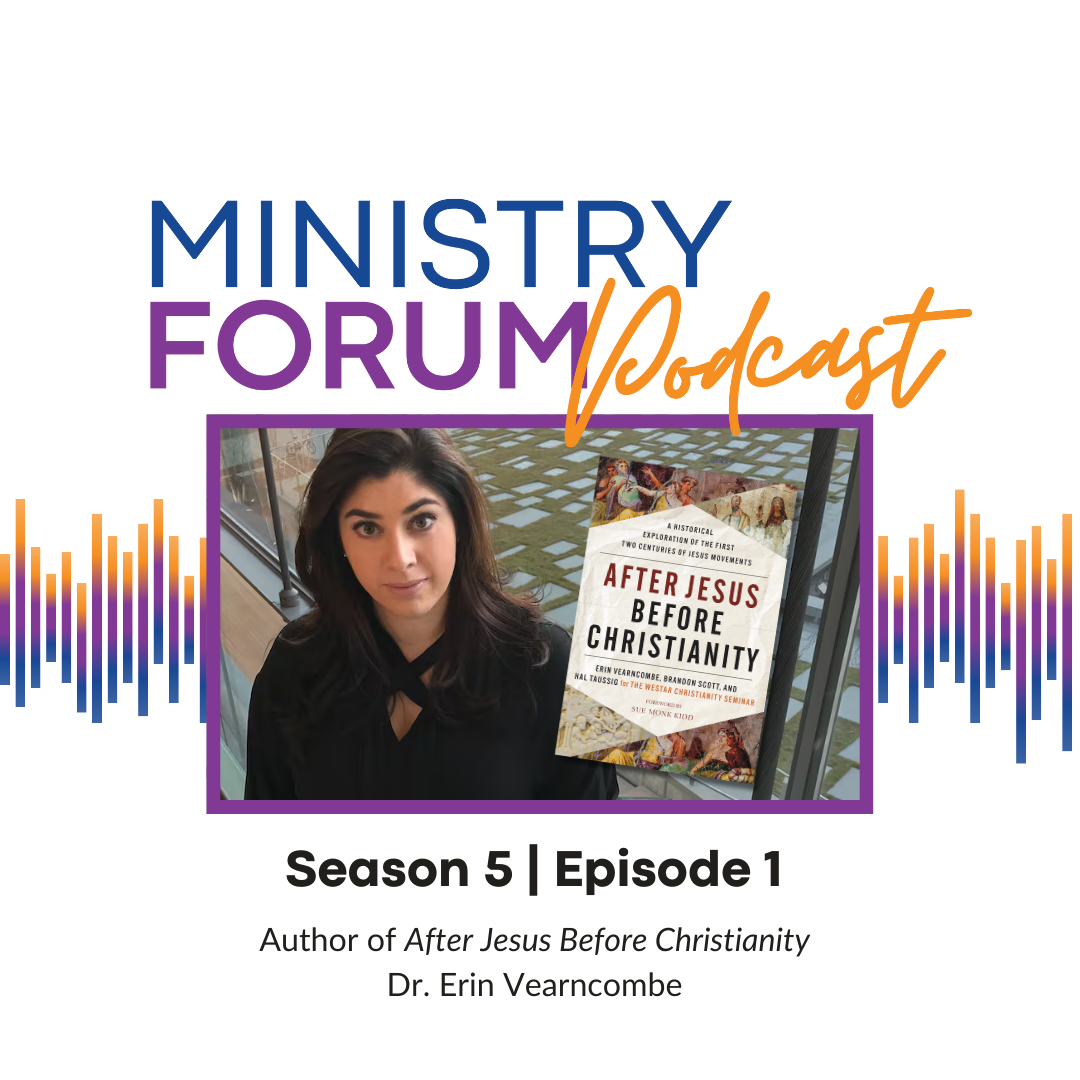
In our conversation with Dr. Erin Vearncombe, the world of early Jesus movements opens up in fresh and surprising ways. Erin talks about how communities in the first century used writing—not as polished theology, but as creative, communal meaning-making. She also reflects on co-authoring After Jesus, Before Christianity and why the earliest Jesus groups looked far more diverse, experimental, and ordinary than many of us imagine. Along the way, she explores grief, identity, trauma, and how the Gospel of Mark may function as a memorial for a community navigating profound loss. It’s curious, grounded, and full of gentle insight.

About Dr. Erin Vearncombe
Erin is an Assistant Professor, Teaching Stream with the Institute for the Study of University Pedagogy at the University of Toronto Mississauga. Prior to this appointment, she was an Assistant Professor at the University of Toronto, and held a Postdoctoral Lectureship at Princeton University from 2014 - 2019. She completed her Ph.D. at the University of Toronto in 2014 in a collaborative program between the Centre for the Study of Religion and the Anne Tanenbaum Centre for Jewish Studies. Erin is an active researcher in multiple fields: religious studies (specifically, the first few centuries of the diverse Jesus groups and traditions that later became Christianity), writing studies, and the scholarship of teaching and learning. Her most recent work, a co-edited volume with William Arnal, came out this spring from McGill-Queen's University Press: Religious Inventions: Ancient Mediterranean Practice and the Study of Religion.
Show Notes
After Jesus Before Christianity
From the creative minds of the scholarly group behind the groundbreaking Jesus Seminar comes this provocative and eye-opening look at the roots of Christianity that offers a thoughtful reconsideration of the first two centuries of the Jesus movement, transforming our understanding of the religion and its early dissemination.
Christianity has endured for more than two millennia and is practiced by billions worldwide today. Yet that longevity has created difficulties for scholars tracing the religion’s roots, distorting much of the historical investigation into the first two centuries of the Jesus movement. But what if Christianity died in the fourth or fifth centuries after it began? How would that change how historians see and understand its first two hundred years?
Considering these questions, three Bible scholars from the Westar Institute summarize the work of the Christianity Seminar and its efforts to offer a new way of thinking about Christianity and its roots. Synthesizing the institute’s most recent scholarship—bringing together the many archaeological and textual discoveries over the last twenty years—they have found:
There were multiple Jesus movements, not a singular one, before the fourth century
There was nothing called Christianity until the third century
There was much more flexibility and diversity within Jesus’s movement before it became centralized in Rome, not only regarding the Bible and religious doctrine, but also understandings of gender, sexuality and morality.
Exciting and revolutionary, After Jesus Before Christianity provides fresh insights into the real history behind how the Jesus movement became Christianity.
Gospels Before the Book by Matthew Larsen
What does it look like to read the texts we now call the gospels like first- and second-century readers? There is no evidence of anyone regarding the gospel as a book published by an author until the end of the second century. So, put differently, what does it mean to read the gospels "before the book"? For centuries, the ways people discuss the gospels have been shaped by later ideas that have more to do with the printing press and modern notions of the author than ancient writing and reading practices. In Gospels before the Book, Matthew D. C. Larsen challenges several subtle yet problematic assumptions about authors, books, and publication at work in early Christian studies. He then explores a host of under-appreciated elements of ancient textual culture such as unfinished texts, accidental publication, post-publication revision, and the existence of multiple authorized versions of the same work. Turning to the gospels, he argues that the earliest readers and users of the text we now call the Gospel according to Mark treated it not as a book published by an author, but as an unfinished, open, and fluid collection of notes (hypomnmata). In such a scenario, the Gospel according to Matthew would not be regarded as a separate book published by a different author, but as a continuation of the same unfinished gospel tradition. Similarly it is not the case that, of the five different endings in the textual tradition we now call the Gospel according to Mark, one is "right" and the others are "wrong." Rather each represents its own effort to fill a perceived deficiency in the gospel. Larsen offers a new methodological framework for future scholarship on early Christian gospels.
Follow us on Social:
Transcript
John Borthwick]
Today on the Ministry Forum Podcast, we're talking about that weird textual thing we call Mark with Dr Erin Vearncombe, one of the author writers of the book, After Jesus Before Christianity: A Historical Exploration of the First Two Centuries of Jesus' Movements. I knew I wanted to talk to Erin once I started this gig at Knox College as their director of the Center for Lifelong Learning. Way back in August of 2023 I had just finished the book and noticed that Erin happened to be listed as a professor from the University of Toronto. She also got first billing on the cover, which is pretty exciting. She'll have to enlighten me and what that all means in academic circles, as it certainly does mean something in Hollywood, from what I know, I'm sorry it's taken so long to finally reach out to Erin and to make this happen. And I I learned that she even had a connection with our Principal at Knox College, Ernest Van Eck. So that's great stuff.
Erin is a professor, an assistant professor, teaching stream with the Institute for the Study of University Pedagogy at the University of Toronto, Mississauga. Prior to this appointment, she was an assistant professor at the University of Toronto and held a post-doctoral lectureship at Princeton University from 2014 to 2019. She completed her PhD at the University of Toronto in 2014 in a collaborative program between the Center for the Study of Religion and the Anne Tannenbaum Center for Jewish Studies. Erin is an active researcher in multiple fields religious studies, specifically the first few centuries of the diverse Jesus groups and the traditions that later became Christianity, writing studies and the Scholarship of Teaching and Learning. Her most recent work, a co-edited volume with William Arnold, came out this spring from McGill Queens University Press, Religious Inventions, Ancient Mediterranean Practice and the Study of Religion. Welcome, Erin. Great to have you on the podcast. Would love to hear how you would introduce yourself, or anything you'd add or correct along the way.
[Erin Vearncombe]
Sure. Thanks so much for having me on today. And you mentioned that I research both in field of writing studies and the study of religion, and that might seem weird to listeners. Those two fields might seem totally separate from one another, but just in terms of introducing myself, I'm finding that writing studies in the study of religion actually intersect in some fascinating ways these days. I mean, I've always been interested in the writings that later became part of the New Testament from the perspective of writings. So can we consider them writings or written things? They emerge from such different cultures of reading and writing than our own, we have very different cultures of authorship. Practices of reading and writing were so different and they meant so differently. But surprisingly to me, at least, because I certainly didn't see chat GPT coming, some of the fundamental questions I was asking about written traditions that emerged from the early Jesus associations are also coming up in my writing studies work now as someone trying to teach academic writing in the age of generative AI, but questions like, What is writing? What does it mean to write? Existential questions like, How is writing meaningful? What gives meaning to our writing efforts and choices, the answers are, of course, really different if we're talking about the written object we now call the gospel of Mark versus a first year undergraduate essay. But I feel like on both sides, I'm navigating some fundamental questions about intellectual authenticity. What makes human thinking valuable? What makes writing meaningful? And what do we even understand writing to be? How do we use available tools and traditions to help us think with and through a given situation? How do acts of writing make us distinctly human? So I work in very different contexts, but I'm finding that the critical questions, at least these days, are strikingly similar.
[John Borthwick]
Yeah, that's absolutely fascinating, yeah. And what, where it ruminates for me is, is the one specific piece would be, howfrom what I understand of generative AI and I've dabbled that you can do. Well, actually, I was on just recently, last week, I was on a webinar that was talking about how to essentially how a AI generative AI could help your sermon writing. And what it would do is you would upload all of your written content, all of your written content, and then ask it to write a sermon on a certain thing, or do some research, but also help you to write it in the way that you speak or the way that you write. And I thought that was really fascinating. And just from my, you know, my memory of biblical scholarship, remembering that in some ways, when we think about who like authorship of specific writings, we often would use that expression of, you know, written in the style of the Johannine community, or the the John person, whoever that might have been, or, or these the authorship of letters. Yeah, I wonder if that's even a part of the mix of what you're sort of raising up in this whole conversation around what is writing, authentic writing things like that, amazing.
[Erin Vearncombe]
Yeah, absolutely. What does it mean to be an author, to have something written in your voice? It's such a weird thing to think about.
[John Borthwick]
It really is, well, I wish you well in that endeavor. Yeah, let's, let's jump into the Bible then, and because we're always asking about that, about, you know, who wrote what, and how did they write it, and things like that. So the book was, I found really, really interesting. I'm not an academic by trade, as it were. I was a pastor of church for about two, three decades, and, but love to dabble in understanding things better, giving me myself more understanding of how I'd preach a text and things like that. We're gonna, jump into, at some point in our conversation, your specific interest in the Gospel that sounds like its path has been a bit like the gospel of the formerly known as Prince. Kind of author. I love that that quip in the book itself, but it shares a few insights that I think probably would be new to some of our listeners. For example, there was no religion called Christianity before the third century. Some people may not have known that there were multiple Jesus movements that one I had actually heard through the work of Barry Wilson from York University. Have you heard of him, or know of him, or he's in the mix that highlights that the Jesus movement was really far more fluid than we thought, or maybe more diverse than we've been led to believe. There's always that line that I hear people use where they'll say, why can't we just go back to the way it was in the first century? You know, wouldn't it have just been perfect? And I think this book maybe teases out a few things around that. Now, again, not being an academic myself, I'm curious about the process of creating, and again, connected to what you've just shared, the process of creating, maybe a unified voice, because the authorship of this book is multiple. You know, there's there often at the end of each chapter, there was a list of papers from seminar participants. But I don't think that meant exactly that a chapter might have been written by them. So I'm wondering if you could touch on a bunch of things, you know, maybe some highlights from the book that you think readers would be interested in, specifically those in ministry, leadership in today's church. And maybe if you could just give a little comment on how the authorship of the book itself came together. That'd be great.
[Erin Vearncombe]
Yeah, absolutely. And authorship in this book, you know, again, we're getting back to those fundamental questions about what it means to author something. It was really important to our publisher that the book sound as though it was written in a unified voice. It was important that the reader felt like they were reading something smooth but you know, on the one hand, on a topic like this one, there's a way in which we didn't want to achieve a unified voice, because it felt so against the work we were trying to do that the earliest Jesus groups, Christ associations, wisdom schools, clubs, they were so diverse that trying to unify anything about them seemed somehow erroneous. But again, for the quality of a reading experience, it was important that the voice of the book seem one, but all of the research for the book came out of the work of, The Westar Institute's Christianity Seminar, and those are the papers that you see listed at the end of those chapters. Your listeners may be familiar with the work of an antecedent to the Christianity seminar, which was the Jesus Seminar, which came into being back in the 1980s. The Jesus Seminar, they're really provocative group of biblical scholars who came together in the US to try to critically determine which sayings and deeds attributed to the historical Jesus were likely authentic in their words. So what made sense for Jesus to have said and done according to the socio historical realities of the time, and they actually voted with colored beads. Again, it was a controversial practice, and they debated about whether a given saying was authentic. If they thought it was authentic, they'd vote with a red bead, possibly authentic, a pink bead, probably inauthentic, a gray bead or inauthentic, a black bead, and they brought their research together and cast their votes. And that work continues, though not with the not with the beads element through Westar Christianity Seminar, though, if you went to a Christianity seminar meeting, sometimes they gave you colored M&Ms in the same colors as the beads, which is fun anyway. So the Christianity seminar scholars come together annually to debate about questions that the academic study of the Bible kind of started to take for granted in scholarship, questions like, how important was, Paul really in the first century of the Common Era, was Jesus even central to all groups in the first century? The Christianity seminar, we really wanted to challenge what we called the master narrative of Christianity, which you alluded to earlier as well, that idea that somehow everything was perfect and unified at the beginning and then became corrupted later on. The story that Jesus came, He did these miraculous things. He handed on his complete teachings to his apostles in order to found the church. His apostles then correctly relayed these complete teachings to the first bishops of the early churches, etc, that there's some unified thing called Christianity from the time of Jesus onward. Until later so called heretics ruined everything unity first and then diversity, and that diversity is often characterized as brokenness or something negative as well. So the papers listed at the end of each chapter, they recognize the contributions that diverse scholars made to the seminars debate about our given topics, whether that was the significance of empire in the earliest Jesus movements, or gender. And in certain cases, specific scholars who were part of the seminar contributed a chapter as well. But then Brandon, Hal and I, we wrote many of the chapters. We tried to bring all of the research together to honor all of the contributing voices in a way that we hoped represented what knowledge construction can be, respectful conversation between different voices. I feel like at its ideal heart, academic knowledge is meant to be dialogic. It's meant to be a conversation between different thinkers. And we wanted to try to honor that ideal of knowledge construction as much as possible, although at times, the process certainly did not feel ideal. How Brandon and I had our fair share of arguments with one another. We each wrote different chapters, but then we brought them together to try to align our writing voices, and we learned a lot from each other. The best feedback I've ever received as a writer came through the conversations and sometimes the arguments that Hal and Brandon and I had together.
[John Borthwick]
Did you have to cast beads to decide which or M&M's to decide, oh yeah, we're gonna go with that word or yeah, this paragraph sounds all right, yeah, that's awesome.
[Erin Vearncombe]
We came close, yeah.
[John Borthwick]
Well, in speaking about how it's not a massive deal, but speaking about whose name comes first, I remember from the Jesus Seminar. I was always fascinated by Robert Funk. I thought when it when it was like funk Jesus Seminar. I thought that was kind of cool, the Funk Jesus Seminar. But his name always seemed to appear first in all the authorship stuff. But I know it was a much wider group than just Mr. Funk, but or Dr Funk, I suppose. Yeah, fascinating, yeah. Well, in some of the chapter titles are provocative as well, in some ways, Demolishing Gnosticism. I mean, what are we going to do without Gnosticism? All that kind of stuff. People love to talk about Gnostic Gospels. I used to run in that and even in parish ministry, someone would find some old book and say, John, did you know that there's all these books in the Bible that didn't get in? And I'm like, I've heard of them, yeah. And then Paul Obscured, I thought that was fascinating, too, this idea of maybe he wasn't meant to have as much or certainly his writings, again, we're talking about writing, his writings weren't meant to have as much scriptural authority as we have given them over the centuries or millennia. I found that quite interesting. Yeah, so for yourself, I'm assuming you have some favorites, but are there some favorites you might want to share with all of us? I know if you want, we could talk about chapter 19, where it says Better than a New Testament. That specifically, I think just because your name gets mentioned in that chapter a couple of times is certainly one area of interest. But before we go, there was there any anything that sort of stood out as, even for you as a scholar, what was kind of interesting or neat to write about, or something you think was going to be a great contribution to the book?
[Erin Vearncombe]
Sure, yeah, I'm actually going to focus on the two chapters that that you mentioned, because I feel like you've hit on two, two hidden gems of the book. The Paul Obscured chapter hasn't come up in conversations about the book as much, and I'm so glad that you're giving me the opportunity to to talk about that topic today. And Paul is such an important figure in the collection of written things that we now call the New Testament all his letters. He's the hero of much of the book of Acts and and nowadays, you know, Christian traditions tend to think about Paul a lot. You know, what do we mean by faith versus works? What is faith? What's grace? And so a Christianity Seminar scholar named Jason BeDuhn, he led this conversation for the Christianity Seminar, and I think Jason argued really persuasively that careful study of Paul's letters suggests that it was, it was difficult for Paul to find a stage for himself. In the first century of the Common Era, he had trouble holding on to supporters. Associations with which he was affiliated were fractious and fractured. After his death in the mid-second century, he became more important, but important specifically as he was strategically reinterpreted by various competing groups who are interested in and using or not using, rehabilitating or rejecting certain so called Pauline ideals based upon their own interests. So Paul was a pretty ambivalent figure a century after his death, and His early legacy centered on his activities as a founder of associations, especially associations that were not necessarily explicitly Judean. So he was not, he was not a theologian, and he wasn't approached as someone primarily in terms of his ideas, but rather in terms of his work and I think that discussion could be quite challenging for those in ministry leadership today, because we have multiple Paul's on our hands. We have the Paul of his letters, though he's not necessarily consistent in his thinking between letters because of the specific circumstances under which his letters were written. We have these snapshots of different moments in Paul's work as a founder of Jesus clubs. Paul has been used in various ways as needed. He's domesticated in the pastorals, and his prominence in the New Testament does not reflect his actual influence in the first two centuries of Christianity, but rather the victory of later interpretations of Paul. But I mean, those in ministry today will hopefully feel encouraged by this, to encourage to approach Paul and traditions associated with Paul through fresh eyes, through fresh perspectives, recognizing that the letters are historically contingent, recognizing that historical contingency of the letters, as well as the ongoing debates about how to interpret, or if to interpret, his ideas about community.
The Gnosticism chapter is another good one. It argues that we should abandon the category of Gnosticism as a scholarly kind of bag to dump things in because it never actually existed as a coherent historical phenomenon. Gnosticism is a scholarly religious invention. I mean, we have all of these writings labeled gnostic, but no unified movement matching these stereotypes of what Gnosticism was. So some of those stereotypes are like people who hated the physical body, they rejected the world. They're very dualistic. No movement matching those stereotypes can be found in ancient sources. So the category really obscures rather than illuminate. It's been more a way of othering traditions that have not seemed to fit neatly into the category of Christian, Christian understood as good, Orthodox, pure, Gnostic as bad, and unorthodox is deviant. So the chapter suggests that we should go back to the writings dumped into that Gnostic bin and read them without that predetermined category. And we always need categories. It's a very human way of thinking, but categories can hinder and harm as much as they can help us. And the suggestion in the book is that we read writings previously labeled under that Gnostic title as part of the diverse literatures of the early Jesus movements.
And I think that this reading can help us to expand the early Christian story, because, again, as you mentioned earlier, there was no such thing as Christianity in the first centuries of the Common Era, and the diversity within and between groups encourages a more humble, I think it encourages us to be humble when it comes to our understanding of Christian history. The writings can help us to embrace complexity. So rather than seeing early Christianity as a battle between true and false versions, we have a much messier, more diverse landscape of communities, all of whom are wrestling with meaning, with belonging, with identity, after traumatic events like the destruction of the Second Temple in Jerusalem. And I think that the chapter two is about the bigger project of the book, which is reclaiming marginalized voices in Christian history. So texts that have previously been dismissed as heretical gnosticism. It may offer us valuable insights into how early followers of Jesus navigated questions of power, of suffering and of community that I think are still relevant today.
[John Borthwick]
Yeah, that's excellent, Erin. I really found it certainly comes through in the writings throughout the book that really teases out that for the reader, the opportunity to just to think a little more, unpack, a little more about, you know, in a way, demystify, but, but to unpack and allow yourself to think, you know, what if it looked different than what we've been led to believe? Yeah. A little more so, and even more so from, not to disparage at all, you know, the Toronto School of theology's training of Master of Divinity students like myself, you know, who maybe paid attention in a limited way in my first year of MDiv, 30 some odd years ago, but I remember what we used to call baby Bible. And when you're accelerating from like the Gospels to the no, do we even touch on those? I think we touched on them. But it was like all the different critical methods was a whole term. You can't really unpack all that. And some of it would be brand it was, it was certainly brand new to me when brand new to me when I started at the college, and certainly lots of my colleagues felt the same. But some what I loved about the book was there was some unpacking that was done that I never really had a chance to really sit with, even when you're going through the Sunday to Sunday rhythm of you know, you have a text and you've got to preach it, and how much you're going to share with the congregation, and how much are you not going to share. But even as just a, you know, an amateur theologian, to sort of have that have this book open up these different areas of like, wow, what if? How does that change the way we think? Or, how do we approach that text slightly differently if we if we think of it using some of the stuff that you all had written in your book. I thought that was really helpful, really fascinating.
When I think about Paul in particular, I can remember in Bible studies in my congregation, I even would sometimes reference this that we have so, in the most basic sense, we only have his letter in return. So if we use email as an example, we just have his return email. We have no idea what the first email was. And just as you were talking about Paul and how we've how we've given him, the Christian church has given him a lot of weight. And what would a New Testament look like without Paul? Christianity would look very different without Paul, especially if we think of him not as a theologian. I used to joke in Bible study that Paul was writing theology on the fly, or in the moment, you know, talk about practical theology. It's like something happens in the moment, and now he's like, Yeah, this is how you could think about it, at least today. Because then somebody would say, Well, how come, in this letter, he says this, and then in this letter he says something else. And I said, Well, haven't you ever written something to somebody once? And the next week or two years from now? You might have a different way of writing it, or a different way of thinking about it, but as we well know, and we won't go there, but even in the last few weeks, we've noticed some things that have been happening within the wider notion of Christendom in certain parts of our world that are leaning heavily onto words that we assume Paul has written. And we just would wonder what that nuance would look like if we looked at our Bible a little differently. But let's not go there. We won't go there, right? Just fascinating, stuff for me.
So I'd sense that maybe chapter 19 is a is one where you revel.I assume you're a fan of Prince and the Purple Rain and all the good stuff, and this is where we get that cool line in there. Could you maybe expand on that reference that comes in the book that we've teased to the people who've maybe not read the book, how it relates to what many of us will actually refer to as the gospel of Mark. Take it away. Erin, tell us more.
[Erin Vearncombe]
Yeah, so I confess I have to credit Hal one of my co-authors with the prince reference,
[John Borthwick]
I was so hoping it was you, Erin.
[Erin Vearncombe]
No, kudos to Hal. Yeah, absolutely, um, but it's such a great reference. So after, after reading my research on Mark, Prince's reference to his adoption of the symbol that he used to self-identify for a while, and Prince's self-description of how the symbol was meant to help people think in new ways and tune into a new frequency that came to Hal's mind as an apt way of describing the approach I wanted to take to the written object we now call Mark. And I know I use a lot of convoluted, even kind of tortured language about what might seem like basic vocabulary, like, why can't you just say Mark? Erin, like, Why do you're like written object we now call Mark. I can't say Christians in the first two centuries because there were no Christians. There were Jesus groups, Christ associations, communities who describe themselves as enslaved to God. The groups are so diverse that one term, one designation, can't do them justice. So instead of Christian, I always have to say these ever changing, lengthening lists of clubs and assemblies and the same linguistic problem applies to writings. And even the term writings itself is challenging, because what writing is and what writing does changes so much across time and context included in it applies to the writings too that are now in the New Testament. Naming has such extraordinary power, and we need to be very, very careful with the names we ascribe to things and phenomena, because that's where we're drawing boundaries between things.
There definitely wasn't anything like a New Testament in the first two centuries of the Common Era, and the writings that mattered in different ways to different Jesus groups, they were really dynamic, flexible, really diverse, and that's where the Prince reference comes in. Prince was willing to experiment with naming and boundaries, to think in different ways, even when that could feel uncomfortable or cumbersome or even impossible. By the end of the first century, some writings were likely read aloud to members of different communities, though many of these writings were likely sets of rules or codes of codes of conduct for Jesus clubs and associations, not scriptural documents, not records of religious authority the way we might now understand them. We don't possess anything from these groups that comes from the first century, and we're not sure how many writings were produced by the end of the first century. But again, even that reference to writings is tricky, because it conjures up a certain writer, reader relationship in our minds that just won't work for the first two centuries. For example. I mean, I loved revisiting Irenaeus description of the four gospels through the course of this research. So Irenaeus was the leader of a Jesus assembly in Leon near the end of the second century of the Common Era. And Irenaeus, in one of his writings, mentions Matthew, Mark, Luke and John and the mention of these four gospels that later became canonical has always been taken as proof that four canonical gospels existed at the end of second century. See Irenaeus tells us, here it is. He has our list. That's the proof. But when you when you look at the Greek, the situation is actually completely different. When you look at the Greek, Irenaeus calls Matthew a written gospel. He calls Luke, a gospel book. He calls John the gospel. And my favorite, he calls Mark agraphos, or writtenly, like something that was kind of written. I think that's so amazing. Matthew Larsen talks about this, and he has a great book called Gospels Before the Book, it's a quiet book that I think needs a lot more attention. But we don't have books here as we know them. Writings existed in such a variety of forms as different writtenly, things representing different traditions, stories, situations and for me, it's just so exciting to think about that it is like tuning into a new frequency, the way Prince, Prince said it.
[John Borthwick]
yeah, that's, that's wild, right? The Yeah, the writtenly I'm thinking about, you know, how this younger generation is treating text language. You know, if you were to look at a young person's text stories as that as a textual object, the way it's written, and all the letters and acronyms and things like that, you know, for if people are looking, in 1000 years from then on, these texts as an object. It would be like, well, is that writing? And yeah, it conveys a message. It tells people what they need to know. It feels a bit coded to those who don't understand all the nuances of emojis and everything else, but, but, yeah, that's fascinating.
[Erin Vearncombe]
Oh, wow, I love that. Like, I can turn anything into a teaching moment, or I try to, and so in my head, I'm like, Oh, if I get to, next time I get to teach about Mark, you know, we should bring in texts and, like, text messages and, oh, that's really cool.
[John Borthwick]
Maybe that's what Irenaeus was getting at. You know, he was, Mark, wasn't really a writer. He just, he just had all these bits and pieces. But I suppose that also blows up a bit, you know, because we're very concrete thinkers, as surprising, as surprising as that may sound for some of us, especially in the church I'm just sitting with, like 30, less than 30 years in the congregation, in a Bible study, or in just conversations with people about the Bible. And I think when people are talking about, even when we talk about Q as a source, and how the gospels were written, and authorship and things like that, I think people are still tangibly thinking about a book in one's hand like there was an actual published book of Mark and then Luke and Matthew, as they were writing their book, they included bits and pieces that they had, and we're imagining like a university student with all, their well in my day, in my day, imagining all those bits of paper on the floor trying to pull together for where's that quote for my essay and things like that. And I think, yeah, I think this book in particular, really, sort of blows that up in a really interesting way. Let's dive into this. This, this next piece where you do talk about this writtenly, and this just totally blew my mind. You have this concept that you unpack in the chapter that reflects on writing being more about memorializing, and you reference the inscriptions quite lengthy, apparently on grave monuments, you even describe the gospel as a material memorial to a missing Messiah, Or, put another way, by the authorship of this, of this chapter, a tomb created writtenly. Can you say more about this? And maybe a curiosity, did the early church people or people, or people a couple of millennia ago, I guess they weren't paying for the word, like they really made really long grave, uh, Memorial writings. I had no idea.
[Erin Vearncombe]
They could, and that would have, that would have been an awful lot of work for whoever was doing the inscribing,
[John Borthwick]
yeah, because one of the quotes is huge. Like, it's a long, yeah, quote, holy cow. Like, Wow, you got a lot of words on your gravestone. Well done.
[Erin Vearncombe]
Yeah, all chiseled into stone. So I've, I've always loved Mark. I've and I've always felt like Mark has been treated badly. And you mentioned this too, like everyone's always like, Oh, Mark uses crappy Greek. Mark is full of all these redundancies. Mark isn't a good writer. And that one really drives me crazy. Mark isn't a good writer. So I guess that I've always wanted to stick up for Mark. For some reason, Larsen’s work is really. Helpful, but he doesn't think that Mark was an intentional writing activity. Mark was like an accident, basically a set of notes that became a textual object. And I found that strange, like, how does how? How is this written thing an accident or unintentional? But everything changed for me when I came across a particular inscription from it's a monument dating to the second century before the common era from Asia Minor, which is modern Turkey. It's a memorial for a priestess named Stratonike. But it's not just a memorial for the priestess. It's also a record for the kind of hero association that rose up around her, that that was focused on her leadership and my discovery of this description of this inscription was accidental. I read a lot of inscriptions, because I'm also interested in ancient clubs and associations, so I wasn't actually thinking about Mark at all when I came across this particular inscription. But sometimes, the best research moments come totally by surprise. You can be so methodical, and then something just comes at you from a totally different and unexpected direction. So according to this inscription, Stratonike, this priestess had died or had she? The inscription talks about how the association formed around her. They were to carry on her activities after her apotheosis. Is the word that the inscription uses her deification. She had been taken up. She'd left the association. She'd been taken up, but her work for the community, her honor for the gods, her love of humanity, her care for each individual member of the association, led this association to want to continue to honor her after her apotheosis and to continue on as a community. It is a really long inscription, but the memorial is set up in the meeting place of the association so that everyone can again, both honor the priestess who's no longer there and continue to participate in the life and activities of the group. And the inscription even says that specific people are to be sent to the group who will continue to explain the honors for the priestess to talk about her life and to make sure that the association continues. And I read this, and I was just floored. It was like, this is Mark. Like, this is such a similar story. This is basically Mark's tradition, and then, pieces just kept coming together for me. So Larsen talks about the Greek word hypomnemata as a provisional kind of writing. And certainly it can be. You know, Plato, for example, refers to hypomnemata as notes, especially if someone's going away for a while and they might not remember all the details of a situation, you write down some notes as a kind of record. So for Larsen, Mark is like a loose, unpolished collection of notes meant to stimulate more fleshed out memories when a reader is performing the written thing for an audience. So the meaning of Mark is outside of Mark itself, essentially, but the most common meaning of hypomnemata is Memorial. So you know, every word has different layers of meaning, different rungs on the ladder, and the top rung of that ladder is Memorial or tomb, like a physical means of remembrance. And there are hundreds of Tomb inscriptions that use the word Memorial or tomb of the family of etc. And these people, nemata, they were the culturally accepted and expected means for interaction with the dead. And I think that the primary importance of what we now call the gospel of Mark was similar to this inscription honoring the Priestess Stratonike. It was, as you mentioned earlier, the material memorial to a missing Messiah. How could a community honor a dead member when that body was absent? How could they find a culturally acceptable means of memorialization? Mark was a mechanism for expected and effective remembrance, so definitely not a book, a kind of monument established in order to ensure that members of the community would have and continue to adhere to particular norms of community life and for remembering Jesus appropriately, it's a mechanism for structured remembrance. That writtenly tomb for the absent body of Jesus.
[John Borthwick]
Yeah, amazing. Amazing. Yeah, what that sparked for me when I read that. I have a background in in trauma, trauma response and emergency management, stuff like that kind of thing. And I suspect that you're probably quite comfortable with Mark's original ending, where the women just run off from the tomb in fear it there is no, there is no resurrection in Mark. And it seems like, as you, as you describe what you just did, there's, there's that sense of, you know, yeah, how do people cope with a missing Messiah? And so you speak of Mark reflecting this kind of disaster response in the in the chapter there, I'm wondering a bit of a trauma kind of response for folks who are these Jesus communities, or Jesus clubs, whatever you call them, that are trying to navigate uncertain and at times, really horrifying circumstances within the first 200 years since the birth of Christ, not just, not just what we often sort of put in there, as you know, the recent years or days, weeks and years after Jesus’ death on the cross, but something much longer, like people are still trying to reconcile these, this first 200 years of this trauma response or this disaster response to a missing Messiah. Am I expressing that accurately from what you've researched or what how you perceive this?
[Erin Vearncombe]
Yeah, yeah. So another reason to love Mark. It's so weird, like, what's with the non-ending? Ending, but if it's not a book, does it need an ending? I mean, it's not telling a story as such. But yes, that reading is accurate. So I draw here from sociological theory about witnessing and trauma to approach mark as a monument to disaster. But I think monument to trauma is a really helpful term here. Definitely, it's a written-ish monument that helps a community process the traumatic loss and absence of Jesus and Jesus’ body, as well as the broader traumas the community was potentially experiencing under the Roman Empire. The abrupt ending with, you know, the women running out from the empty tomb and terror and silence. You know, that's been approached historically as a narrative failure or something incomplete. But I think the non-ending is actually the point. So I think Mark is creating what there's a sociologist named Kirk Savage, and he talks about therapeutic monuments, as opposed to triumphant public monuments. So we're a public monument might celebrate heroism and victory. A therapeutic monument helps communities to I'm going to quote Savage here to the best I can, so Savage says that therapeutic monuments help communities find collective purpose when the victim's own individual purpose has been violated or destroyed. So I think Mark's gospel does something quite sophisticated as a therapeutic monument. Um, you know, Mark plays with time and presence in the writing-ish techniques of this work. And you know, people talk about historical presence in Mark, there's a collapse between past and present throughout the traditions in Mark which, you know, creates what we could call presence at a distance. Reading communities become witnesses to Jesus death, even though they're absent in both space and time from the actual events of Jesus death that might seem really abstract, but the traumatic ending so the absent body, the terrified students, mirrors the actual situation of early Jesus communities, who were dealing with multiple layers of trauma, the death of their leader, the destruction of the Jerusalem temple, this broader situation of Imperial violence. So Mark creates this written object that functions like a physical memorial stone for this community giving, giving the community a way to gather around absence itself and process collective trauma through this witnessing to Jesus life. So the gospel is like a technology for trauma response, not despite its disturbing ending, but actually precisely because of it. I think.
[John Borthwick]
I mean, I think you I'm trying to, I'm trying to remember, I think there was a time in all the Easter sermons I did where I decided to lean on just to Mark. I use Mark as the Easter sermon. Okay, it was. Yeah, it was fun, as just a way, because one thing that I always found challenging about an Easter Sunday for often, the, how would you say the, you know, the people who came on Easter but never came any other time, and people still, the potential of the of the eye roll within communities of like, I had a couple of characters in my in my congregation whose partners would join them only on Easter and Christmas and, and they, they didn't really buy this whole church stuff. And what was fascinating was that we'd often have conversations, and they would have this sort of eye roll of like, Oh, really. Okay, so you're gonna play that again, right? He rose from the dead. He talked to everyone. It isn't this great. Are you doing that? That again? And I thought, well, what would it be like if we just went with the women get there and they run out of the tomb in terror and tell no one? What If you tell told no one that Jesus is risen, and that bears out. I mean, even in the other Gospel accounts where, you know, the Emmaus road experience, where people have left town and they said, Yeah, some the way it's sort of phrased is like, yeah, some women told us that he's risen from the dead, but yeah, are we really going to believe that? And then they have the whole supernatural experience again. But there's kind of like that notion of within our humanness we, which is why people have traumatic responses to things, or why people develop post-traumatic stress disorder. It's because our brains are wired with, we got to fix the story like we got to have a story that goes from start to finish and ends, and if we and when you get disrupted from a traumatic incident, your brain's trying to file it all the way. And if, if it doesn't file it away properly, it can really impact you, right? And so when we hear the Gospel story and the resurrection story, it's kind of like all these authors have these agendas of, I think of trying to make the story fit and work, and it's going to have to be perfect and all that, and I'm not going I can go in all directions of I believe in the resurrection. Let's be very clear on the Ministry Forum Podcast, I believe in a resurrection, but I also believe that resurrection happens. And I think we can also sometimes just sit with what would it be like if you were the people that were there who'd followed Jesus for three years? He dies in the cross in a traumatic way. You bear witness to that, and then you go to the tomb, and he's not there, yeah. How are you going to what are you supposed to do now, that kind of question, and not making it all tidy, and also, there was always a bit of an edge, it always felt like, because it's even so blatant in the gospels, you know, how are we really going to believe these women, seriously? And you can take a lens of, well, the gospel is actually, you know, they do paint a decent picture of the women in one way. It's sort of like the male's reactions are, they don't buy it. But then the first woman who preaches that he is risen, or the first person who preaches who He is risen is a woman, and all that kind of stuff. Anyways, I could go on for days around this, but just sort of the curiosity that is Mark writtenly sharing just this snippet to allow people to sit with the trauma response. And for those who are 2000 years out, you know, for some of us, maybe we don't have that real, tangible sense of Jesus presence. And how are you supposed to live as a Jesus follower without you know the story being tidy, because I don't know about you, but I look around and the story doesn't look tidy as easy as it could be. So, yeah, fascinating. Really fascinating for how Sunday morning, Easter Sunday, could be a different story if you sat with Mark for a while.
So could I be so bold? I've heard from academics before, and in their various research areas, they would rather not. But could you be so bold? Or could I be so bold as to ask the scholar to extrapolate what some of these insights that are that percolate in the book might offer to the reality we do find ourselves today as Jesus followers are there. Can you point to some helpful touch points from the past that are often referenced in the book that might inspire the church today for the context we find ourselves in?
[Erin Vearncombe]
Yeah, I think that is your most challenging question yet. And, and I want to be very careful about how I approach it, and I want to be clear too, that I'm not making any theological claims here or Christological claims. I'm a historian, and I'm making historical claims about the nature of Mark. I'm interested in the history of writing as well. So writing as a thing, writing as a practice or set of activities. And I'm interested in the New Testament as a later historical development. So sometimes authoritative categories get projected backwards onto history and. And I think we need to be really careful about that process. We can use history to validate our own beliefs, our own selves, and part of what I'm hoping this research helps us to do is to challenge our assumptions. And that's really important work. I think it takes a lot of humility to examine ourselves in that way.
The book, it's about community and its heart, and the different ways in which written objects functioned within communities. Jesus groups and clubs. They shared meals together, they shared conversation. Their experience was embodied. It was fundamentally relational. And I think it would be pretty interesting to reflect upon how written things function relationally. Now, what writing means to us and how we use it as a more abstract idea, but on a more primary level. I'll return to absence and trauma. Mark is about dealing with absence and trauma, and the interpretation of mark as a memorial response to trauma, the trauma of the oppression and violence of the Roman Empire, that Imperial violence, I think it offers as a way to understand how communities process collective trauma through a kind of storytelling and ritualized remembrance and that interpretation could be not just relevant for but maybe life giving for communities right now dealing with loss or crisis. I think many of our communities are.
[John Borthwick]
yeah, thanks, Erin. I have some academic historians who often say, Please don't ask me to interpret the future. That's not what I am. I'm a historian, but I can do some uncovering of what happened in the past as a way of, as a way of putting a mirror, perhaps, to what we're seeing in some of the situations. So I appreciate your response. I really do. Is there anything that I haven't asked you that you really wished I had?
[Erin Vearncombe]
That's a huge question. There's so much we could talk about. I know, yeah, at some point I feel like we could have a really lengthy conversation about gender and early Jesus groups and wisdom schools. You have to have me on again.
[John Borthwick]
There you go. Yeah, absolutely.
[Erin Vearncombe]
But what I will say now, though, I think relates to the bigger outcome of the book. So how Brandon and I always start to think about the bigger outcomes of this research and the work of the Christianity Seminar in terms of refuge. So there were so many different kinds of associations, schools, clubs, households in the first two centuries. There's so many different experiments in community life and all of these Jesus group experiments, they revolved around the creation of refuge within empire, building upon existing everyday social realities like clubs and associations. Clubs were a really significant part of ancient Mediterranean life, and they offered a ready model for a kind of social safety where there's a lot of economic sharing realities too, like households, as many of these groups were kinds of chosen families or like counter households to the standards, Imperial households unit. There are all groups of people who were looking for a kind of social safety, for belonging under the realities of empire, when norms for living and understanding and being in the world were becoming fragmented. So I think the goal of the book and of the Christianity Seminar’s work more broadly, is to help us see the diversity of these groups, not to point out their messiness, necessarily, though I love their messiness, or just to deconstruct what we think we know that this isn't meant to be a deconstructive work. This isnt's meant to be fundamentally constructive, because it's constructive in that we get to hear and consider voices we hadn't heard before, and testing the master narrative of Christian history, we can see more clearly just how boundary testing many of these groups were, and I think that could be really helpful to a lot of communities today. We can see how they found meaning, how they found belonging in contexts where conventional forms of belonging were being tested or falling apart. And again, I think that search for belonging is something we can all relate to today.
[John Borthwick]
Absolutely, well. Thanks, Erin, this has been a fascinating conversation. I'm so glad we finally got to meet and connect. I will invite you back sometime for another conversation on something else. Yeah, we'd love to continue this conversation. And so for we, I hope people will read the book. We'll put in the show notes, the reference to the book and where to get it, and all those kinds of things. And. I'll also reference a couple other things that you mentioned in the podcast. We'll make sure that folks get that information as well to connect, especially with Gospels Before the Book by Matthew Larsen. We'll make sure that the folks get that that could be an interesting read for folks as well. Have a great rest of your day, and we so appreciate you joining us on the ministry Forum Podcast today. It's been a gift and all the best in your continued research.
[Erin Vearncombe]
Thanks so much for having me. I've really enjoyed our conversation.
[John Borthwick]
Thanks for joining us today on the Ministry Forum Podcast. We hope today's episode resonated with you and sparked your curiosity. Remember, you're not alone in your ministry journey. We're at the other end of some form of technology, and our team is committed to working hard to support your ministry every step of the way. If you enjoyed today's episode, tell your friends, your family, your colleagues. Tell Someone, please don't keep us a secret, and of course, please subscribe, rate and leave a review in the places you listen to podcasts. Your feedback helps us reach more ministry leaders just like you. And honestly, it reminds us that we're not alone either. And don't forget to follow us on social media at Ministry Forum on all of our channels. You can visit our website@ministryforum.ca for more resources keeping up with upcoming events and ways to connect with our growing community until next time. May God's strength and courage be yours in all that you do. May you be fearless not reckless. May you be well in body, mind and spirit, and may you be at peace.