
A Deeper Way to Connect: What I Learned from Amber Johnson
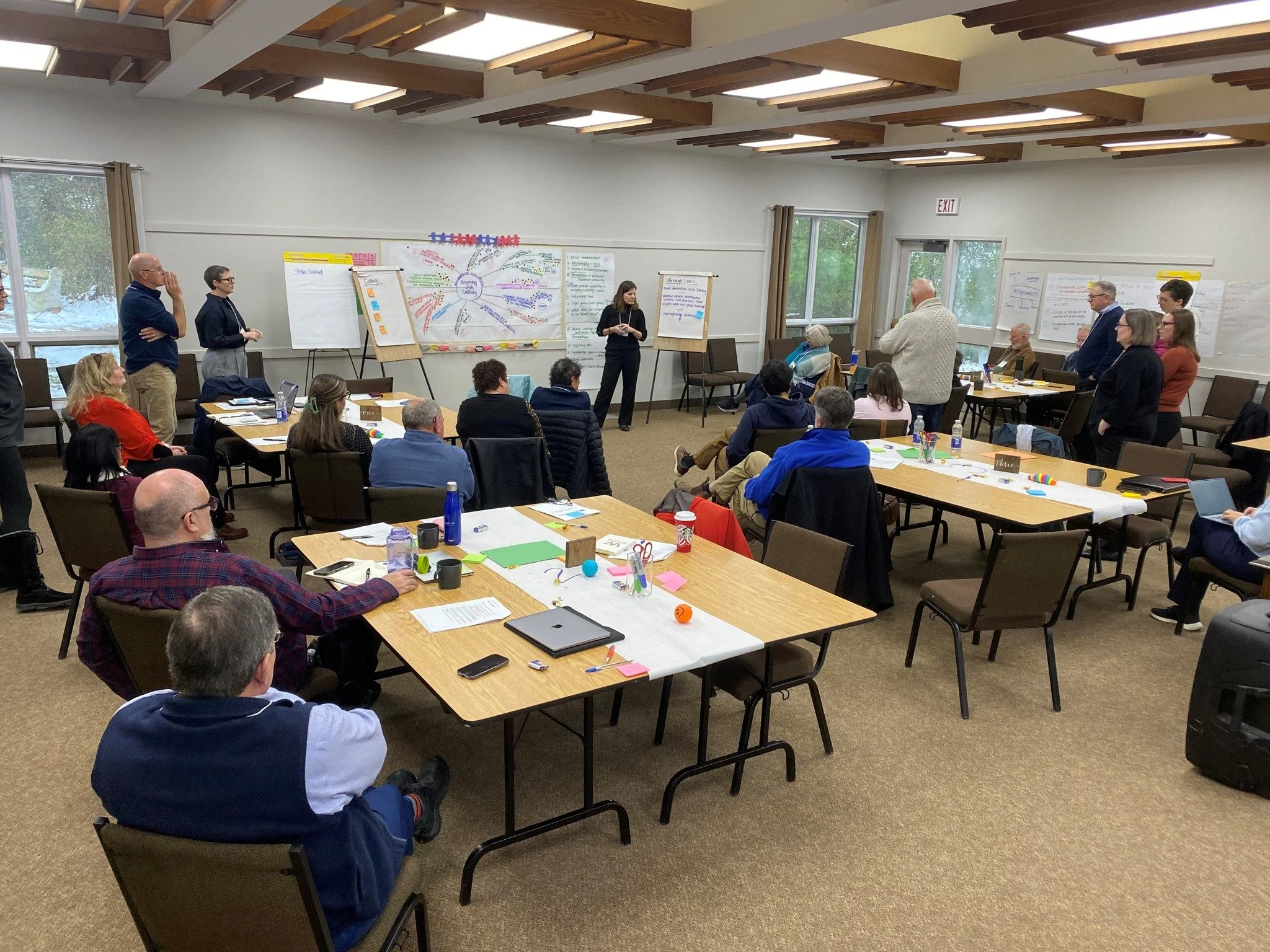
I was invited to join the Board of Knox College, some faculty and staff representatives, as well as some alumni to a Visioning Summit held at Crieff Hills Retreat Centre recently. It was a valuable time of engagement, listening, and sharing from an appreciative inquiry lens facilitated by Amber Johnson and Kate Mangino, the Board’s consultants for this work. This was a step in a larger journey to discern the priorities for the College over the next ten years.
One piece that the lead consultant, Amber Johnson, generously offered the College was to call together a learning cohort on appreciative inquiry to allow some ministry leaders to learn the approach and participate in leading the experience as it unfolds. It was my pleasure to reach out to a few key leaders who expressed interest in joining this short term learning opportunity (at no charge to them!) We look forward to their leadership at the next Summit.
Sometimes engaging with a facilitator is a purely transactional experience but it has not felt that way with Amber and Kate. I’ve heard from some of those who attended the Summit that they have connected further with both Kate and Amber, some have subscribed to their Substack or podcast, and others are reading their books. A few days after the Summit, Amber shared on her Substack (as you can see I’m now a subscriber) that she had delivered a TEDx talk on connection… and if you watch it (which I hope you do - it’s about 11 minutes) you will see that Amber is on a mission to connect with others on a deeper level which she models so very well in the work she does.
As we consider the many conversations and connections that shape our daily lives, Amber’s TEDx talk offers a timely “intervention.” Whether you tend to approach interactions with hesitation or with eagerness, it may be a good moment to rethink how we show up with one another and consider a new way of engaging.
Amber offers a two step plan to connect more deeply with your loved ones, work colleagues, and new acquaintances. And, you know what, it might also make you feel less alone despite the multiplicity of connections you may have.
Step One: Cut the closed, predictable questions with the traditional scripted answers.
“How are you? How is work?” “FINE”… which often stands for: “Freaked out, Insecure, Neurotic, and Emotional" or"Feelings In Need of Expression".
Step Two: Ask questions that seek understanding.
Questions that seek to build connection. You’ll need to listen to Amber’s talk to see some excellent examples of this.
And why would we do this? Because when people feel lonely and misunderstood, it can lead to mistrust… which leads to conspiracy theories, says Amber.
Here are a few questions to consider using at your next human interaction as suggested by Amber in the spirit of inviting people to share something real:
What are three little things you’re thankful for? The smaller, the better. (Example: shoes with comfy insoles, products that work for curly hair, 1.25x speed on podcasts, the sound of leaves crunching under feet.)
Tell me about a time you felt joy in the last year.
What feels fulfilling in your life right now?
Tell me something trivial that really matters to you. (The less important, the better!)
One year from now, what do you hope you can say you are grateful for?
What’s something you recommend? (a song, a podcast, a book, a product, etc.)
And you can model the answers to these kinds of questions by simply offering the answer to one of these questions without being asked as a conversation starter. Amber did this in a meeting we were having with the cohort where she talked about a book series that she enjoys when she’s traveling - Jacqueline Winspear’s Maisie Dobbs (I just finished Book 2 and am loving it!).