
Does Your Congregation Know How to Invite A Friend to Church?
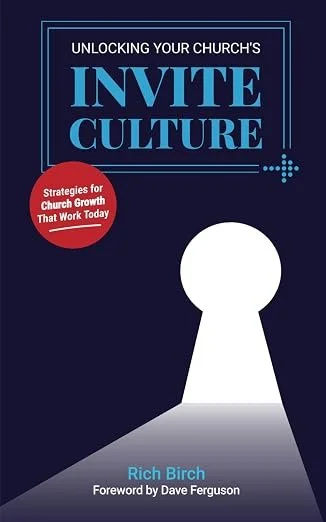
One of the churches we’re working with through our Virtual Front Porch Initiative shared something in their application that caught our attention. They talked about becoming a church with an intentionally strong culture of inviting.
It’s a phrase not often heard in mainline church circles, but it was intriguing!
Their work has been shaped by Rich Birch’s book Unlocking Your Church’s Invite Culture, and after hearing them speak about it, we wanted to dig a little deeper… so we picked up a copy to investigate.
The book doesn’t simply ask, “How do we get more people through the doors?” Instead, it explores what it looks like to become a community where inviting others is a natural part of congregational life.
Now, whenever we read a church leadership book, especially one written from a more evangelical or non-denominational context, we might find ourselves doing a bit of translating. There are always ideas that fit neatly into our contexts and others that need to be adapted. But if we dismiss a resource too quickly because it wasn’t written for “churches like ours”, we can miss a genuinely helpful resource!
So… let’s talk about invite culture!
What Is an Invite Culture?
At its simplest, invite culture is the idea that people regularly invite friends, neighbours, family members, and colleagues into the life of the church.
Not because they’re trying to sell something, but because they’ve experienced something meaningful and want to share it.
The challenge, according to Birch, is that inviting doesn’t happen automatically. It requires intentionality. Churches that develop a culture of invitation tend to talk about it, celebrate it, equip people for it, and make it feel normal rather than awkward.
So this begs the question: when was the last time we talked about inviting in our churches?
Now, to be fair, many of us have probably talked about hospitality.
We talk about being welcoming. We talk about making visitors feel comfortable. We think about coffee hour, greeters, signage, accessibility, and creating spaces where people feel at home.
Those are all important conversations.
But hospitality and invitation aren't quite the same thing.
Hospitality is what happens when someone arrives. An invitation is what happens before they get there.
Of course, the two are deeply connected. After all, if someone works up the courage to invite a friend to church, they probably hope that person will feel genuinely welcomed when they arrive!
Birch's book explores both invitation and welcome. The book asks how churches can become communities where people feel confident inviting others, while also thinking carefully about the experience people have when they show up.
And one of the most practical ideas in the book that you should absolutely try is experiencing your church through the eyes of a first-time guest. The longer we're part of a congregation, the easier it becomes to stop noticing certain things.
Think about it this way:
We know where to park.
We know what all the rooms are called.
We know when to stand, when to sit, and when to respond.
We know the acronyms, the traditions, all the little inside jokes and references.
But what if you invited someone from down the street to join you next Sunday?
You may find yourself paying attention to things you haven't thought about in years. Is it obvious where someone should enter the building? Would they know what's happening during worship? Are there moments where a little explanation might help them participate more fully?
Just to be clear, this isn't about stripping away tradition or making church feel less like church. It’s more about accessibility and becoming better translators.
The Christian faith carries a rich language, history, and set of practices. Most people wouldn't be expected to understand all of that on their first visit to a congregation. The question isn't whether newcomers need some explanation; the question is whether we're helping provide it.
A printed explanation, a brief welcome, a clearly marked entrance, or simply having someone alongside a first-time visitor can make all the difference.
There is a lot more explored through the book - we’d invite you to explore it yourself (or maybe you already have, and you have thoughts… share them in the comments!)
What we appreciated about Birch's approach is that it stays very practical and offers concrete ways churches can encourage and support it. There are suggestions for helping congregants consider who to invite, ways to celebrate stories of invitation, and practical tools to make extending an invitation feel a little less intimidating.
Further Reading & Listening
Unlocking Your Church's Invite Culture by Rich Birch
"An Invite Culture That Actually Grows Your Church" – conversation between Rich Birch and Carey Nieuwhof.