
Clergy Exhaustion is Systemic, Not Personal
I’m always playing catch up… maybe you find yourself doing the same.
Perhaps by the Spirit’s leading… two separate articles from two different countries landed in my inbox months ago. One comes out of Duke’s Clergy Health Collaborative focused on United Methodist Clergy in North Carolina in the United States. The other is a reflection by Rev. Mark Clavier, an Anglican priest writing out of his years serving in the Church of England and the Church in Wales but also coincidentally, earlier years in North Carolina since he grew up in the USA and is a graduate of Duke Divinity School. Neither was written with Canadian Presbyterians in mind. And yet I found myself nodding at both because the ache they describe is one many of you have named to me quietly, over coffee, in a hallway, at the end of a long Sunday, and in emails and phone calls.
I want to share what they say. But first, a word of caution.
⚠️ We need to read these across the difference, not a mirror. ⚠️
The Duke research tracks one denomination, in one U.S. state, with its own polity and its own particular pressures. Clavier writes about a church with parish structures and governance that look nothing like ours. The numbers won't map cleanly onto a Canadian Presbyterian context, and we shouldn't pretend they do. What's worth our attention is not the precise statistics but the fact that two communities this far apart are describing the same weariness and reaching, independently, for the same diagnosis.
Duke's Clergy Health Initiative has been measuring the same clergy, in the same conferences, every couple of years since 2008. It is one of the most careful long-term pictures of pastoral well-being we have. Their newest report frames this season as a “historic first” because the three components of burnout – emotional exhaustion, depersonalization, and low personal accomplishment – ALL IMPROVED in a “statistically significant” (I love those words) way for the first time in 17 years. That’s rare. And a bit of good news for clergy.
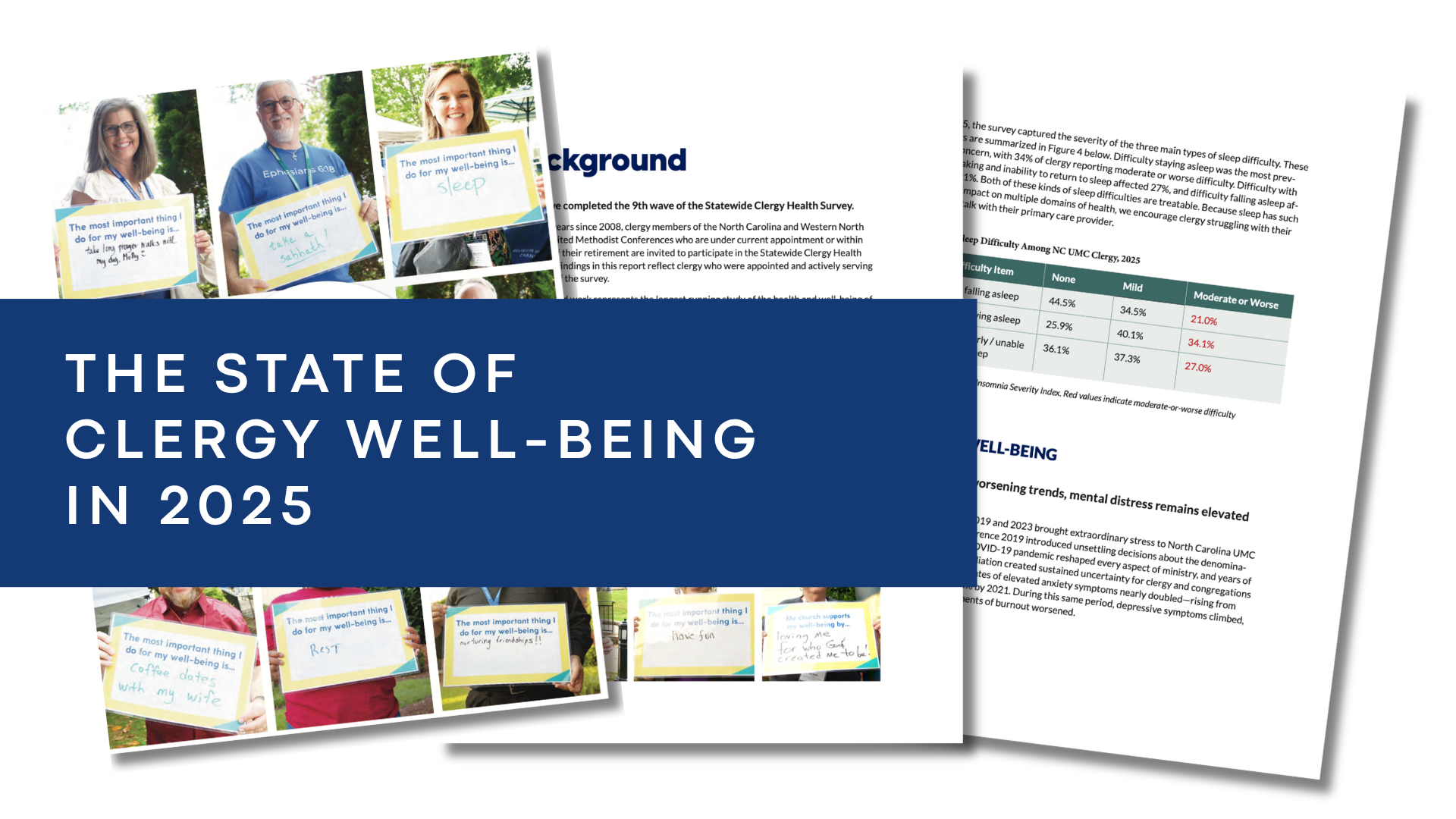
Unfortunately, the underlying data make clear that the physical, mental, and spiritual health of clergy is still concerning. Read the full report to get a better sense of what they are tracking here. Encouragingly, the same researchers find that a strong majority of clergy still register as "flourishing," and they've identified four practices that consistently set flourishing pastors apart from exhausted ones: tending their physical and mental health, setting real boundaries around work and home, nourishing genuine friendships, and staying rooted in a sense of working in step with God.
Clavier's piece moves underneath the numbers to ask why. His argument, in short: clergy burnout is not mainly a failure of individual grit. It's the predictable result of a system that asks the impossible and then quietly suggests that those who falter simply weren't strong enough. He calls this the danger of preaching "resilience" without changing anything… I’ve seen this in so many organizational health approaches. It allows dysfunctional and misaligned systems to blame the individual person instead of addressing the root problem.
He names several pressures that will feel familiar even where the structures don't match ours: the slow erosion of hope that comes from ministering for years inside long-term decline; the loneliness of work that often unfolds in solitude, with no colleagues down the hall; and the steady drift of a pastor's energy away from the actual care of souls and toward administration, compliance, buildings, and an inbox that never empties. The vocation, he argues, is healing, guiding, and accompanying people… and too many clergy now feel reduced to keeping the institution's lights on instead. Very similar insights were shared by Dr. Todd Ferguson in his book, Stuck: Why Clergy are Alienated from Their Calling, Congregation, and Career. We captured his lecture from a while ago at Crieff as one of our Recast Ministry Forum Podcast episodes.
Clavier’s way forward isn't a self-care tip. It's a call to share the load: to rethink how we allocate people and resources, to strip away the demands that pull clergy away from their calling, and to build a culture where support for ministry leaders is a lived reality and not just a sentiment. I’d echo this call as I continue to field literal “calls” from Presbyteries that are at a human resources tipping point these days.

You know I’m a broken record… saying: “You Are Not Alone”… but it’s true. The fact that these two pieces describe the same exhaustion and point to the same causes like overload, isolation, and a vocation squeezed out by everything else tells us that this is bigger than any one of us, any one congregation, or any one bad year. It is not your fault… or a personal shortcoming you may have. It is something the whole Church is being asked to face.
And as I often say… I’m not certain that it makes our present reality any better or the weight any lighter on a Tuesday morning. But it does mean the response can't only be individual either. The work of tending pastoral well-being belongs to all of us… to presbyteries, to colleagues, to congregations… and yes, to communities like Ministry Forum.
I love how Clavier closes with the words of Jesus that many of us have preached to others more often than we've received them ourselves: "Come to me, all who are weary and burdened, and I will give you rest" (Matthew 11:28). May we learn to extend that invitation to one another — not only to those in our pews, but to those standing behind the pulpits. Certainly, for the sake of our ministry leaders but for the sake of the Gospel itself.
You are not alone in this.