
Press On - Soccer Sunday at Knox College
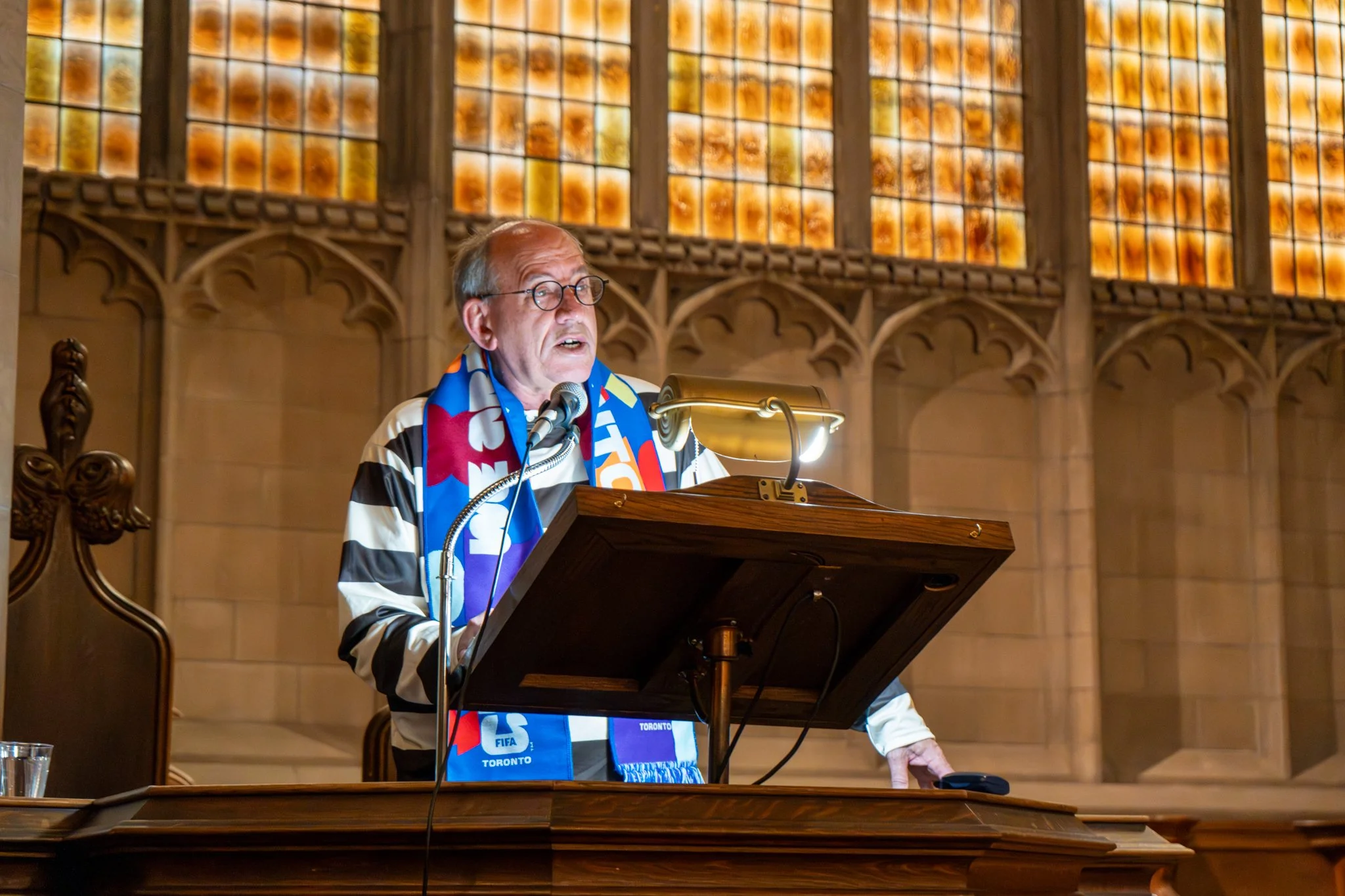
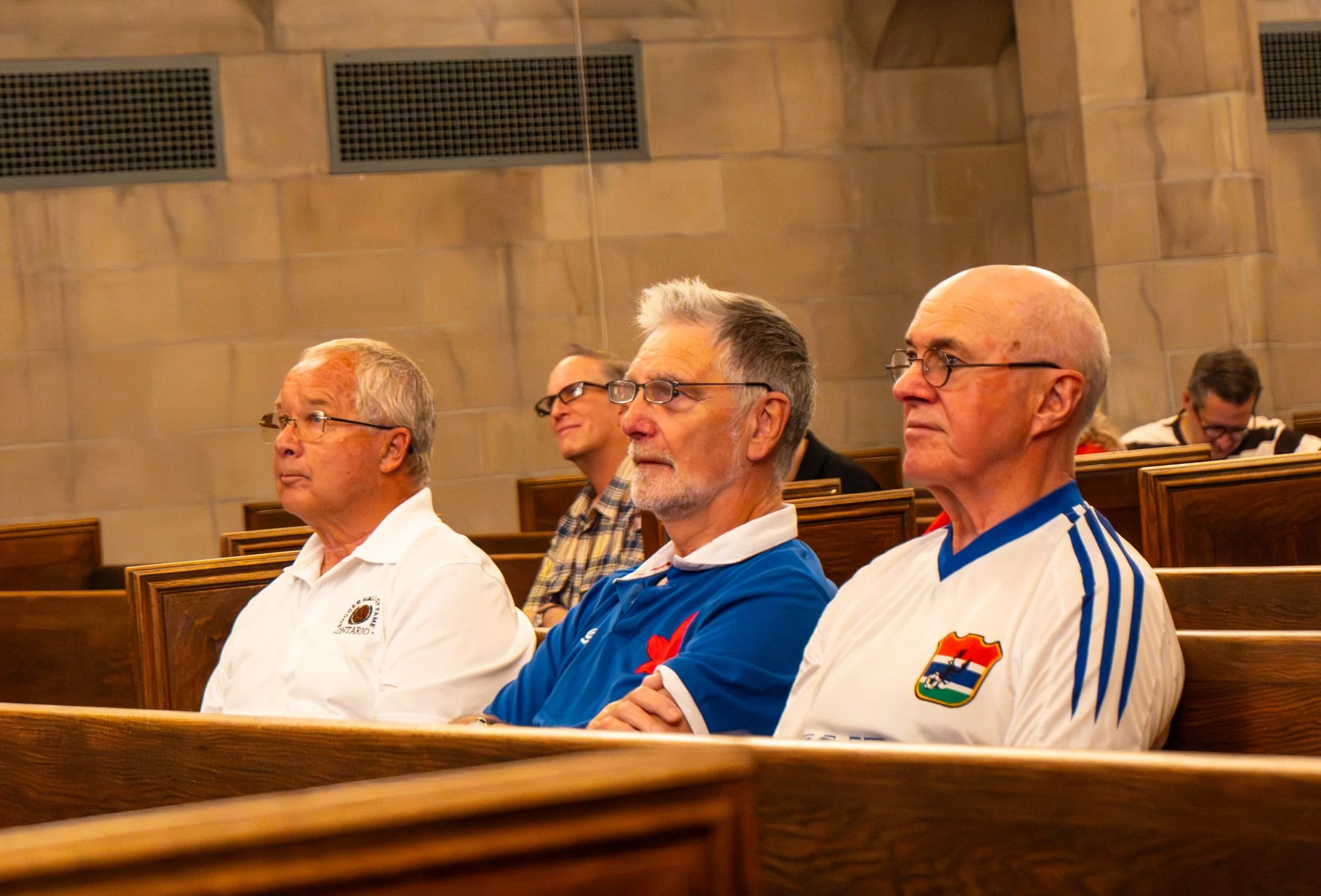
Earlier this month, Ministry Forum Director, The Rev. John Borthwick had the opportunity to preach as part of Knox College’s annual Soccer Sunday service - a celebration that brought together faith, community, and the rich history of the beautiful game.
In his message, John reflects on perseverance, purpose, and what it means to keep pressing on together. Drawing from Philippians 3, stories from the soccer pitch, and the remarkable legacy of Knox College’s 1878 championship team, he offers a thoughtful and engaging reflection on faith, belonging, and the communities that help carry us forward.
You can watch the full service below, and we've included a transcript of John's sermon for those who prefer to read along.
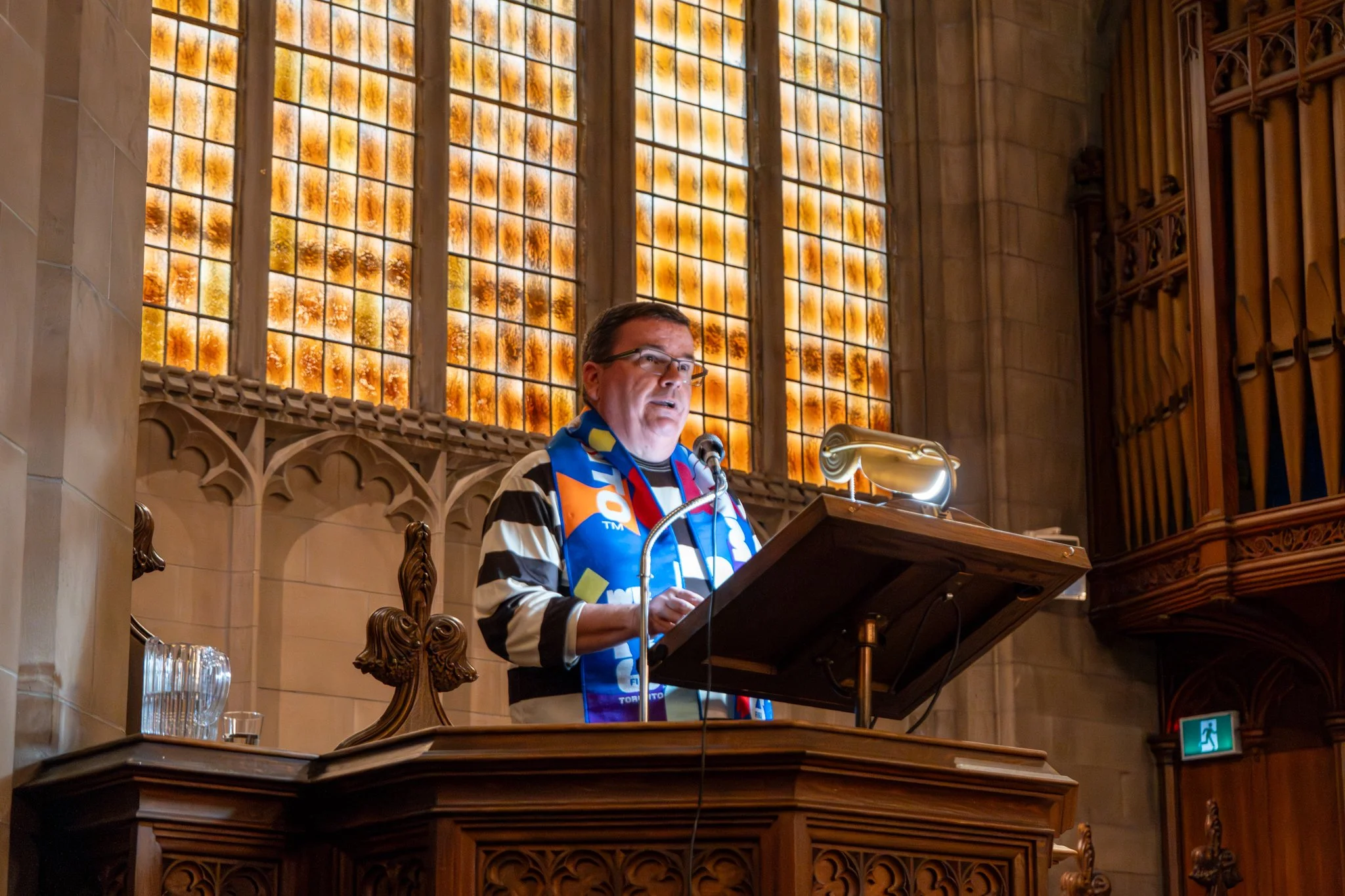
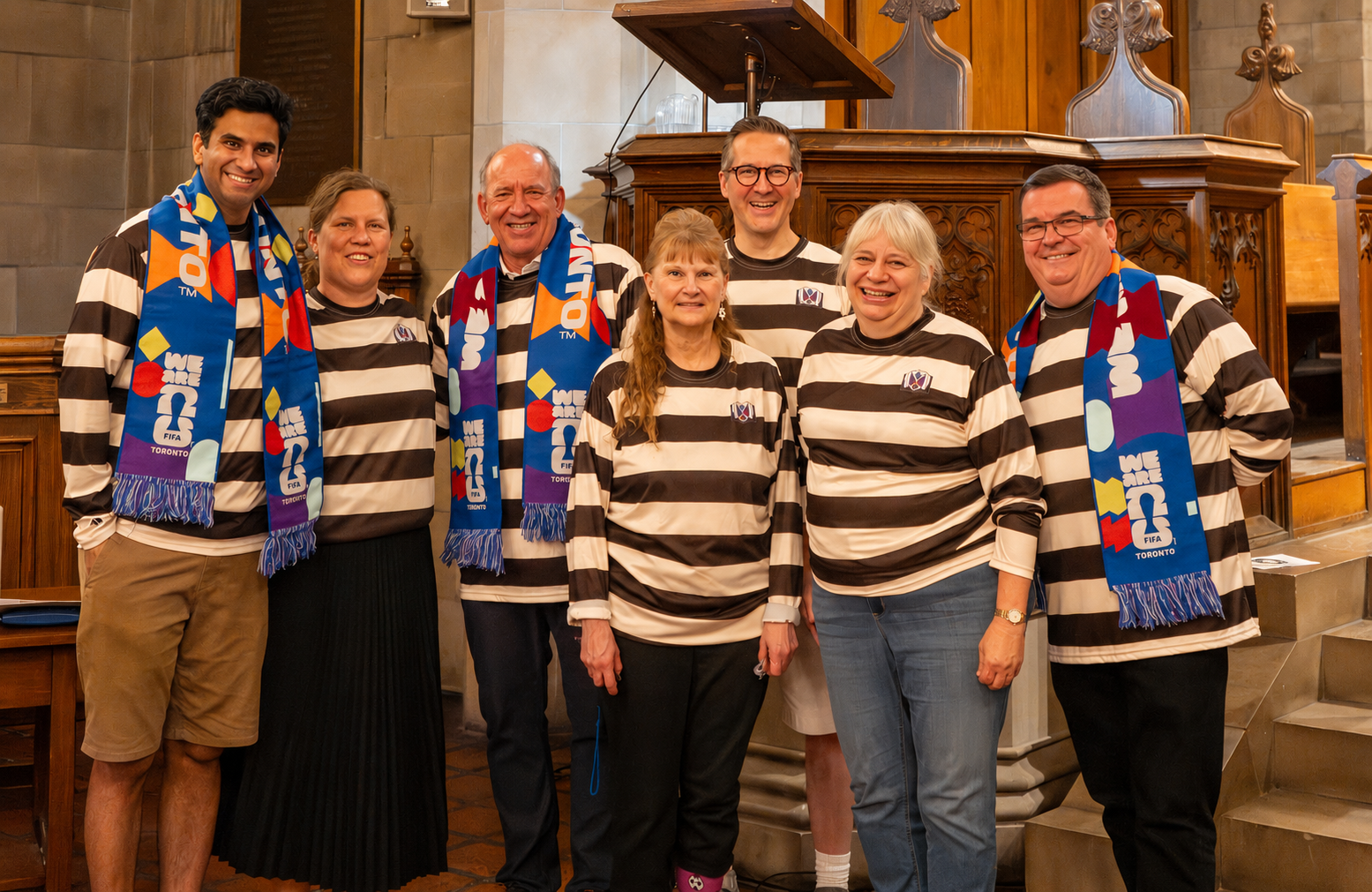
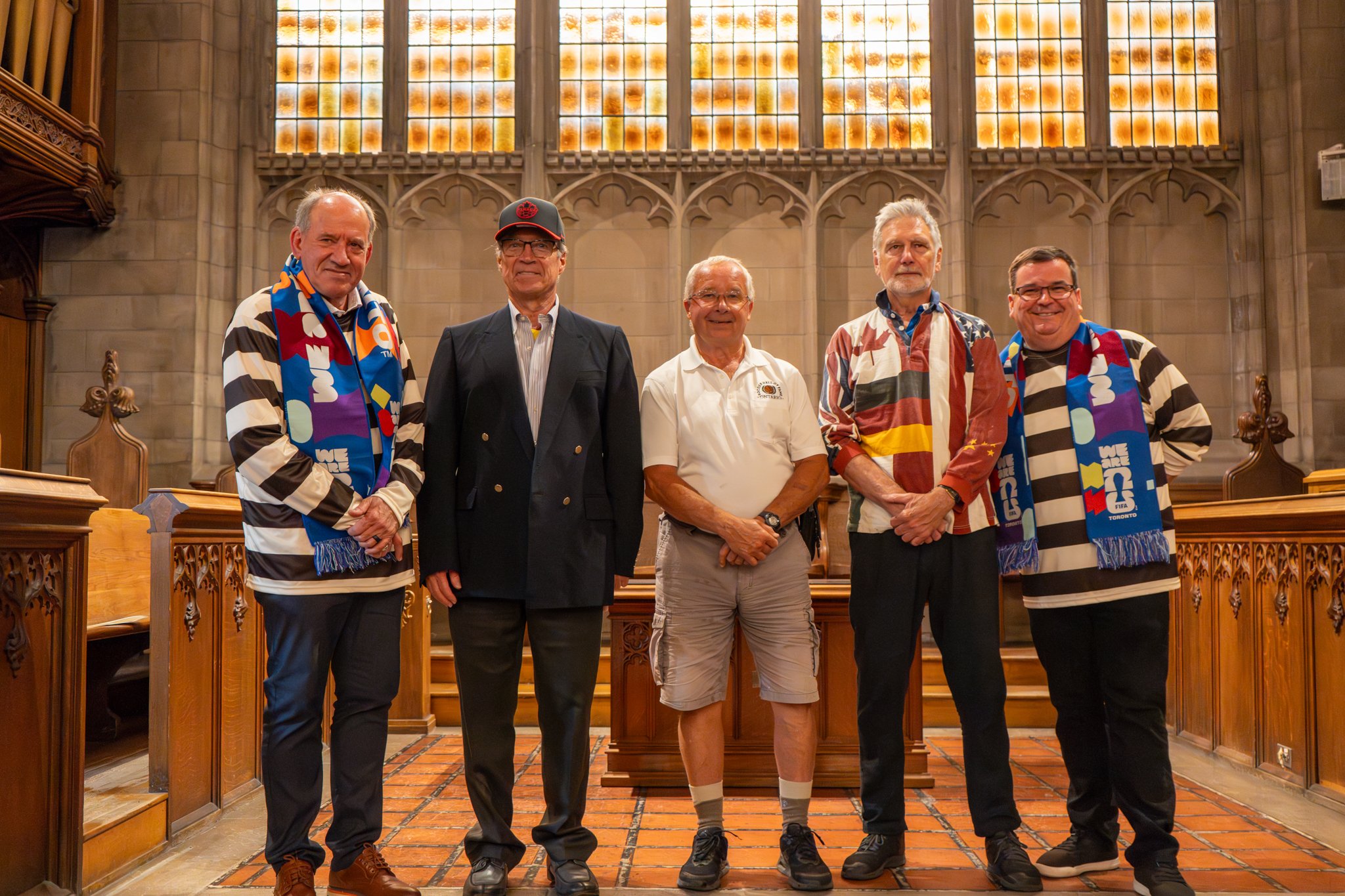
As today’s preacher…
I’m going to try and juggle three things.
Celebrate the arrival of the World Cup in our City!
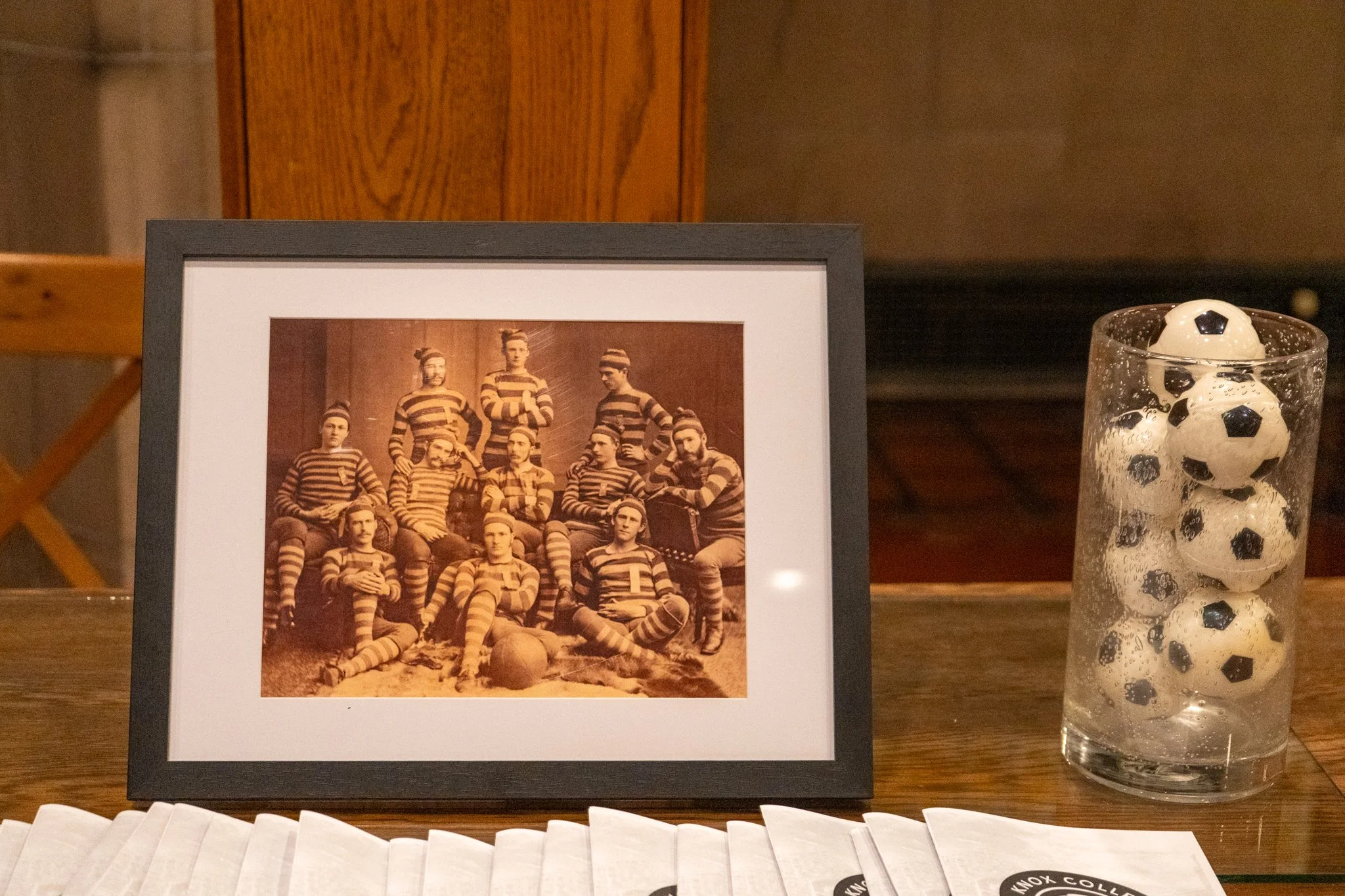
Honour a team of Knox College students
from the 1870s
who became the first soccer champions…
in the recently formed Dominion of Canada…
and who are being inducted
into the Ontario Soccer Hall of Fame
as a part of this service.
And all the while…
I’m going to attempt to connect these threads…
with a scripture passage…
that, as strange as it may seem,
might have something to say about all of this.
So, here we go.
I want to begin by sharing
what I learned from Timbits soccer.
For those of you visiting from elsewhere —
Timbits soccer is a Canadian rite of passage
for some…
where children too young
to tie their own cleats
are released onto a field
in matching jerseys
with a ball that is somehow
always too big for them.
It’s sponsored by a doughnut company.
And it is exactly as serious as it sounds.
At five years old…
my main contribution to the team was…
let’s call it: botanical.
While the action raged at the other end of the pitch,
I was generally crouched at midfield,
examining the grass.
I was conducting research.
Identifying clover…
searching for the four-leaf variety…
Looking back, I think it was
some of the most contemplative work of my early life
and I have been trying to recover
that practice ever since.
There is something holy…
about a child who stops to look at the grass.
Didn’t Jesus say, consider the lilies.
Even Paul, who tells us to “press on…”
pressed on while sitting still…
writing from a prison cell…
yet wide awake to all around him.
The second thing was the rule of the keeper's hand.
On my team,
if you stepped on the keeper's hand
in a scrum in front of the net…
the rule was simple:
congratulations, you're playing goal now.
You went in, the keeper came out…
and you stood between the posts…
in an oversized sweater…
trying to understand what had happened to you.
There is a strange grace…
in being handed a position you didn't ask for.
Most of us did not apply
for the life we’ve ended up in.
We were not consulted.
But we pressed on…
we’ve made the best of it…
and somehow, some of us, have ended up in goal.
And the not-having-chosen-it —
is sometimes where the deepest part
of who we are gets discovered.
The third thing I learned was…
that everyone gets a trophy.
I used to roll my eyes at this.
(not when I was a kid… don’t get me wrong…
for a lad like me…
it was the only trophy I was ever going to get!)
We can debate rewarding people…
for showing up another time.
But listen to today’s text…
Paul writes:
“Not that I have already obtained this,
or have already reached the goal.”
Paul may be the patron saint
of the participation trophy.
This whole letter to the Philippians
is written from prison.
Paul is in chains.
He is not winning.
And yet… he still claims the prize —
not because he has earned it,
but because Christ has laid hold of him.
Now, the original language here is beautiful.
Paul presses on, he says,
to lay hold of that for which Christ
has already laid hold of him.
The grip is mutual.
But Christ grabbed first.
In football, laying hold – especially of the ball…
is an infraction.
But in Paul, being laid hold of by Christ…
is the whole point.
(I did warn you about the heavy lifting!)
In a way, as Paul understood it…
it is not about you choosing Christ…
it is about Christ choosing you…
and you deciding what to do with that…
Like football…
you do not choose whether the ball comes to you…
but you can choose what you do when it arrives.
In 1919 — forty years after our team won…
a minister named Rev. John Linton
preached this very passage
on what came to be called Soccer Sunday.
He preached it
to nearly a thousand footballers
who had marched in from Sunnyside.
Perhaps some in the crowd…
had come home from a war
that had laid hold of them
in ways no one chose.
Linton told them, in the language of his day
and his tradition,
that the captain of the team of their lives
should be Jesus Christ…
and the opposing club was Satan.
That was Linton’s way of putting it.
I am not going to preach it quite that way today…
partly because the room is different…
and partly because I think the text
gives us something better
than naming the enemies we must vanquish:
it gives us something that draws us closer together.
Soccer is a team sport!
Its beauty comes not from any one player…
but from the way the team moves together…
in one direction.
Which brings me to set pieces.
perhaps the most theological moment
in all of soccer.
Everyone stops.
The whistle blows.
There is a strange, electric silence.
The whole team takes its place.
One player touches the ball —
and nothing happens without the others.
Eleven people. One ball. One direction.
And Paul says…
“Let those of us, then,
who are mature
be of the same mind.”
That's not Paul demanding uniformity...
or insisting we agree on everything…
That's Paul calling a set piece.
Each person has a position… a role.
The play only works…
if all of us are running…
in the same direction.
Something happens at a World Cup…
that happens almost nowhere else…
For about a month, every four years…
the whole human family gathers around a single ball.
Tens of thousands of people in a stadium…
billions more watching from kitchens and cafés…
and living rooms and pubs on six continents…
all paying attention to the same thing
at the same time.
And look at what people do when they get there.
Strangers hug strangers.
Grown adults paint their faces.
Languages that share no words
share a common roar
when the ball hits the back of the net.
A grandmother in Lisbon…
and a teenager in Little Portugal…
just down the road from us…
are, for ninety minutes, on the same team.
In a world that finds new ways
every day
to divide us…
“the Beautiful Game”
quietly insists
that we belong to one another.
Knox College itself learned a version of this early.
In 1878 our students played teams
from across this city —
University College, Trinity Medical,
the cricket and lacrosse clubs.
Different schools,
different ambitions.
They showed up on the same field…
played the same game…
And made each other better.
Nearly 150 years later…
Knox is still trying to learn to do that well…
to be a community wide enough
for people of every background, belief,
ability, orientation, and identity.
We’re not always good at it.
No college is.
No church is.
No country is.
But the aspiration
is the one Paul names:
that those who are mature
would be of the same mind.
Not the same opinions.
Not the same beliefs.
But, the same generous,
hospitable,
eyes-on-each-other mind
that makes a team out of strangers.
Knox names this as fundamental
to the kingdom of God.
Other traditions here…
and watching online…
will name it their own way.
The naming is yours.
The work is ours together.
Now, I’ll risk a little more controversy.
There’s one thing about the Beautiful Game
I’ve never understood.
and I want to confess it.
Why?...
after 120 minutes of breathtaking football…
do we settle the whole thing on penalties?
It feels wrong, doesn't it?
Two teams play for two hours…
give everything they have…
and then we line them up…
and ask one player to win or lose
a tournament from twelve yards out.
But maybe — and I offer this gently —
maybe penalties are honest.
Maybe they’re an admission
that some things can’t be decided
by effort alone.
Sometimes the match is a draw.
Sometimes life is a draw.
Sometimes both teams played amazingly well…
and there’s no winner the rules can name.
I sense Paul knew this.
He does not say he is winning.
He says he has not reached the goal.
He says he is still pressing on…
being laid hold of…
and so he keeps running.
In a world that wants a winner declared…
before the lights go out…
that wants every story resolved
by the end of the hour…
Paul gives us permission to still be running.
Now, no reflection on “the Beautiful Game”…
would be complete these days…
without a shout out to Ted Lasso.
There is a character in the show…
named Dani Rojas…
and Dani has essentially one line.
He shouts it across the training ground…
shouts it after he scores…
shouts it maybe in his sleep.
“Football is life!”
In the show, it's a joke.
In this passage, it's not.
Paul is saying the same thing in biblical Greek…
The pressing on. The straining forward.
The holding fast.
This is the life of faith. “FAITH IS LIFE!”
(Rev. Linton would have loved
having Dani Rojas to quote.)
Someone asked me as I was preparing this sermon:
“Pressing on toward what?”
Paul calls it 'the prize of the heavenly call of God in Christ.'
In my tradition, many would call this the goal in itself…
But I’d argue…
that the prize isn't a place you arrive at.
It's the kind of person…
and the kind of community…
you are becoming on the way.
The game itself is the prize.
The pressing on is the point.
In December of 1878…
just steps from where we sit…
on the Front Campus lawn
of the University of Toronto…
eleven students from Knox College
beat the best team in the country, one-nil.
The whole school…
had about a hundred students.
They were not supposed to win.
They were not professionals or athletes.
They were studying for the Christian ministry.
Eleven young men in long sleeves…
on a cold December afternoon…
who simply played the game in front of them.
They pressed on.
They held fast to what they had attained.
And almost 150 years later…
we are still talking about them.
That, I think, is what Paul wants for us.
Not the trophy – the pressing on.
The Beautiful Game… played for the love of it… played with the team God has put around you… played in the one direction that matters.
Whatever you believe…
whoever you cheer for…
whichever team brought you into this room today…
May you… press on!
Press on.
AMEN.