
Rescuing Church Growth from Idolatry
I’ve followed the writing of Dr. Andrew Root for years. I’ve read pretty much everything he has put out there… and I found his series on “Ministry in a Secular Age” particularly interesting despite getting lost in Root’s philosophical mind from time to time. If you want a short take on the core themes of his work, I’d recommend his collaboration with one of our own, The Rev. Dr. Blair Bertrand called: When Church Stops Working: A Future for Your Congregation beyond More Money, Programs, and Innovation (2023). I’ll admit it… and Root has called people like me out on it – I’ve wanted him to simply and plainly tell me what to do. When I was in congregational ministry and dabbling with a little thing called The Abbey, I had the opportunity to ask him directly… and he still dodged the question (rightly so, I’d say! But I don’t have to like it!)
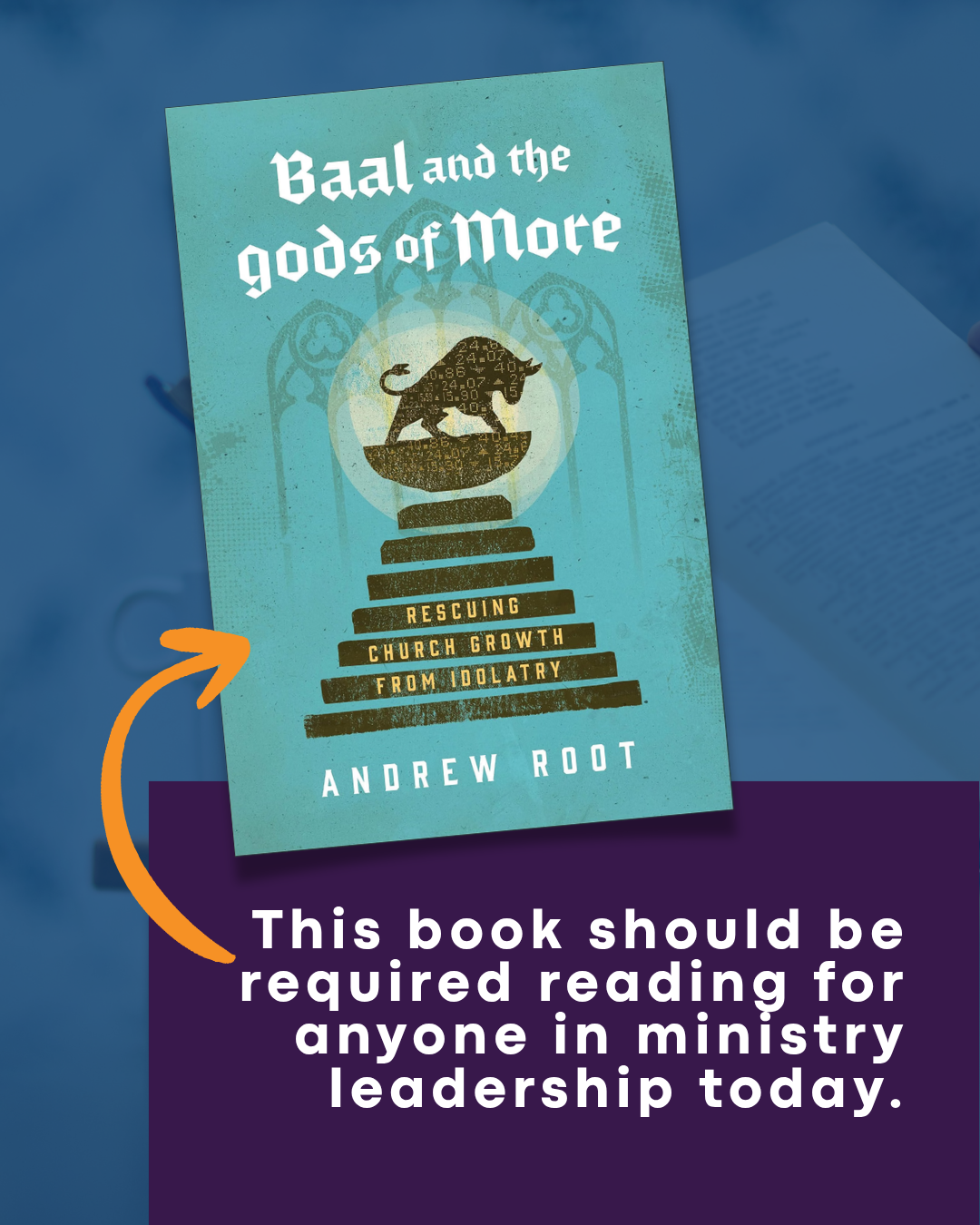
His newest, Baal and the Gods of More: Rescuing Church Growth from Idolatry takes his thinking a little further and is naming something that many of us have felt in our bones but haven’t quite had words for. I think this book should be required reading for anyone in ministry leadership today.
Why? Well, how about this… he’s not even out of the roman numeral introduction and he’s dropping this on the reader:
“Our crisis is not one of decline (or lack of a certain kind of growth) but a crisis of hearing and obeying the Word of God. But to hear the Word of God, you have to grow into something or, better, someone. Growth is good, not bad. But not all growth is the same. And some forms of growth are idolatrous.”
How would that line land in the conversations that many of us are having right now? In my experience, as I connect with presbyteries, sessions, boards, and leadership meetings across the country, the animating question is almost always some version of how do we stop the numbers from falling? or put another way, how do we keep the lights on? Root's claim is that the question itself has quietly become an idol.
He tells the story through the old contest on Mount Carmel between Yahweh and Baal. The god Baal, Root reminds us, was a god of fertility… production. Root's unsettling suggestion is that late-modern Protestantism, in its panic about decline, keeps confusing Yahweh for Baal… laying "the insatiable drive for more onto the backs of pastors and congregations." A yoke that is anything but easy.
He gives this drive a name he borrows from the sociologists: the logic of escalation. Growth for the sake of more growth. In a culture built on it, standing still feels like dying, and so "grow or die" becomes the mantra we can't stop reciting even when it's burning us out. Root's most piercing line, for me, is this: for late-modern Western Protestants, the fear of decline has replaced the fear of the Lord. We are now animated more by the threat of shrinking than by the God who speaks. As moderns, he says, we've come to want a future more than we want God.
What makes the book more than a diagnosis is that Root refuses to let our usual escape hatches off the hook. He watches two camps trying to save the church… the "techno-optimists" who believe innovation and creativity will get us growing again, and the "identitarians" who believe deeper welcome and recognition will. He has real sympathy for both, and so do I. But he argues that both, left unchecked, can get quietly captured by the same logic of more: more relevance, more reach, more affirmation, more capital of one kind or another. There is never a point at which it is enough. That's the tell. Baal never says "enough."
So where does he land? Not on a better strategy. That's rather the point. The renewal Root imagines isn't growth ofsomething (capital, numbers, reach) but growth into someone… the risen Christ through prayer, obedience to the Word, and the slow, unglamorous, person-to-person work of ministry. He calls it sweetness rather than golden gains. It's the pastor who putters around the building, brings the meals, sits in the grief, and reminds one lonely man that he is held. Nothing grows per se. Nothing is being produced. And it turns out to be the thing that saves.
I think Andy has hit the nail squarely on the head. I also don't always know how you preach this to a session that is genuinely, achingly worried it won't make budget, or to a board staring down a building it can no longer heat. "Stop trying to grow and learn to be held" is a beautiful sentence in a book. It is a much harder sentence to say to people whose fear is real and whose grief is legitimate. Telling anxious people to simply be less anxious has never once worked, in Scripture or in life.
I don't think Root would have us weaponize his book against worried congregations, and I certainly hope you don’t either(if you do decide to read it!). But I've been wondering whether the way in is quieter than a strategy. Maybe it starts by refusing to hand our people one more thing to do, and instead giving them permission to grieve honestly what has been lost and then to notice who is actually still in the room. Maybe it's naming, out loud, that the goal for this season is not to reverse the graph but to grow deeper with the handful of people God has actually placed in front of us. One of Root's quieter notes lands here for me: in our hunger for numerical growth, many of our churches have people who share only the most surface connection with one another. There may be more renewal available in that gap than in any growth plan.
And maybe, as ministry leaders, we all need a reminder from time to time that we are not called to be cogs in anyone’s machine… including your denomination’s… instead we are beloved children of God and that is enough. And as such, we need to be held, remembered in prayer, and receive as much as we give.
Clearly, I’m on the same journey as many of you. I don’t know what this looks like in practice. I do know that I tried to bring it to life as a pastor in fits and starts as I battled with the gods of more. If you've found language that lets you carry this kind of message into an anxious room without adding to the fear, I’d love to hear from you.
You are not alone in this.