
What If You Didn’t Have To Do It All?
There's a quiet exhaustion that many ministry leaders carry: the sense that everything depends on you. The hospital visits. The Bible studies. The sermons. The administration. The pastoral care. The strategic planning. And somewhere underneath all of it, a nagging feeling that if you drop even one ball, someone will notice.
It's a heavy way to live.
A recent conversation I came across between two church renewal thinkers named Alicia Granholm and Dwight Zscheile(from Faith+Lead) brought back some memories. Here’s the conversation:

They were talking about what they call "the fourth pivot"… the shift from clergy-led, lay-supported ministry to lay-led, clergy-supported ministry. Maybe you’ve started to hear this phrase more and more these days. It is certainly an expression used by the PCC’s Change Leadership Team in some of their communications. And while that framing might sound theoretical, what they were really describing was a path out of that exhaustion.
Their argument is simple, even if living it out is not: the ministry of the church was never meant to rest on the shoulders of one person. The New Testament vision is of a body: distributed gifts, animated by the Spirit, every member contributing something no one else can quite replicate. The highly professionalized, clergy-centered model many of us inherited isn't the original pattern. It's a product of a particular moment in history. And we're in a new moment now.

What strikes me most is how they describe the role that remains for clergy in this reimagined model. It certainly isn’t diminished but is actually brought into greater clarity. Theological and spiritual leadership. Sacramental ministry. Coaching and equipping others to discover and use their own gifts. Being a person of prayer and scripture who helps the community go deeper. That's not a smaller calling. For many clergy, it's actually why they answered the call in the first place.
The hard part, of course, is letting go.
What if the lay leader teaches the Bible study imperfectly?
What if the hospital visit is awkward?
What if the sermon isn't as polished?
These are real fears. But Zscheile offers a reframe worth sitting with: Jesus himself gave ministry away. He sent out the twelve. He sent out the seventy. He left! And somehow that departure was the thing that finally freed his disciples to become who they were meant to be.
Now, here’s what’s missing, in my opinion, from this conversation… there is an assumption that the people who are in community with ministry leaders are ready and willing to answer the call to ministry. I’m not 100% certain that is true. If it is in your context, then please get out of the way and let the people have at it! But if it isn’t, let’s share a thought or two on WHY that is not as easy as one might assume:
First, the dominant generation in the today’s church has grown accustomed to a professional, clergy-centred model… and truth be told, many of our predecessors and perhaps even colleagues today are good with that. There are aspects to working solo that make some things easier - collaboration and team work is harder.
Second, mindsets are so very difficult to shift. It will be challenging to make the transition to this model. There will be pushback including phrases like “Well, what do we pay you for anyway? Just to pray?” This will not be an easy road ahead. And lastly, the interior condition of the ministry leader… we’ve named the spiritual discipline of“letting go” but there is also our own ego and perfectionism and desire for expediency and so on and so on. And let’s not forget that a journey of this kind will require vulnerability on the part of the ministry leader and openness from the community that they serve.
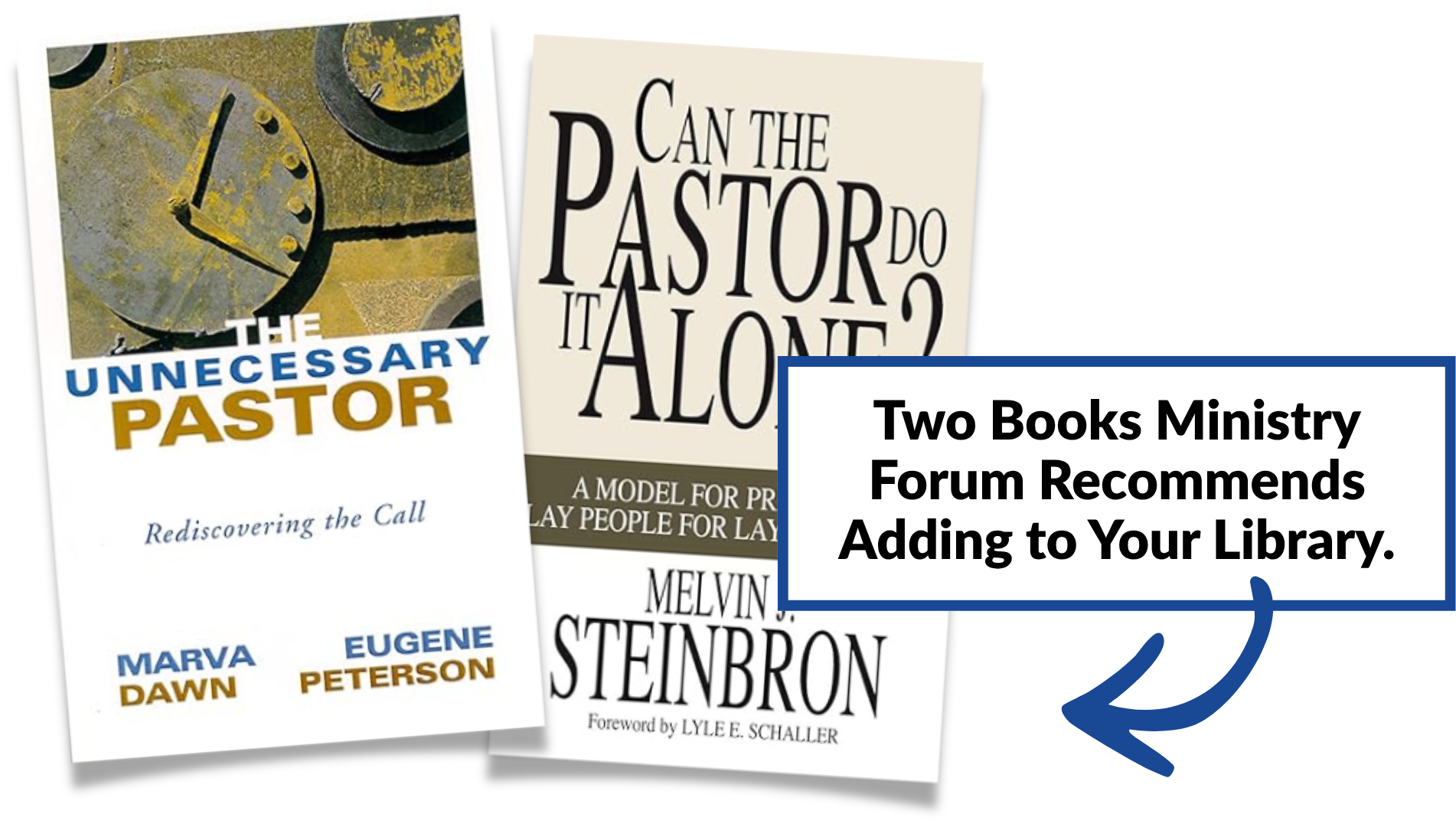
As I listened to the conversation, I was delighted that the referenced Eugene Peterson and Marva Dawn’s collaboration from 1999 (just as I was starting out in my first call): The Unnecessary Pastor: Rediscovering the Call. It also brought to mind another quote by Peterson that I sought to live by in congregational ministry: “You are not the minister of our changing desires, or our time-conditioned understanding of our needs, or our secularized hopes for something better. With these vows of ordination we are lashing you fast to the mast of word and sacrament so that you will be unable to respond to the siren voices.” Sadly, despite my best efforts over 2 1/2 decades of congregational ministry I wasn’t able to break the habit of the professionalized clergy model.
Even, when early in my second call, I discovered the book, Can the Pastor Do It Alone?: A Model for Preparing Lay People for Lay Pastoring by Melvin Steinbron (2004) and ordered dozens of copies for our leadership team… a significant portion of my ministry remained a solo act with some amazing individual accompanists but never a sense that we were a whole orchestra. And all this was almost 30 years ago… we were talking about this… and not much has changed, except we’ve all gotten A LOT older.
So, there’s a question that remains… if you and the community you are a part of is open and compassionate enough to ask it and hold space for the answer… What are the particular things this community needs from the paid ministry leader and what might someone else actually be better positioned to offer?
And maybe this needs to be a wider conversation involving the Presbytery or other local congregations… too often this work is siloed. Ministry leadership is too important, and too hard, to do all alone. And the story of God’s ministry leaders like Moses or even Jesus set a very different example than the one we may have inherited.
If this reflection resonates, I’d love to hear what it is stirring for you!