When Change Actually Happens
“I was told there would be no math.”
You may remember the line from Saturday Night Live in the 1970s, when Chevy Chase played President Gerald Ford. Or perhaps you recall it from the 1994 film Reality Bites, capturing the disorientation of a generation trying to find its footing in uncertain times.
Either way, it’s a line that surfaces whenever something feels unexpectedly analytical (especially in spaces where we assumed things would be more intuitive, relational, or spiritual.
And yet… here we are.
Because when it comes to change - especially in ministry - there may, in fact, be a little math involved.
When Does Change Actually Happen?
Across many recent conversations with ministry leaders a common theme keeps surfacing: CHANGE. Individuals sensing something isn’t quite right but unsure what to do about it.
Recently, during a visioning process at Knox College, a facilitator put a simple formula on the whiteboard. It stopped me [John] in my tracks because it named something I’ve seen again and again in congregational life, and in life more broadly.
Here it is:
Change happens when:
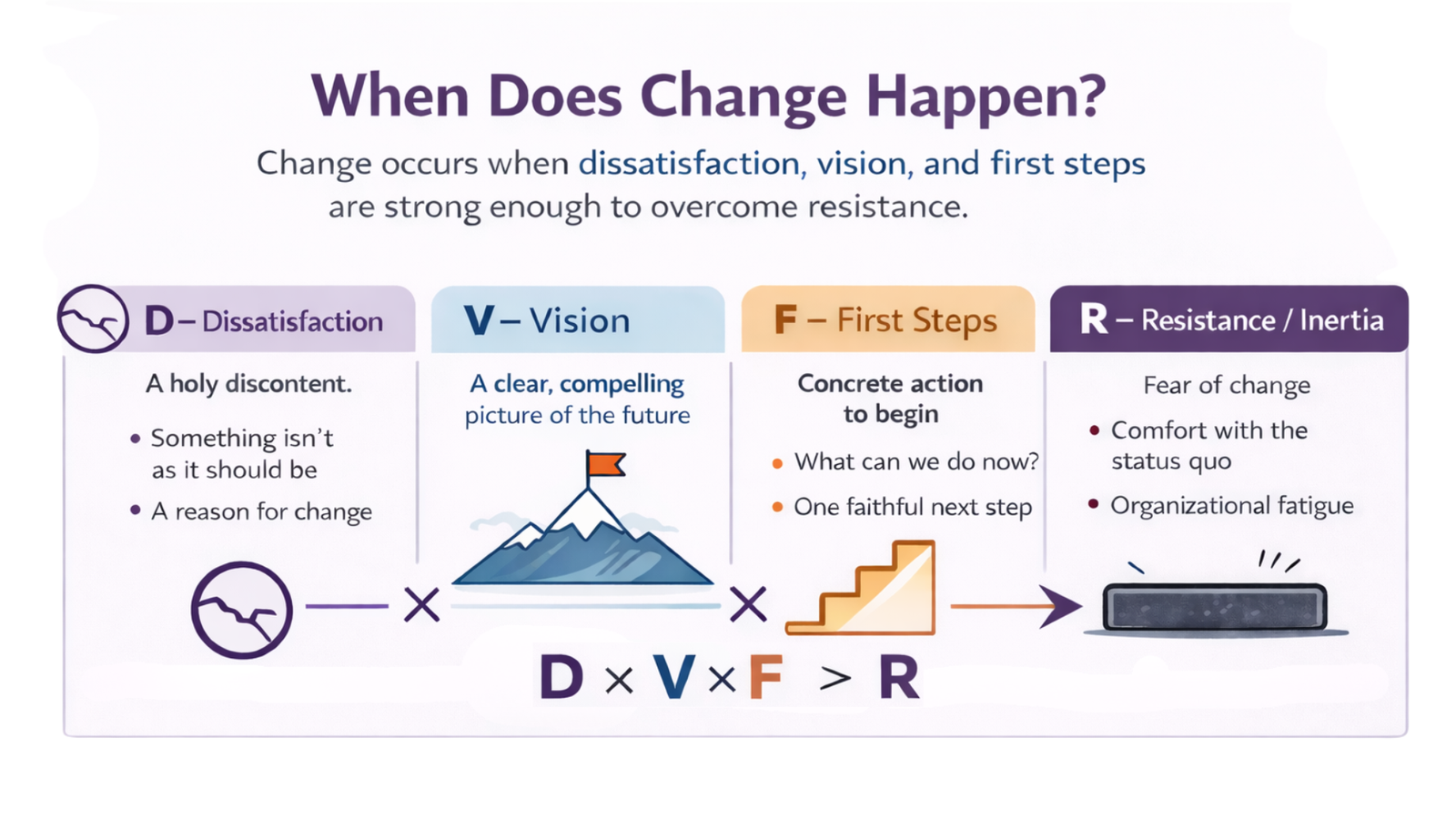
D × V × F > R
Where:
D = Dissatisfaction (a reason for change)
V = Vision (a compelling picture of the future)
F = First Steps (concrete action to begin)
R = Resistance / Inertia
In words: change occurs when dissatisfaction, vision, and first steps are strong enough together to overcome resistance.
We See This EVERYWHERE
I think this is something that almost any ministry leader can appreciate! You see it in psycho-spiritual care, addictions work, congregational ministry… you see it in LIFE! And here’s the interesting spin that I’d like to put on it… something I’m confident that folx who are practitioners in psychospiritual care will see as obvious…
We often make an assumption that someone SHOULD or WOULD WANT to change. The greater truth might be that they personally aren’t dissatisfied or they still see the benefit to be more than the desire to make a change. That is hard for some of us to fathom.
We often assume that people should want to change.
After all, we may see the writing on the wall. We may feel urgency. We may believe change is necessary for survival, faithfulness, or health. But the internal math may look different for others.
In congregational ministry, I used to say that people don’t resist change because they fail to recognize something needs to shift. More often, they resist because they don’t know what to change or what the “first steps” might be. Fear and anxiety about the future loom large. But I’m not sure that’s always the full story.
Sometimes, if we’re honest, people would simply rather not change. They are reasonably content. The status quo works well enough. The discomfort of change feels greater than the discomfort of staying put.
But here’s a twist — they may also feel guilty about that contentment. There are plenty of voices in the wider church culture suggesting they should be more innovative, more missional, more adaptive, more urgent. So they feel bad about feeling good. That’s a heavy emotional load to carry.
Resistance Isn’t Irrational
Resistance can look like:
Fear of loss
Anxiety about competence (“Can I do this?”)
Fatigue from previous change efforts
Attachment to identity
Comfort with the familiar
Resistance is often a form of protection, which means increasing pressure rarely works.
In these cases, if we want change to happen we need to strengthen dissatisfaction (why this matters), clarify vision (where we are headed), and (SUPER IMPORTANT!) identify, doable first steps.
As you think about your ministry context, what do you notice?
Where is there genuine dissatisfaction?
Where might people actually be more content than they admit?
Is the vision clear and compelling or vague and abstract?
Are the “first steps” obvious and accessible?
What forms of resistance are most active in your system right now?
As you consider these questions, it might be helpful to plot your particular context and challenge into the equation… it might be time to do a little math!