
Divinity Atlas
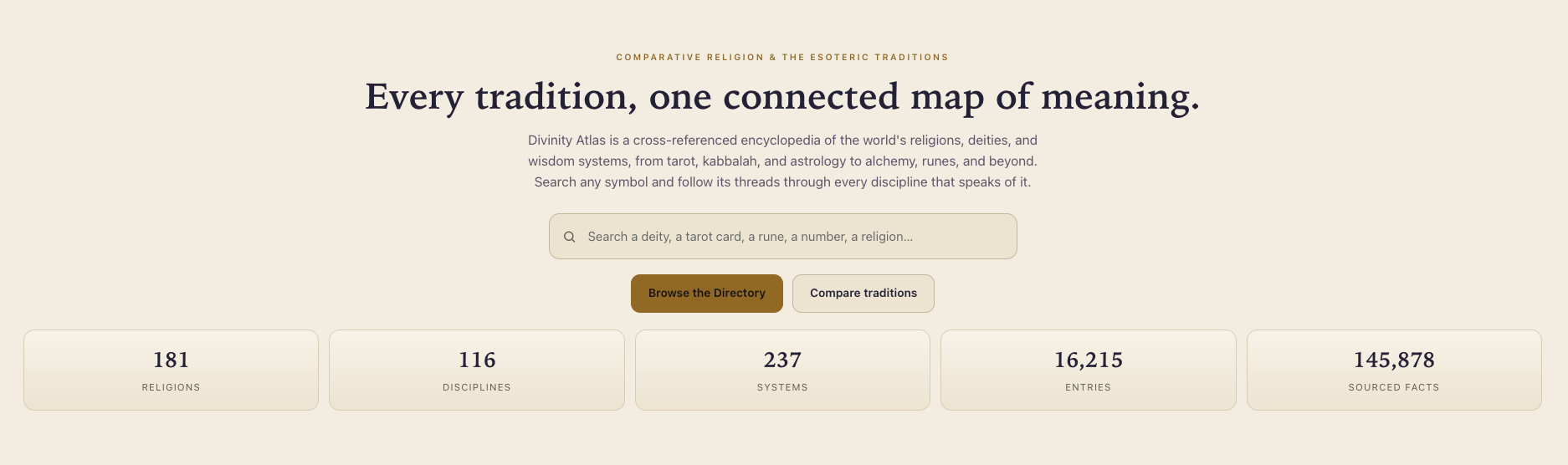
Divinity Atlas is a free online encyclopedia of world religions, spiritual traditions, mythologies, and belief systems. Designed as a research and learning resource, it brings together thousands of articles covering religious history, beliefs, practices, organizations, sacred texts, and influential figures from traditions around the world. The platform is intended to help readers explore religions on their own terms, while providing transparent sourcing and documenting where traditions agree, disagree, or continue to evolve.
For additional background on the project, see the launch article from Religion News Service.
At launch, Divinity Atlas included more than 16,000 entries supported by over 138,000 citations from thousands of published sources. Rather than presenting information as a fixed reference work, the site is built around an evidence-based editorial process. Every established claim is linked to its source, contested claims are clearly identified, and readers can formally challenge information by providing verifiable evidence. Challenges are reviewed publicly, with published decisions, supporting reasoning, and any dissenting opinions remaining part of the record.
The platform includes a range of tools for learning and comparison, including side-by-side comparisons of religious beliefs and traditions, guided learning pathways, interactive maps showing the historical spread of religions, relationship maps between people, ideas, and movements, and quizzes for self-study. Articles are designed to be accessible for both casual readers and those seeking more in-depth research.
The platform was developed around the principle that no single religious tradition serves as the baseline against which others are measured. Instead, it seeks to describe each tradition according to its own sources and self-understanding while distinguishing between established scholarship, contested interpretations, and questions that remain unresolved.
For churches and ministry leaders, Divinity Atlas can be a helpful resource for understanding the beliefs, practices, and history of other faith traditions. It may be useful when preparing for interfaith dialogue, engaging with neighbours from different religious backgrounds, supporting community ministries, or developing greater religious literacy for ministry in increasingly diverse communities.
Divinity Atlas is free to access and does not require an account for its encyclopedia content. Optional paid features, such as personalized readings based on various historical divination traditions, are offered separately from the encyclopedia and are clearly distinguished from its reference materials.
Learn more about Divinity Atlas: divinityatlas.com