
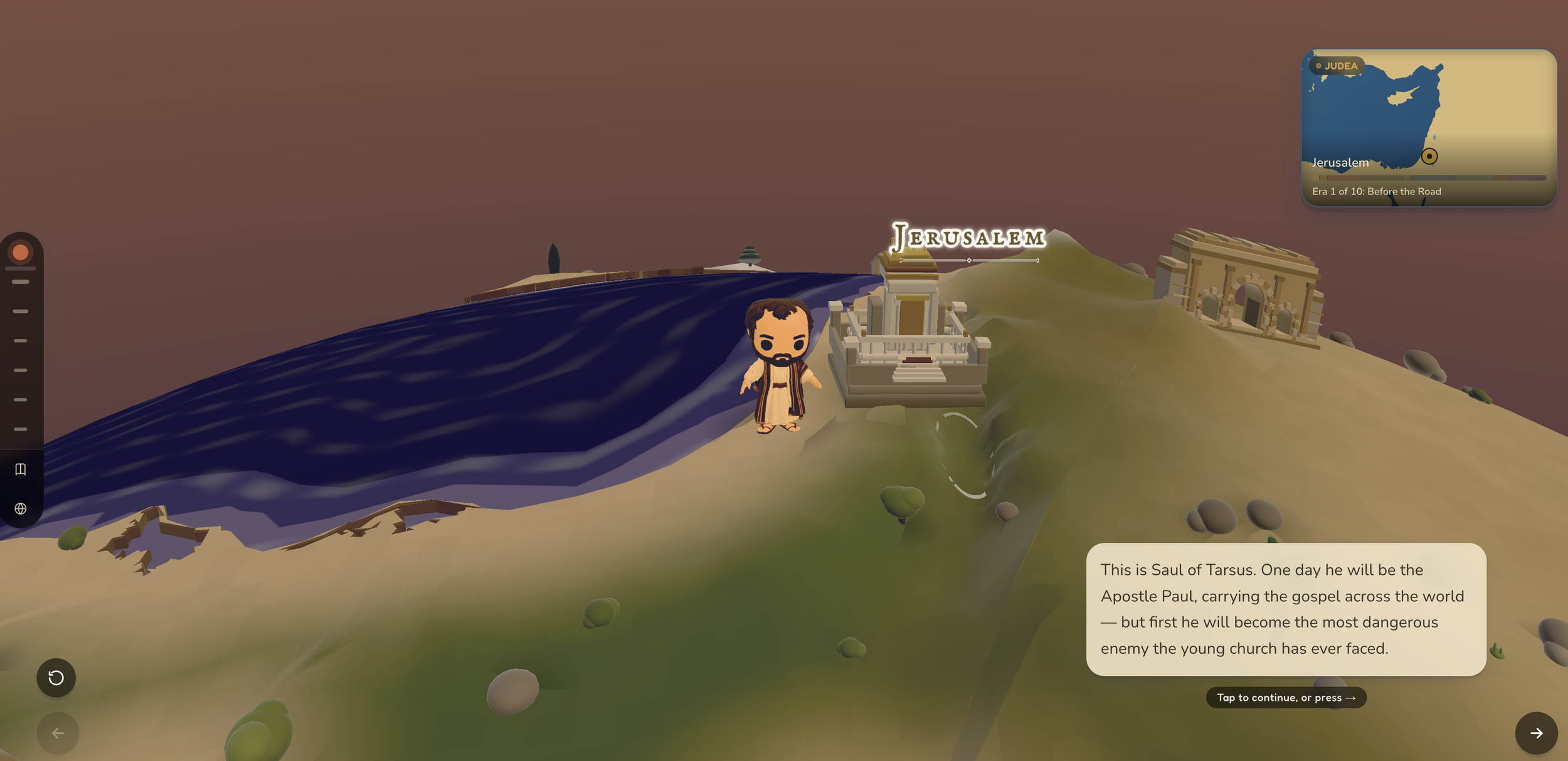
Pauline Letters is a free Bible study website focused on the life, journeys, and writings of the Apostle Paul. It connects the narrative of Acts with the thirteen New Testament letters traditionally attributed to Paul, helping readers see where the letters may fit within the larger story of his ministry.
The site can be explored through an interactive 3D journey across the Mediterranean or through written study pages. Maps, a timeline, and guides to the individual letters allow readers to follow Paul's movements and explore the historical settings in which the letters were written. The site's chronology cross-references events in Acts with passages from Paul's letters, while identifying places where dates, locations, authorship, or other historical questions remain debated.
A significant feature of Pauline Letters is its attention to sources and uncertainty. Biblical material, historical evidence, scholarly reconstruction, and later Christian tradition are distinguished from one another rather than presented with the same level of certainty. Sources include Acts and the Pauline letters, ancient-world geographical resources, inscriptions used in reconstructing chronology, manuscript evidence, and named scholarship addressing disputed questions. Readers can follow citations and examine the evidence supporting particular conclusions.
Pauline Letters includes resources for personal study or small groups:
Guides to the thirteen letters traditionally attributed to Paul
An interactive chronology of Paul's life and ministry
Maps tracing Paul's journeys
A seven-session study of Philippians with Scripture passages and discussion questions
Printable teaching and study materials
Reusable chronology and letter datasets
An embeddable route map for educational use
The project was created and is edited by Thomas Diong as an independent educational resource. It is not affiliated with a denomination, church, seminary, or academic institution and does not claim academic peer review. Diong describes the project's theological perspective as historic Christian orthodoxy with an evangelical approach to Scripture. Where Christians and scholars disagree, the site identifies those disagreements rather than presenting its reconstruction as universally accepted.
The project uses AI in content preparation, translation, and review, but explicitly distinguishes these processes from scholarly peer review and encourages readers to evaluate its conclusions through the published sources, evidence labels, uncertainty markers, and revision information.