Count On Me
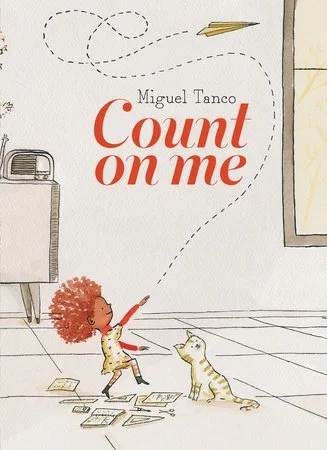
Count On Me | written and illustrated by Miguel Tanco
This story challenges the gender-stereotype about girls and math. Everyone has a passion. For some, it's music. For others, it's art. For our heroine, it's math. When she looks around the world, she sees math in all the beautiful things: the concentric circles a stone makes in a lake, the curve of a slide, the geometric shapes in the playground. Others don't understand her passion, but she doesn't mind. There are infinite ways to see the world. And through math is one of them. Learn about fractals, basic polygons, concentric circles, solid figures, types of curves, types of trajectories, kinds of sets and that math is more than just adding numbers together.
Ideal for:
National STEAM Day November 8
International Day of the Girl October 11, 2025
Pi Day/International Day of Mathematics March 14.
Count on Me. Text © 2019 Miguel Tanco Illustrations © 2021 Miguel Tanco. Reproduced by permission of Tundra Books, an imprint of Penguin Random House Canada Young Readers, a Penguin Random House Company, Toronto.
Katherine lives in a home filled with people pursuing their passions: her dad is an artist, her mum is an entomologist, her brother loves music (and is getting good with practice). At school, Katherine tries different activities, searching for her own passion, but nothing is quite right. Except math.
Math is everywhere in the world around her and Katherine delights in looking for it. She finds it in the fractals of tree branches, in the geometric structures at the playground, in the concentric circles that form when she skips stones at the lake, in the perfect curve of the slide, in the trajectory of paper airplanes or her body when she leaps from the swing, and in finding ways to share treats fairly at home.
In the end, Katherine realizes that there are infinite ways to see the world and math is one of them. Not the only one, but the one for which she has a gift.
While following your bliss or finding your passion may not be biblical themes, discernment of gifts most certainly is. Count on Me could be used to spark conversation about gifts, and how each of us has different ones which can be used for the common good (or to use the biblical metaphor, to build up the body).
Biblical Themes: In his letters (Romans 12:4-5 and 1 Corinthians 12:12-31), Paul compares the church to a body with many parts. His point is both unity (all the parts belong to the same body and are honoured or suffer together) and distinction of gifts (each part of the body has a different purpose). He connects this image of the body with the idea that people are given a variety of spiritual gifts which are used in different ways to build up and strengthen the body of Christ, which is the Church. Some of the gifts Paul names are teaching, encouraging, generosity, cheerfulness, compassion, prophecy, healing, discernment, wisdom, knowledge, and faith. These are all different, but they all come from the same source.
Making Connections:
An Abundance of Gifts! In worship or at some other congregational gathering, distribute slips of paper and markers. Invite everyone to think of someone in the community who offers a particular gift. On the slip, write their name and their gift. Then collect all the slips in a beautifully wrapped gift box. You might want to include the various gifts (though not the names) in the prayers of thanksgiving.
Talk about Passion! What do you love to do? Or what is something you are passionate about learning about? What do you do to learn more or get better at your passion? If you haven’t found your passion yet, what activities have you tried? What would you like to try?
Building the Tabernacle: The book Exodus describes in detail the process of building a tent for God—the tabernacle or sanctuary which the Israelites carry with them through the wilderness. In Exodus 25-27 we find instructions for making the tabernacle and its furnishings, while Exodus 35:4-39 describe the actual construction. Among all the details, two things stand out: the first is that people offered the best and most beautiful things they had; the second is that many different skills were needed, including weaving, sewing, spinning, dyeing, metal working, woodworking, construction, cutting and polishing gemstones, embroidery, engraving, leatherworking, casting bronze, carving—and measuring! There is a lot of math involved in a building project like this! Take a good look at your own place of worship and make a list of all the different skills and abilities that would have been needed to construct it. What parts do you find most beautiful?
Looking for Beauty: One of the ways Katherine knows math is her passion is because she sees it everywhere and finds it beautiful. Try to make a habit of paying attention to what you find beautiful, or what brings you joy or pleasure. At the end of every day, look back and try to remember what you noticed and how it made you feel. This is a simple form of an ancient spiritual exercise called the examen. If you like, write down the beautiful and joyful things you noticed in a special journal. Or draw a picture of them.