
Encounter
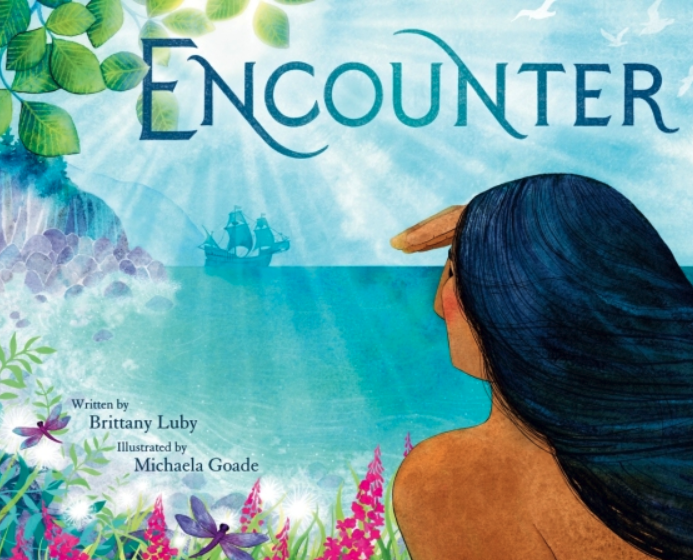
Encounter | by Brittany Luby | illustrated by Michaela Goade
Based on an actual journal entry by French explorer Jacques Cartier from his first expedition to North America in July 1534, this story imagines the first encounter between a European sailor and a Stadaconan fisher.
As the two navigate their differences (language, dress, food) with curiosity, the natural world around them notes their similarities. The seagull observes their like shadows, the mosquito notes their equally appealing blood, the mouse enjoys the crumbs both people leave behind.
This story explores how encounters can create community and celebrates varying perspectives and the natural world. It is at once specific and universal. It’s a story based on a primary document and historical research, but it is in equal measure beautifully imagined. It makes room for us to recognize our differences while celebrating our shared humanity.
Ideal for:
National Day for Truth and Reconciliation September 30
National Indigenous History Month June
National Indigenous Peoples Day June 21.
Encounter. Text © 2019 Brittany Luby Illustrations © 2019 Michaela Goade Flett. Reproduced by permission of Tundra Books, an imprint of Penguin Random House Canada Young Readers, a Penguin Random House Company, Toronto.
In this beautiful and poignant tale, the sun awakens a Stadaconan fisher, who paddles out in his canoe, then a French sailor, who leaves his ship and sets off in a rowboat to explore “unknown lands in a new world.” But when he sees Fisher from a distance it occurs to him, “perhaps these lands are not so new.” When the tide nudges both men inland, they meet face to face, with curiosity, not malice.
While the two men observe one another and try to communicate, often laughing at their differences, the animals around them take note of their sameness. Seagull notes that they both cast long shadows; crab sees them swimming and observes that they have both found suitable shells to wear; mosquito announces that they both taste delicious!
The two men try to exchange food, but Fisher does not like hard biscuit, and Sailor thinks he would rather eat pebbles than tough seeds. But Fisher shows him how to open the shells of the sunflower seeds—a lovely illustration of the way indigenous people helped newcomers survive by sharing their knowledge.
When night falls and Fisher and Sailor go their separate ways, “Moon listened to their two hearts beat. Ba-boom. Ba-boom. She heard the beauty of all living things.” Like Sun and Tide who brought them together, so does Moon recognize that the men are kin.
Author Brittany Luby, an indigenous history professor of Anishinaabeg descent, describes her story as an “alternative” view of the arrival of Jacques Cartier. This imagined peaceful encounter is not an attempt to rewrite history or erase or justify violent actions. Rather, it shows that violence is a choice—as is nonviolence.
Readers who know their history will feel the ache of what might have been, in contrast to what actually happened in history. Sailor is an example of an ordinary person with good intentions who ends up participating in systems that harm others. More positively, in the single day portrayed in this book, he represents the possibility of doing things differently.
“This story reminds us,” she explains, “that in every encounter there is the potential for common ground.”
Biblical Themes: peacemaking, creation, welcoming the stranger
Making Connections:
Choose Peace: The story of David and Abigail in 1 Samuel 25 is a very interesting story about a conflict that could have ended badly, but thanks to Abigail, concluded peacefully. Read the story aloud and notice all the places things could have taken a violent turn. What made the difference? Then choose another story of conflict from the bible, for example: Joseph and his brothers (Genesis 37); Jacob and Esau (Genesis 25, 27); Sarah and Hagar (Genesis 16 and 21). Read the story, then imagine a different ending for it—one that leads to peace. How else might the encounter have ended? What could have made a difference? Was there an alternative to violence?
A Better Story: Brittany Luby, the author of Encounter, dedicates the book to her nieces and nephews, who need a better story. What do you think this means? Begin with what you know about indigenous-settler relations and brainstorm what that relationship could look like in the future. What could we do now to make a better story?
What does your street remember? In her book My Street Remembers, author Karen Crossing tells the story of events that took place over thousands of years on a single street in Toronto where she now lives. What do you know about the land where you live, work, and worship? Who lived there before you? What does your street remember? Once you have learned more about the story, create a timeline on a big piece of butcher paper.