
Etty Darwin and the Four Pebble Problem
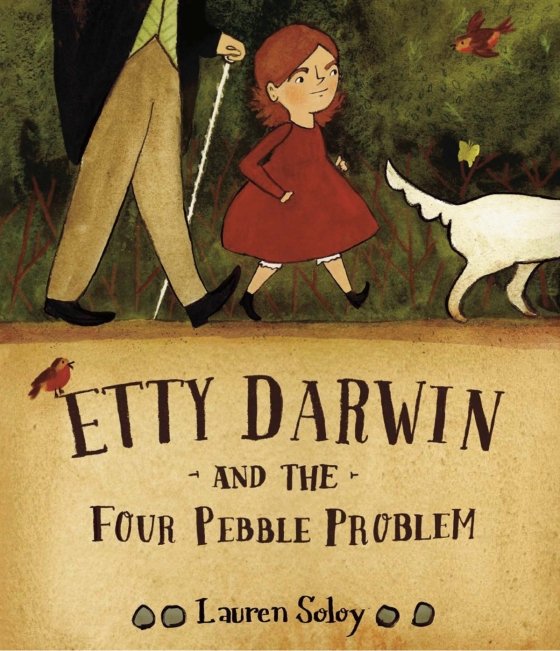
Etta Darwin and the Four Pebble Problem | written and illustrated by Lauren Soloy
This historical-fiction story is based Henrietta (Etty) Darwin and her famous father, Charles. Etty went on to become a valued and keen editor of Charles’s work and a thoughtful and intellectual being in her own right. This imagined conversation between Etty and Charles as they stroll around Charles's real-life “thinking track” explores their close relationship and shows that even science is nothing without an open mind and imagination.
Ideal for:
National STEAM Day November 8
International Day of the Girl December 17
International Day of Women and Girls in Science February 11
International Darwin Day February 12
Pi Day/International Day of Mathematics March 14.
Etta Darwin and the Four Pebble Problem. Text © 2021 Lauren Soloy Illustrations © 2021 Lauren Soloy. Reproduced by permission of Tundra Books, an imprint of Penguin Random House Canada Young Readers, a Penguin Random House Company, Toronto.

This imagined conversation between Etty Darwin and her father Charles is a delightful meditation on how we know what we know, and the limitations of our knowledge.
Charles Darwin is “one of the greatest thinkers in the history of the World” and does some of his best thinking while walking outdoors on the path he has built on his property. Sometimes Etty joins him and asks questions she has been pondering (she is a thinker too). On this occasion, she asks her father: Do you believe in fairies? Charles replies that he has never seen proof that fairies exist. Etty responds eagerly, But you could believe in them anyway, right? She does not like her father’s answer, that he has trouble believing in anything without proof.
As they continue to walk, Etty and her father have a thoughtful conversation about evidence and perception. One question leads to another, including a particularly thought-provoking one from Charles to Etty: Why do you want to believe in fairies? In the end, both father and daughter agree that it is good to keep at open mind.
In a concluding note, author Lauren Soloy explains that when she grew up, Etty Darwin helped her father with his work and even edited some of his writing, but when she was a little girl she used to the backs of his manuscripts as scrap paper, to draw pictures and write fairy stories. This glimpse into the tender and mutually respectful relationship between father and daughter points to an important theme of this charming book: it is possible for people with conflicting worldviews to listen to one another with open minds and treat each other with generosity and love.
Also powerful is the message that even in a worldview based on observation and evidence, there is still room for mystery.
Biblical Themes: family, nature, curiosity, imagination, wonder, awe, openness to mystery
Making Connections:
Go for a walk: Charles and Etty Darwin do their best thinking while they are walking outside. Go for your own walk outdoors. Don’t bring any kind of devices with you, just walk, notice things around you, and let your thoughts roam. See where they go.
Walk a Labyrinth: Find out if there is an outdoor labyrinth near you or create one (perhaps on church property) using stones. Instead of using pebbles to count laps, hold a pebble as you walk and let it remind you of a question you have. It could be a decision you are trying to make, or something you’ve been wondering about. Before you enter the labyrinth, say the question to yourself. As you walk the path, hold it in mind as you hold the pebble in your hand.
Big Questions: Etty Darwin and her father love all kinds of big questions. Make a list of your own biggest questions. Do some of them have answers? How would you find out? Are there some questions that don’t have answers? Why might it be good to ask them anyway?
Write a Psalm: While she walks with her dad, Etty sees some wonderful things: butterflies that look like leaves, wildflowers, the impression left by a hiding fox. Read Psalm 104 or 148, both Psalms that delight in the wonders of the created world. What sorts of things do they mention? Write your own Psalm using details of nature you observe around you.
Seeing and Believing: Etty believes in fairies even though she hasn’t seen one. Her father does not believe in them, because he has never seen evidence of one. These different attitudes show up in people today, and people in the bible too! In a story from the gospel of John (20:24-29), the rest of the disciples see the risen Jesus after Easter, but because Thomas was not there to see doesn’t believe Jesus is alive. When Jesus appears again, Thomas is convinced, but Jesus says to him, “Have you believed because you have seen me? Blessed are those who have not seen and yet have come to believe.” (John 20:29) What do you think about this idea? When is it important to see evidence before you believe something? When might it be important to believe without seeing?
Fairies and Angels: The bible is full of stories of visits from messengers called angels. Throughout history, people have had very different ideas about what angels are and what they might look like. Like the fairies that Etty Darwin enjoys looking for, there is also no scientific evidence for them. Do you believe in angels? If you do, why do you want to believe in them? How do you imagine them? If you were a fairy, where would you want to live? If you were an angel, what message would you bring?