
Fairy Science: Solid, Liquid, Gassy
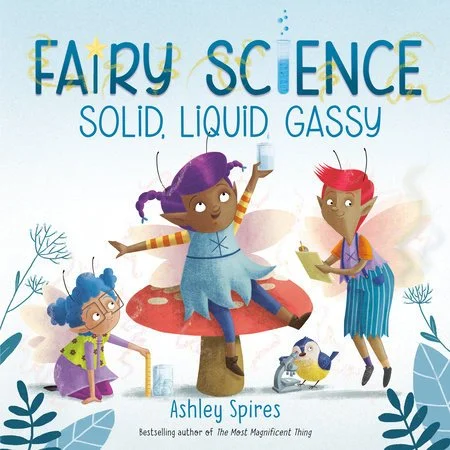
Fairy Science: Solid, Liquid, Gassy | written and illustrated by Ashley Spires
Esther the fairy doesn't believe in magic. But fairies are all about magic, despite Esther's best efforts to reveal the science of their world. This time around, though, she's got her fairy pals Clover and Fig, along with trusty sidekick Albert the bird, to help create a more science-oriented entry for their school’s “Magic Fair”–Pixieville's magical answer to a science fair, which has never gone well for Esther before. When the local pond disappears, Esther realizes this might be the perfect opportunity for a real experiment! It's up to Esther and her fairymates to ask questions, make hypotheses, do research and show their conclusions–this time, all about the water cycle. But when everyone Esther knows believes that Jack Frost is responsible for ice and that moon sneezes cause evaporation, she'll have to learn that sometimes discovery is its own reward.
Ideal for:
National STEAM Day November 8
International Day of the Girl December 17
International Day of Women and Girls in Science February 11.
Solid, Liquid, Gassy. Text © 2020 Ashley Spires Illustrations © 2020 Ashley Spires. Reproduced by permission of Tundra Books, an imprint of Penguin Random House Canada Young Readers, a Penguin Random House Company, Toronto.

Described as a spellbinding introduction to the water cycle, Fairy Science is also a clever and lighthearted approach to the conflict between contrasting worldviews.
Esther is a fairy who does not believe in magic (a big deal for a fairy). She prefers microscopes to wands and experiments to wishes. She and her small group of rational friends use the scientific method to explore and learn about the world around them. This occasionally brings them into conflict with their peers (and teacher), for whom imagination and whimsy are more important than hard facts.
All the fairies are getting ready for the annual magic fair when a problem arises: their pond disappears! The fairies come up with all sorts of creative explanations for what might have happened to it (none of them based on a shred of evidence). Only Esther and her friends try to solve the mystery by observing and gathering facts. Their astonishing conclusion? The pond is in the sky! The unseasonably warm weather has caused it to evaporate and become clouds! When the weather cools, it will fall as rain and become their pond again.
When their prediction turns out to be accurate, some fairies still insist that it was magic that made the pond reappear. The results of the magic fair (both funny and frustrating) also reveal that the majority of the fairies have not been converted to the scientific world view. But Esther and her friends persist in their search for truth through careful observation and experimentation.
While it may seem like a stretch to connect Fairy Science with biblical or theological themes, it does echo the longstanding tension between faith and science in the history of the church. While many Christians have been open to (and contributed to) the scientific search for truth, others have resisted the insights of science when they seem to contradict scripture or its vision of humanity and our place in the cosmos.
For example, as astronomy and geology revealed that our universe is much larger and much older than we had realized, that the Earth is not at the centre of it, and human beings are intimately related to other life forms, some people of faith denied or derided these new ideas. These conflicts continue today, over everything from the validity of climate science to vaccines and the age of the Earth. But do science and faith have to be mutually exclusive? When their claims collide, which should prevail, and why?
Biblical Themes: wonder of the natural world, joy in observing creation, patience, truth
Making Connections:
Scientific Psalm: Astronomer Chet Raymo has written extensively about how learning more about the intricacies of how the universe works has made him more appreciative of its wondrous beauty. In short, science has increased his awe, not diminished it. With this idea in mind, choose some detail you have learned from science (e.g., how birds navigate, how plants are pollinated, how photosynthesis works, the life cycle of stars) and write a psalm expressing your awe and wonder and gratitude for such an amazing world.
Stories of Conflict and Resolution: As part of a group study, or in preparation for a worship service, choose some point of conflict between faith and science in the history of the church (e.g., the claim that the Earth orbits around the sun) and learn more about it. What was at stake in the argument? Who were the people involved in the dispute? How was it resolved? What can we learn from the story?
Rainy Day Experiment: Try creating your own water cycle demonstration using the instructions at the back of the book