
The Fog
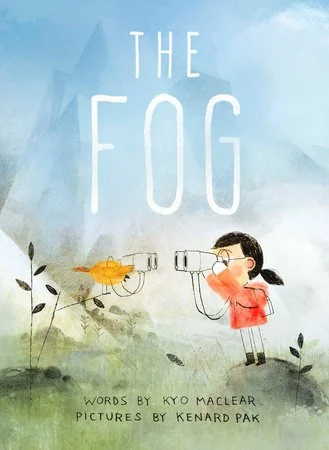
The Fog | by Kyo Maclear | illustrated by Kenard Pak
A clever and whimsical environmental fable about a bird who is a human-watcher from a dynamic author-illustrator duo.
Warble is a small yellow warbler who lives on the beautiful island of Icyland, where he pursues his hobby of human watching. But on a warm day, a deep fog rolls in and obscures his view. The rest of the birds don't seem to notice the fog or the other changes Warble observes on the island. The more the fog is ignored, the more it spreads. When a Red-hooded Spectacled Female (Juvenile) appears, Warble discovers that he's not the only one who notices the fog. Will they be able to find others who can see it too? And is the fog here to stay? Kyo Maclear's witty story, brought to life with the delicate, misty artwork of Kenard Pak, is a poignant yet humorous reminder of the importance of environmental awareness.
Ideal for:
Take Me Outside Day October 20
Earth Month and Earth Day April 22
Canadian Environment Week June
World Environment Day June 5.
The Fog. Text © 2017 Kyo Maclear Illustrations © 2017 Kenard Pak. Reproduced by permission of Tundra Books, an imprint of Penguin Random House Canada Young Readers, a Penguin Random House Company, Toronto.
This story begins on the far north, on a wild sea, on an island covered with ice. People come from around the world to visit and are more or less ignored by the local wildlife, except for one little yellow warbler who observes these visitors and classifies them the way humans usually do birds. This hobby of people-watching keeps the warbler content, until one day a strange warm fog rolls in from the sea and covers the island.
No one else seems concerned about it—or even notices it. But warbler is more attentive than most. He tries on his own to lift the fog but can’t do it. Then he invites his neighbours over to discuss the situation, but they minimize, deny, or ignore the problem, or argue that the change is natural, and everyone must simply accept it.
Eventually, even the warbler begins to wonder if his memory is faulty and things had ever really been as different as he thinks. Then he meets a rare specimen: a red-hooded spectacled female (juvenile) who can also see the fog! Together, they find a way to send message out to ask whether there are others out there who can see it too. Replies come from all around the world. With each message of support, and a growing intention to fix the problem, the fog lifts a little and it becomes easier for everyone to notice what they have been missing all along.
At once humorous and sobering, this fable about climate crisis cleverly decenters human beings and allows us to see our own attitudes and behaviour mirrored in the responses of animals to the strange fog. And in a powerful statement about our interdependence with other living things, animals and girl cooperate to find a solution to the problem.
There is lots of potential to connect this book with biblical themes of care for creation, and the modern epidemic of eco-anxiety. Science has clearly shown us the harm that human consumption (especially the use of fossil fuels) has inflicted on our environment. Like the animals in the story, some see this and lament, but others ignore or dismiss the warnings. Children and young people are particularly vulnerable to grief over climate change, because they are the ones who will pay the highest price for it. Responses to The Fog could include naming and expressing this sadness, while also looking for signs of hope, particularly in shared action.
Biblical Themes: creation care, stewardship of environment, place of humanity in the natural world, humility
Making Connections:
And it was good: Read aloud the first account of creation in Genesis 1. What do you notice about it? What phrases or images stand out? In the past, these verses have sometimes been used to defend the idea that humans are the pinnacle of creation (the most important) and that the natural world is here for us to use and consume. What problems has this interpretation created? Is it the only way to read this story? What other messages do you hear in it?
Creation stories: Collect creation stories from other cultures and compare them to the creation account in Genesis 1. What does each story say about human beings and our place in the natural world? What do we learn from each one? For an interesting contrast to Genesis 1 in the bible, read Job 38-39. Where are human beings in this passage?
Lament: Write or draw something that expresses your sadness about something in nature that has changed or been lost as a result of human behaviour. For example, light pollution makes it hard to see the stars; rising temperatures mean the loss of glaciers and damage to coastal communities; maybe you miss snow at Christmas or the lake you once skated on no longer freezes hard enough to be safe.
Crowd-Source Hope: Find and share hopeful stories of climate action. Check out the work of Elin Kelsey, a leader in solutions-focused climate justice: https://elinkelsey.org
Dig in the dirt: Plant vegetables or help create a community garden as an act of hope. The Rev. Konnie Vissers is a Canadian Presbyterian minister who founded Rooted: Centre for Theology and Eco-justice as a theological response to eco-anxiety in children and young people. She uses gardening as a form of environmental education and a means of combatting hopelessness. Learn more at: https://rootedcentre.ca
Classify yourself! The little warbler in the story gives funny names to the humans he observes. In her biography on the book jacket, author Kyo Maclear imitates this practice and introduces herself as “a Blue-Hooded Word Gatherer whose sweet-whistled song has been known to attract and repel her offspring. In spring and summer, this chocolate-loving female can be found flitting about city parks and waterways. In the colder months, she is best spotted in bookshops, libraries, and cafes. Common activities include restless foraging and picture-book making. Originally a migratory species, Kyo enjoys her current nesting ground of Toronto.” Using this as an example, how would you describe yourself? Write a description and draw a cartoon to go with it!