
A Sky-Blue Bench
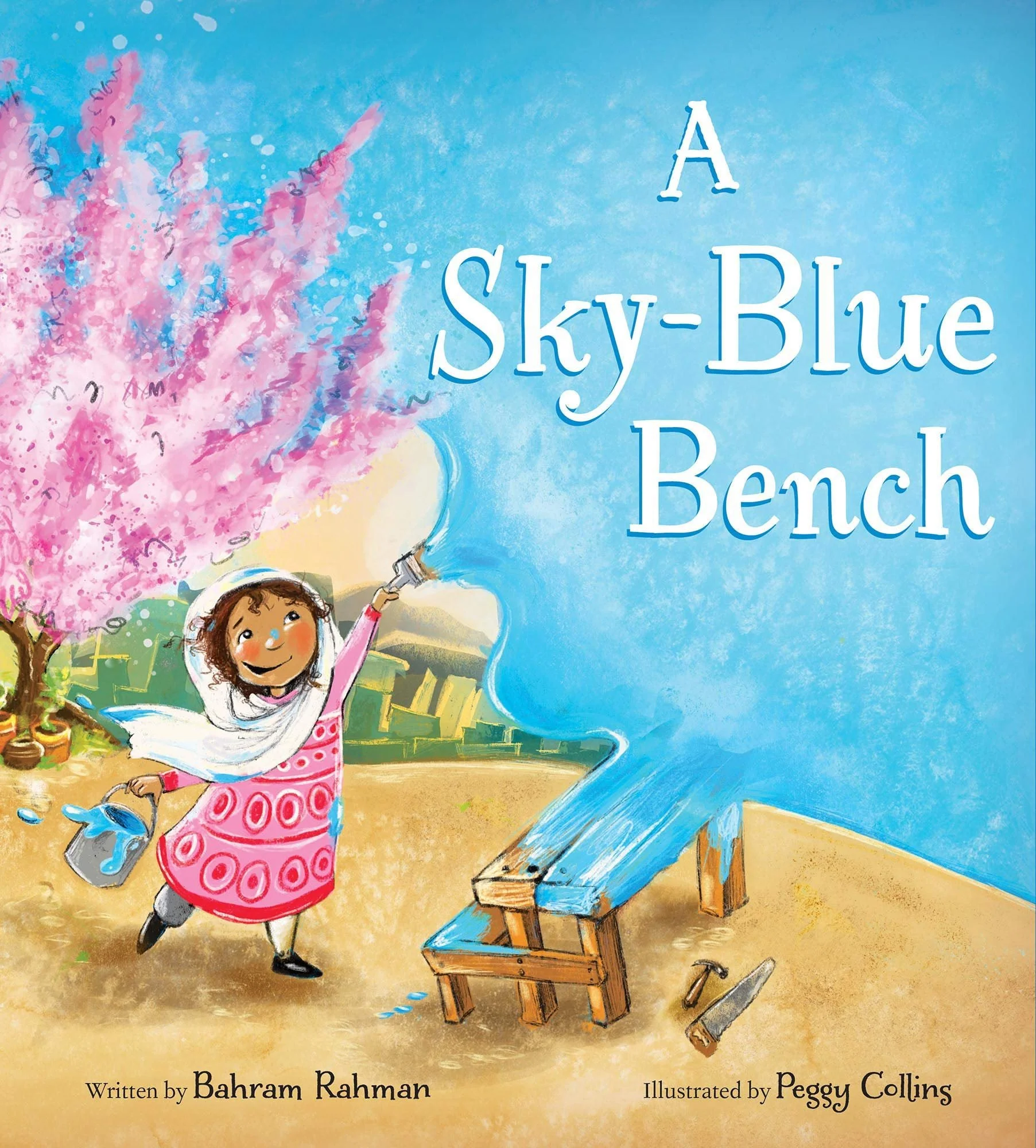
A Sky-Blue Bench | by Bahram Rahman | illustrated by Peggy Collins
It's Afghan schoolgirl Aria's first day back at school since her accident. She's excited, but she's also worried about sitting on the hard floor all day with her new prothetic "helper-leg". Just as Aria feared, sitting on the floor is so uncomfortable that she can’t think about learning at all. She knows that before the war changed many things in Afghanistan, schools like hers had benches for students to sit at. If she had a bench, her leg would not hurt so much. The answer is obvious: she will gather materials, talk to Kaka Najar, the carpenter in the old city, and learn to build a bench for herself.
In A Sky-Blue Bench, Bahram Rahman of The School Bus, returns again to the setting of his homeland, Afghanistan, to reveal the resilience and resolve of young children—especially young girls—who face barriers to education. Illustrator Peggy Collins imbues Aria with an infectious spunkiness and grit that make her relatable even to readers with a very different school experience. An author’s note gently introduces an age-appropriate discussion of landmines and their impact on the lives of children in many nations, especially Afghanistan, which has the highest concentration of landmines of any country in the world.
Ideal for:
International Day of Peace Sept. 21
Human Rights Day Dec.10
International Day of Education Jan. 24
International Women's Day and United Nations Day for Women's Rights and International Peace March 8
World Refugee Day June 20
Canadian Multiculturalism Day June 27.
Sky-Blue Bench. Text © 2021 Baharam Rahman Illustrations © 2021 Peggy Collins. Reproduced by permission of Pajama Press, Toronto.

Going back to school after you’ve been away is hard, especially when you’ve been in hospital, your school has no seats, and your new “helper leg” makes sitting on the hard floor awkward and uncomfortable. At the end of her first day, Aria cries and tells her mother she doesn’t want to go back. “I know it hurts,” acknowledges her mother, “But I also know that you can get through this—my tough little girl.”
Older readers will grasp the fuller story: Aria has lost her leg to a land-mine. But this is not made explicit in the story so younger readers need only know that Aria is trying to adjust to a big change and is having trouble. Knowing how important education is, Aria is determined to find a solution to her problem. Her ideas seems simple, but her classmates see all sorts of difficulties with it. “Girls don’t build benches,” they object, but Aria will not be deterred. A bigger problem is finding supplies to build one. With the help of a friend, she scavenges building supplies, then goes to see Kaka Najar, the carpenter in the old city. Kaka Najar gives Aria tools, advice, and a can of sky-blue paint because it is the colour of courage, peace, and wisdom.
Aria’s bench is a great success, both as a place for her to sit, and as a source of inspiration to the girls in her class, who decide that their classroom also needs another table and bookshelf!
A Sky-Blue Bench is a wonderful example of how a well-told story can be both a window and a mirror. Most of the children reading this book will likely never have experienced the kinds of traumatic events Aria has, but they may have been sick or injured and had to take time to heal. Or perhaps they have had to miss school for some other reason and will connect to how hard it is to fit back into a once familiar place. Aria’s distress and discouragement are relatable, even if the events that led to them are not. Likewise, her life in Afghanistan as portrayed in the cheerful and energetic illustrations, is both unfamiliar (e.g. the school without furniture) and familiar (e.g. household chores, kids playing).
Feisty, independent, and brave, yet wise enough to ask for help when she needs it, Aria shows us the courage it takes to rebuild a life after loss. But she is not the only one who has to build (or rebuild) something. Her whole country has been broken apart by war. Imagine going to school in a classroom with no furniture! The final line in the book, “We can build everything we need, together,” speaks for people everywhere who have endured terrible things but still have hope for a better future.
If you wanted to include this book in worship, you could tell the story of the destruction of Jerusalem and its temple, and the subsequent decades of exile, followed by return and rebuilding. Of course, the temple that was rebuilt was not as grand as the first. The book of Ezra even describes old people weeping when they saw its foundations because they remembered the original (Ezra 3:12). It would also be important not to import biblical theology about the exile as punishment for sin into the story of Aria and her people. But the destruction and rebuilding of the temple is a powerful symbol of resilience and hope.
Biblical and Theological Themes: Courage, persistence, kindness, community, healing, rebuilding, hope
Making Connections:
Repair Café: Are there members of your congregation who are skilled at fixing things? Construction work? Electronics? Small appliances? Are there people who sew and mend? Darn holes in knitted clothing? Organize a community event where people can bring what’s broken and get help fixing it. Not only does an event like this build community and solve small problems, it also gives broken or damaged items a new lease on life and keeps them out of landfill.
Fix-it School: A variation on the repair café is to have a multiage event where people with practical skills (like mending, for example) teach others how to do it. For example, teens could teach computer skills to older people; knitters could teach basic stitches to anyone who wanted to learn.
Grab your hammer: Habitat for Humanity is an organization that builds homes (including Tiny Homes) for people who need them. Learn more about their work at https://habitat.ca. Perhaps some members of your congregation or community could volunteer for a build.
Windows and Mirrors: It is often said that stories can be both windows that let us look through and see the lives of people different from ourselves, and mirrors that let us see ourselves reflected. What about Aria’s story is a mirror for you? Where do you see yourself in her story? What things do you relate to? What about her life is similar to yours? How is her story a window? What do you notice about Aria and her life that is very different from your own? What did you learn from her story? What questions do you have about Aria and her life?
Problem Solving: What problem is Aria trying to solve in this story? What is her solution to the problem? Can you think of any other ways she could have solved the problem? In his note at the back of the book, author Bahram Rahman writes, “Although Aria has limited resources, she—like many other children in Afghanistan—confronts life as it is and solves her problems with creativity and hard work. She won’t give up until life is better for her and the people around her.” Do you have a problem you need to solve? Can you brainstorm some different ways to solve it? What would you need? Who could you ask for help?
Sky blue stones: Paint river rocks with sky blue paint and decorate them with designs in other colours, then spray them with a sealant. Let them remind you of the courage, peace, and wisdom we need to solve our problems