
Outside, You Notice
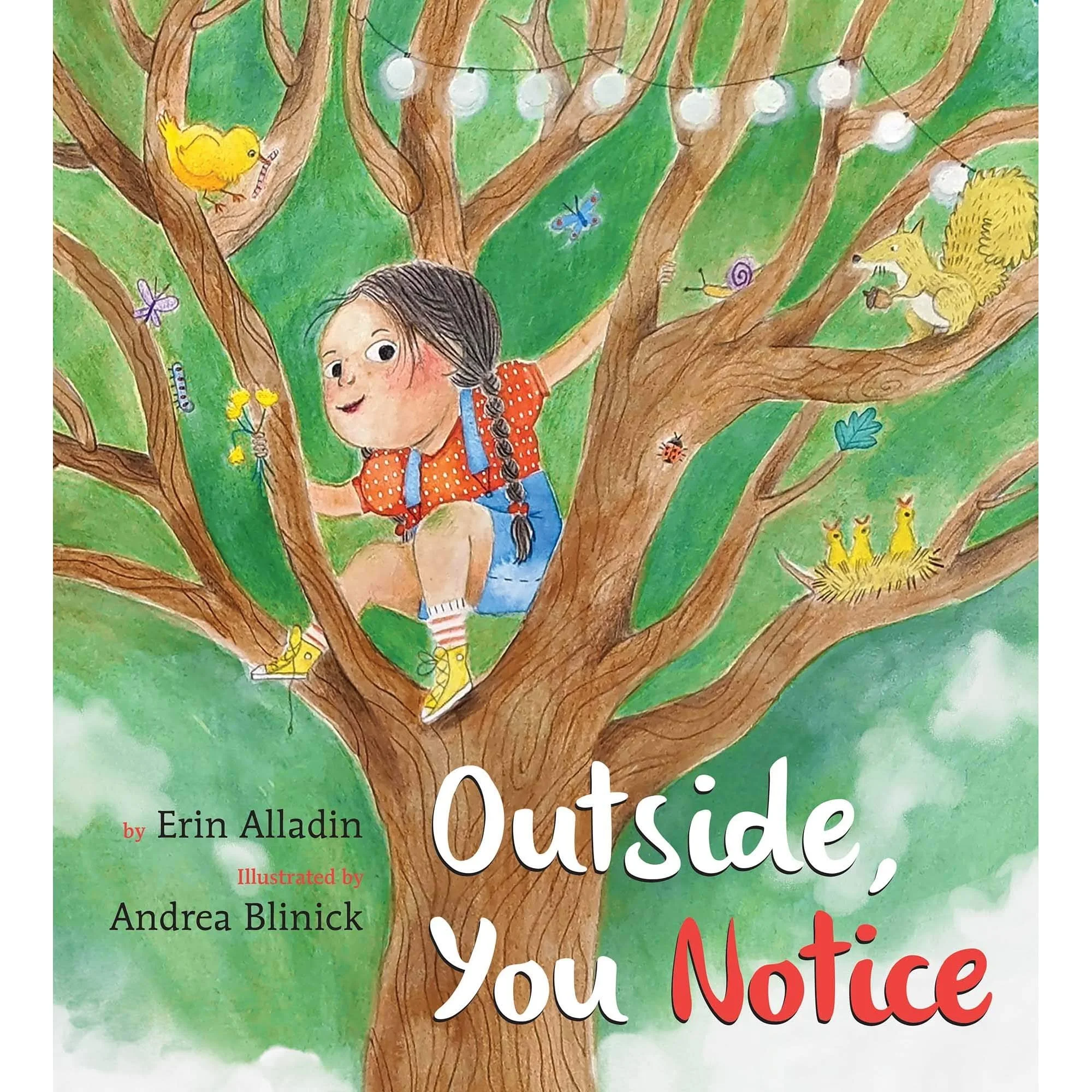
Outside, You Notice | by Erin Alladin | illustrated by Andrea Blinick
Time spent in the outdoors stirs a child’s imagination.
Nature sparks wonder, wonder leads to curiosity, and curiosity brings about a greater knowledge of the world and one’s self. In Outside, You Notice, a meditative thread of child-like observations (How after the rain / Everything smells greener) is paired with facts about the habits and habitats of animals, insects, birds, and plants (A tree’s roots reach as wide as its branches)!
Ideal for:
Take Me Outside Day October 20
Earth Month and Earth Day April 22
Canadian Environment Week June
World Environment Day June 5.
Outside You Notice. Text © 2021 Erin Alladin Illustrations © 2021 Andrea Blinick Collins. Reproduced by permission of Pajama Press, Toronto.
Not surprisingly, this book begins with a child outside, stretched out in the grass beneath a tree, smelling a flower, while around her birds flit and a squirrel frolics. The text speaks directly to the reader, commenting how outside, you notice things, like how after the rain, everything smells greener, how digging in the earth “makes you feel more proud than dirty,” and “that seeds cupped in your hands feel like the tiniest and most important things in the world.” The poetic text brims with questions, some of which are answered in little fact-filled text boxes, which convey fascinating details about the natural world without being weighed down by them. Young readers learn things like why some leaves are shaped like funnels and most others are flat, why rain smells so fresh, why soil is different colours, and why flowers have fragrance.
Combined with illustrations that are whimsical and humorous, the text manages to inform without losing its sense of delight and wonder. Best of all, the story centres the child and her experience, but places her within a wider world, honouring her as a precious individual while locating her within a grand and intricate whole. It is difficult to find an exactly biblical parallel to this, because texts like Psalm 8, which portray human beings as simultaneously small yet precious, do so by seeing them as over and above the natural world. It might be interesting to read Psalm 8 and Outside, You Notice together and ask questions like: Do these texts make you feel small, or big? Do they make you feel important, or unimportant? Do they make you feel like you belong to the Earth, or have control over other creatures? Is it possible to feel big and small at the same time? Is it possible to be different from other living things in some ways, but the same in others? If humans always think we are the most important, what does that do to our planet, and other living things?
Outside, You Notice is a gentle and appealing invitation to go outdoors, dig in the dirt, get to know the trees and flowers up close, pay attention, be still—and bloom.
Biblical and Theological Themes: attentiveness, gratitude, mindfulness, care for creation, wonder, awe, joy, questions, curiosity, growth from small things, parables of the Kingdom, stillness, peace in nature, patience
Making Connections:
Go outside. Find a park, a field, a beach, a forest, a playground with green space, and spend some time playing, resting, walking, or just being. As long as you’re dressed for the weather, you can go out rain or shine.
Senses Scan: Find a quiet and comfortable spot outside to sit, either alone, or with a small group and a leader guiding the meditation. Focusing on one sense at a time, try to pay very close attention to what is around you. For example, if you start with sight, look careful at what is in your field of vision, both near and farther away. What colours do you see? What shapes? Get close to the ground and see what you notice. Then move on to other senses. Right where you are, what sounds do you hear? What can you smell? What textures and temperatures do you feel with different parts of your body? You might want to skip taste, unless you are with someone who knows a lot about wild plants!
Forage! If there is a place near you that offers guided experiences in foraging, this could be a fun group or family outing. Let experts lead you into the woods to look for edible fungi, plants, and berries. Be sure to do this only with a qualified guide.
Rain Walk: Go for a walk in a grassy area or a place with trees after it rains and notice the smell. Does the world smell greener to you? Notice the different shapes of leaves and how the rain moves over them or collects in them.
Cloud Breathing: On a day when the sky is blue and there are puffy clouds and a bit of a breeze, go outside and lie on your back. Breathe slowly in and out and imagine that every exhale is making the clouds move. Do this for a while, then notice how being still and breathing deeply makes you feel.
Fly a kite! (just keep away from overhead wires)
Plant Fruits and Veggies: If your church has room for a garden, maybe a group can get permission to dig up some land to plant a community garden. This could be a great outdoor education project for all ages (for inspiration see: rootedcentre.ca). If a congregational or community garden feels like too much to start with, begin with growing some herbs and tomatoes in pots and share them with your neighbours.
Everything is Compost! If your church doesn’t already have a compost pile, look into starting one, using food scraps, coffee grounds, etc.
Growing, Dying, and Rising: Jesus talked about seeds a lot, probably because it is so amazing how so much can grow from something so tiny! A seed is mysterious because although it seems small and dead, life grows from it. Outside, You Notice talks about how seeds cupped in your hand “feel like the tiniest and most important things in the world.” Read the Parable of the Mustard Seed in Matthew 13:31-32, Mark 4:30-32, and Luke 13:18-19. Why do you think Jesus uses a seed to help people understand the Kingdom of God? When he was trying to help his friends understand the purpose of his death, Jesus used the image of a seed dropped into soil. He said unless the seed falls into the ground and dies (breaks open and becomes something different), it remains a seed and nothing grows from it (John 12:24). But if it dies and is changed, something amazing happens. What do you think Jesus was trying to say about his death? Do seeds teach us anything about death in general?
Market trip: Visit a local farmers market and see if you can find varieties of fruits and vegetables that you don’t see in the grocery store. Ask the grower about them. Where do the seeds come from? If you can buy something you have never eaten before, give it a try and see how it tastes!
Sunflowers: Plant sunflowers and in the fall you can harvest the seeds and use them for next year or leave them for the birds