The Library Bus
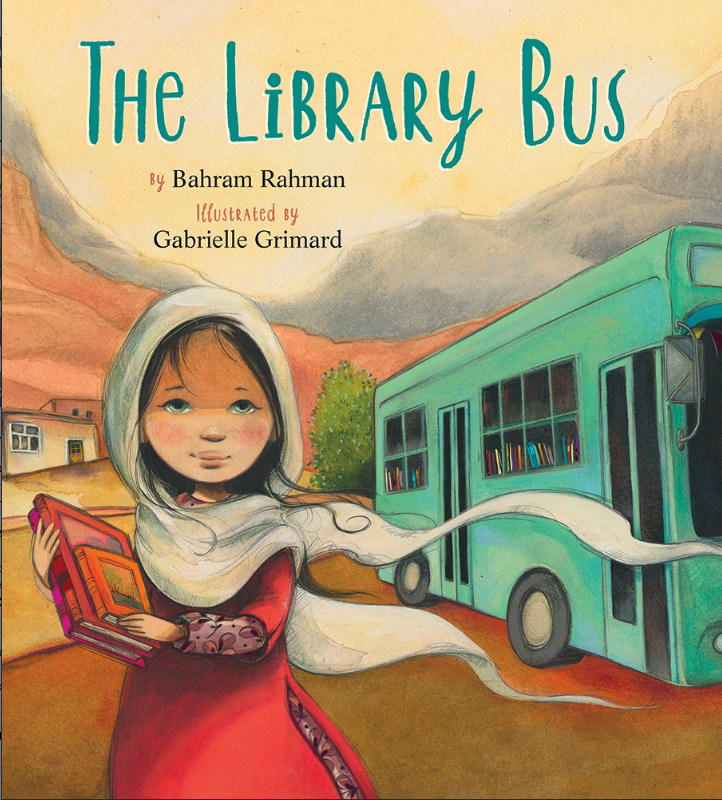
The Library Bus | by Bahram Rahman | illustrated by Gabrielle Grimard
Inspired by Kabul, Afghanistan’s first library bus and coloured by family memories, a touching snapshot of one innovative way girls received education in a country disrupted by war. It is still dark in Kabul, Afghanistan when the library bus rumbles out of the city. There are no bus seats—instead there are chairs and tables and shelves of books. And there are no passengers—instead there is Pari, who is nervously starting her first day as Mama’s library helper. Pari stands tall to hand out notebooks and pencils at the villages and the refugee camp, but she feels intimidated. The girls they visit are learning to write English from Mama. Pari can’t even read or write in Farsi yet. But next year she will go to school and learn all there is to know. And she is so lucky. Not long ago, Mama tells her, girls were not allowed to read at all.
Ideal for:
International Day of Peace Sept. 21
Human Rights Day Dec. 10
International Day of Education Jan. 24
International Women's Day and United Nations Day for Women's Rights and International Peace March 8
World Refugee Day June 20
Canadian Multiculturalism Day June 27.
The Library Bus. Text © 2020 Bahram Rahman. Illustrations © 2021 Gabrielle Grimard. Reproduced by permission of Pajama Press, Toronto.
Pari’s mother drives the only library bus in all of Kabul, and Pari is her helper. Together, they travel the mountain roads to bring books to children (especially girls) in Afghan villages outside the city. Pari’s mother also teaches the girls English, a language her father taught her in secret when she was a little girl. She tells Pari she must study hard and keep learning, because “then you will be free.”
The connection between learning and freedom becomes especially poignant in the refugee camp where girls crowd around the bus, clamoring for new books and school supplies. Pari, who will be going to school in the city next year, watches how eager the girls are to learn, and how calm and gracious her mother is as she sings the alphabet, doing her best under difficult circumstances to help the girls as her father once helped her.
Author Bahram Rahman, who grew up in Afghanistan under the Taliban, explains that he wrote this story to tell of the strength of children, especially girls, in his war-torn country, and to celebrate the creativity, resourcefulness, and bravery of female teachers who make it possible for girls to continue their education in spite of many obstacles.
Biblical and Theological Themes: community, supporting others, endurance through suffering, courage, hope
Making Connections:
Book Buses Around the World: Learn more about book buses around the world and how the change the lives of children and their communities: https://www.theguardian.com/cities/2019/nov/05/moving-stories-inside-the-book-buses-changing-childrens-lives
Pack Horse Library Project: The Pack Horse Library Project was an effort to improve literacy rates in rural Appalachia during the Great Depression. From 1935 to 1943, librarians (mostly women) on horseback carried thousands upon thousands of books to people in the remotest areas of the mountains. Learn more about this project and the brave women who carried it out online.
Read-a-Thon: Organize a congregational read-a-thon. You could make it an evening event with snacks and hot chocolate, and story circles for those who cannot yet read. A traditional read-a-thon usually involves participants getting people to sponsor them for number of books (or pages) read, but you could also just ask people who come to the event to donate what they can. All money raised could be donated to a library bus project somewhere in the world.
Learn your ABCs: Pari speaks Farsi, though she has not yet learned to read and write. But from listening to her mother teach the English alphabet, she knows many of the letters and their sounds. If there is a Farsi speaker in your community, see if they will teach the alphabet to anyone who wants to learn. Invite other members of your community who read and write in different language systems to teach their own alphabets—or at least a few letters. Have a poster-making session where people of all ages can copy phrases (for example, We love libraries or Books for all) in different languages.
Sweet Words: In the book of Psalms, the writer exclaims, “How sweet are your words to my taste, sweeter than honey to my mouth!” (Psalm 119-103; see also Jeremiah 15:16 and Ezekiel 3:1-3) There is something lovely about the idea of savouring God’s words the way you would a sweet treat. Lectio Divina is an ancient way of reading short passages (often from the bible) slowly and thoughtfully, savouring and absorbing them. Try introducing lectio divina in worship or in small groups and finish with book-shaped cookies. Here is an article on teaching lectio to children: https://www.christiancentury.org/blogs/archive/2015-10/how-pray-lectio-divina-kids
Poetry Night: Other kinds of words can be savoured too, especially poetry. Set up a display of poetry books for all ages. Or host an open-mic coffee (or hot-chocolate) house and invite people of all ages to read a favourite or original poem.