
My Beautiful Birds
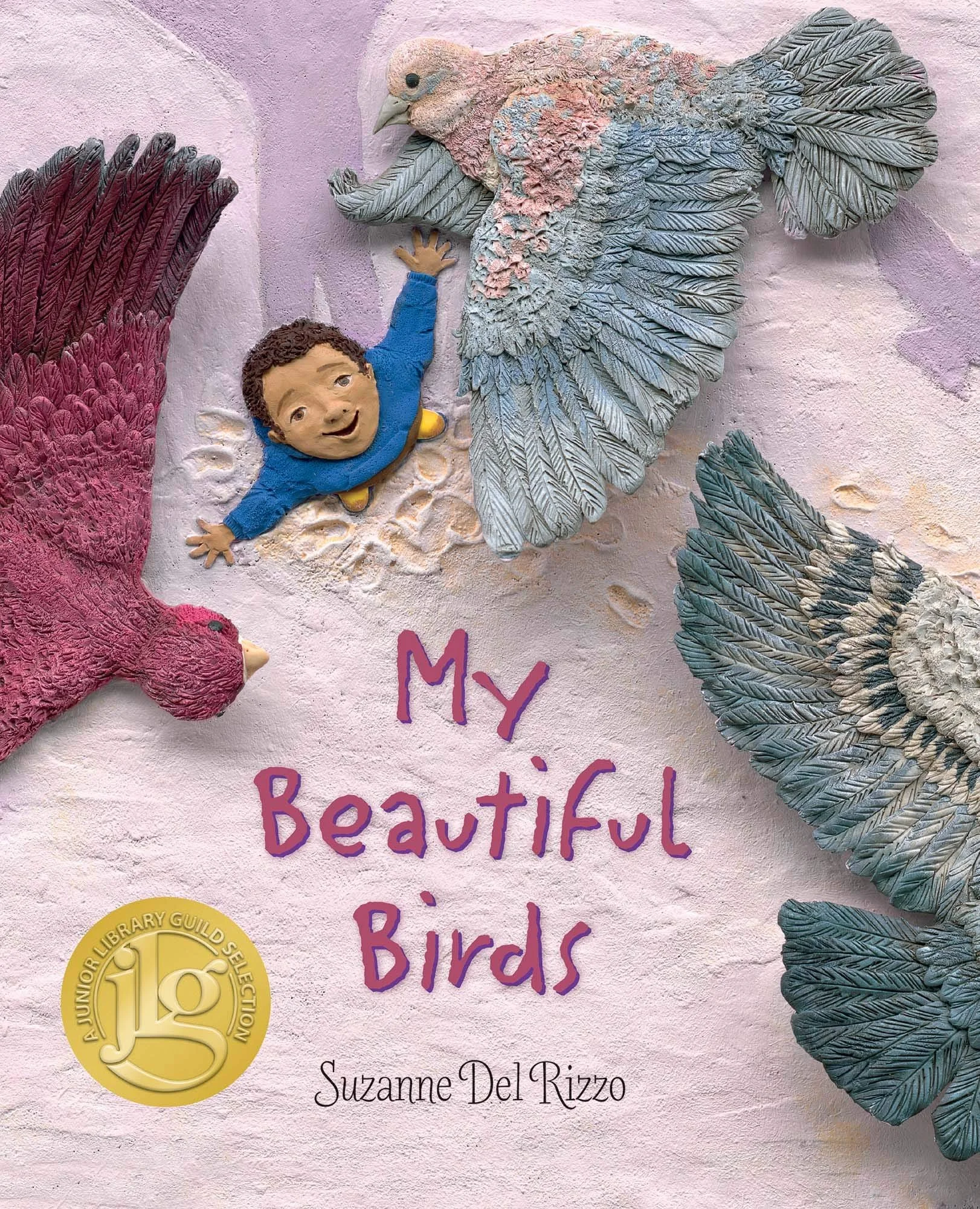
My Beautiful Birds | by Suzanne Del Rizzo
A moving story about one boy’s refugee experience in the Syrian Civil War and the birds who help him on the road to emotional healing. Behind Sami, the Syrian skyline is full of smoke. The boy follows his family and all his neighbours in a long line, as they trudge through the sands and hills to escape the bombs that have destroyed their homes. But all Sami can think of is his pet pigeons—will they escape too? When they reach a refugee camp and are safe at last, everyone settles into the tent city. But though the children start to play and go to school again, Sami can’t join in. When he is given paper and paint, all he can do is smear his painting with black. He can’t forget his birds and what his family has left behind. One day a canary, a dove, and a rose finch fly into the camp. They flutter around Sami and settle on his outstretched arms. For Sami it is one step in a long healing process at last.
Ideal for:
International Day of Peace Sept. 21
Human Rights Day Dec. 10
International Migrants Day December 18
International Day of Education Jan. 24
International Women's Day and United Nations Day for Women's Rights and International Peace March 8
World Refugee Day June 20
Canadian Multiculturalism Day June 27.
My Beautiful Birds. Text © 2017 Suzanne Del Rizzo Illustrations © 2017 Suzanne Del Rizzo. Reproduced by permission of Pajama Press, Toronto.
Sami holds tight to his father’s hand as they climb the hill. Behind them in the distance, a city burns and the Syrian sky is full of smoke. What about his pigeons—his beautiful birds? Are they alive? His father reassures Sami that his birds have escaped too.
In a sea of tents and temporary shelters at the refugee camp, Sami wonders: What will we do? How long will we be here? As people plant small gardens, open shops, and set up schools, it begins to feel like here will last forever. As his hope fades, Sami takes no pleasure in the things he used to love, like playing soccer and doing math. When he tries to paint a picture of his beautiful birds, everything on the page turns to black smoke.
But one day he is visited by birds—not his birds, but others who need a gentle hand and a safe home. In them Sami finds both pleasure and purpose. He feeds them and collects materials for their nests, while they help him in turn with their sounds and nibbles and nuzzles. Slowly, Sami begins to feel like himself again.
The story ends without resolution. Sami and his family are still waiting in the camp. We never find out what happened to his beautiful birds. The conflict rages on and new families continually trick in, fleeing violence, their grief raw. But Sami has healed enough so that when he recognizes the pain of another child, he is able to go to her, bird in hand, and tell her his name. The last page shows them painting a mural together.
This gently told story of war and displacement, beautifully illustrated in polymer clay and acrylic, succeeds by focusing tightly on the experience of one child and the specific thing he misses most: his beautiful birds. A final note from author-illustrator Suzanne Del Rizzo expands the view of the conflict and talks about the plight of refugees around the world, but the story itself relies on particularity for its impact. Sami’s relationship to animals, the way he expresses himself through art, and some of the activities he does (playing soccer, flying kites) make him a relatable character, even for children who have never come close to the terrors and losses of war.
Biblical and Theological Themes: war and conflict, peace, exile, homelessness, grief and lament, the experience of being a refugee, relationship with the natural world, kindness, safety, refuge, shelter, freedom, hope, peace, promise, compassion, welcome, hospitality
Making Connections:
Jesus was a Refugee: It may be helpful to people of all ages to realize that throughout history innocent people have been displaced because of war, violence, famine, disease, and other situations beyond their control. The bible is full of refugees like Sami and his family—people forced to leave their homes and seek safety and refuge elsewhere. Think of the sons of Jacob, who travel on foot all the way to Egypt looking for food when famine strikes their homeland of Canaan. In the book of Ruth, famine forces Naomi and her husband Elimelech and their sons to leave Bethlehem and go to the foreign country of Moab. Later, when both her sons and husband have died, Naomi and her daughter-in-law Ruth travel back to Bethlehem because they have no one to provide for them. The Hebrews who flee from slavery in Egypt are refugees; so are the exiles in Babylon, though they are forcibly transplanted. Jesus, Mary, and Joseph also became refugees in Egypt when the jealous and deadly rage of King Herod made it too dangerous for them to remain in their own home. Look at some of these stories and pay attention to the different reasons why people leave their homes. What are some of the reasons people become refugees today? For more information about the plight of refugees, please see the United Nations Human Rights Council (unhcr.org). For more information and resources about the Syrian conflict, visit: https://pajamapress.ca/syrian_conflict_resources
What Would I Bring? Look carefully at the first spread in the book. When Sami leaves home he carries a small purple bag. What do you imagine he has in it? Notice what the people around him are carrying. Each person has chosen to bring something important, though Sami could not bring his birds. Display a small suitcase or backpack—small enough for a child to carry. Ask everyone to imagine what they would bring with them if they had to leave home and could only keep what could fit in the bag. Write or draw pictures of the contents. Then talk about the choices. How did you decide what to keep and what to leave behind? Were there things you wanted to bring but could not carry or use?
Birds of Promise: Look back through the book and notice every place birds appear. What do they mean to Sami? When a canary, a dove, a rose finch, and a pigeon fly over the camp, the story says, “they paint the sky with promise and the hope of peace.” Does this remind you of any stories in the bible? In Genesis 8:10-12, after the torrential rain has stopped, Noah sends out a dove from the ark. When it comes back with an olive branch in its beak, Noah knows that the flood waters have begun to go down. The next time he sends the dove, it does not return, and Noah knows it has found a new home. For Noah, the dove is a sign of hope and new life after a time of great destruction and loss. Look up “origami doves” online and find a simple pattern for folding paper doves (or another bird). Write or draw prayers for peace and hope on squares of paper and fold them into doves. Maybe the doves could be collected and hung in the sanctuary of your church as a symbol of hope and peace.
Not My Birds: Sami offers a safe place and shelter to other birds, even though they are not his own. “These are not my birds,” he thinks, “…but it doesn’t matter.” Why doesn’t it matter to Sami? Why does he help the unfamiliar birds? What happens as a result? What might this part of the story have to say to us about offering shelter and showing kindness to people who come from faraway places? Does it matter where they come from?
Plasticine Art: Susan Del Rizzo uses polymer clay to create the three-dimensional art in this book. Barbara Reid is another well-known Canadian artist who uses a similar technique to illustrate books in plasticine. Using squares of illustration board, stiff cardboard, wood, or plastic (like an empty CD case) as background, create your own pictures with plasticine. You could take inspiration from the story or make up your own scene that speaks of hope and peace.