
My Name is Blessing
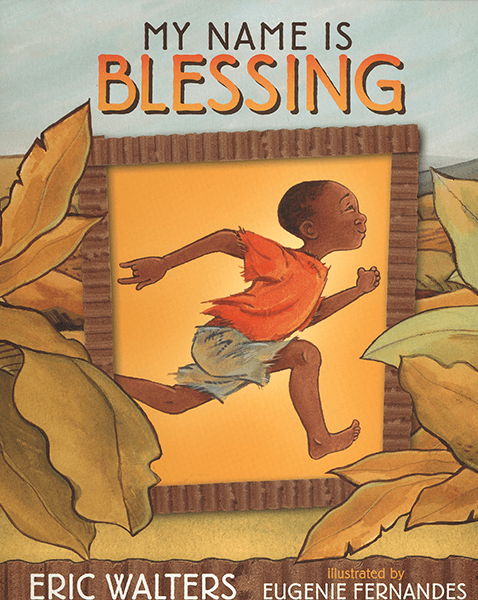
My Name is Blessing | by Eric Walters | illustrated by Eugenie Fernandes
Based on the life of a real boy, this warm-hearted, beautifully illustrated book tells the story of Baraka, a young Kenyan boy with a physical disability. Baraka and eight cousins live with their grandmother. She gives them boundless love, but there is never enough money or food, and life is hard --love doesn't feed hungry stomachs or clothe growing bodies, or school keen minds. Baraka is too young, and, with his disability, needs too much, and she is too old. A difficult choice must be made, and grandmother and grandchild set off on a journey to see if there is a place at the orphanage for Baraka. The story begins by looking at Baraka's physical disability as a misfortune, but ends by looking beyond the disability, to his great heart and spirit, and the blessings he brings.
Ideal for:
International Day for the Eradication of Poverty October 17
Global Accessibility Awareness Day May 19
International Day of Persons with Disabilities December 3
My Name is Blessing. Text © 2014 Eric Walters Illustrations © 2014 Eugenie Fernandes. Reproduced by permission of Tundra Books, an imprint of Penguin Random House Canada Young Readers, a Penguin Random House Company, Toronto.
Muthini, whose name means suffering, is no stranger to hardship. Born with no fingers on his left hand and only two on his right, he was left by his mother to be raised by his grandmother, Nyanya, even though she lives in poverty and is also trying to provide for eight other grandchildren. The one thing the family has in abundance is love.
Now and then, Muthini asks his grandmother why me? Why do I only have four fingers? Nyanya says, “we are each given more of some things and less of others.” In a beautiful moment of affirmation, she tells her grandson that his heart is unusual large; his brain is big, so he can think more clearly than most; and he has a great spirit. Gently and firmly, Nyanya builds Muthini’s confidence, and urges him to use his spirit well and not fight back in anger, even when people are unkind to him.
One day Nyanya looks sad when she comes to pick Muthini up from school. She has made a difficult decision—one which she does not want to make. She has grown too old and tired to look after Muthini and must send him away to a boarding school. Gabriel, the man who receives them at the school, shocks both Nyanya and Muthini when he declares there is “no room for Muthini” in his school and never will be. But then he adds, “there is always room for a blessing.” Gabriel takes away the name Suffering and gives Muthini a new name and a new identity: Baraka which means blessing.
While modern readers may balk at the thought of a teacher changing a child’s name without permission, it is important to keep in mind what motivates Gabriel. As he explains to Baraka, by changing his name he hopes to change how people perceive him. This in turn will change his future. It is clear to Gabriel and Nyanya can see that this precious little boy is neither a burden nor defined by suffering. When other hear his name, they should see him for what he truly is: a blessing.
Biblical and Theological Themes: family, love, acceptance, the significance of names, welcome, generosity, belonging, disability, suffering, blessing and what it means to be both blessed and a blessing to others (beatitudes)
Making Connections:
What’s In a Name? There are many examples in the bible of people being given names because of their meaning. There are also examples of names being changed: Abram and Sarai become Abraham and Sarah; Jacob becomes Israel; Saul becomes Paul; Naomi asks her friends to start calling her Mara (bitter) because of the terrible losses she has suffered. In table groups, talk about some of these questions: Does your name have a meaning? What does it mean? Do you know who gave you your name and why it was chosen? What are some reasons why people change their names? Have you ever changed (or wanted to change) your name? If you be called anything, what name would you choose?
Who is Blessed? Many people use the word blessing to refer to good things or fortunate events. When things are going well in their lives they say they are blessed. But what does this mean when things are not going well? In his longest and best-known sermon, Jesus says some strange and startling things about blessing. In the beatitudes (Matthew 5:1-12) he describes certain people as blessed or happy—but not the ones we might expect! Blessed are the poor in spirit (or simply poor), says Jesus, those who mourn, the meek, those who hunger and thirst for righteousness. Notice that Jesus speaks in the present tense: he does not say that these people will be blessed in some distant future. The beatitudes are part of the Sermon on the Mount—a longer teaching about how followers of Jesus should live in the world. If the Sermon on the Mount is a kind of blueprint for the world Jesus calls his followers to build, then maybe the beatitudes describe the people whose lives will transformed in wonderful ways by such a world. Try reading the beatitudes this way. What do you notice?
In Your Own Words: Try rewriting the beatitudes (Matthew 5:1-12) in your own words. Think about your own time and place. Who might be examples of the people Jesus describes? What about our own world would have to change for these people to be happy or blessed?
Beatitudes Collage: Provide Bristol board, glue, scissors, and magazines. Think about the image kingdom of heaven (also referred to in the bible as the kingdom of God). Whatever name we use for it, it seems to be a way of speaking about the kind of world Jesus calls us to help create. Cut out pictures that remind you of what this world could look like. What are some things your community could do here and now to bring that world closer?
More and Less: In small or larger groups, talk about these questions: What do you feel you have less of than other people? What do you have more of? How can you use it to be a blessing to the world?