
Trampoline Boy
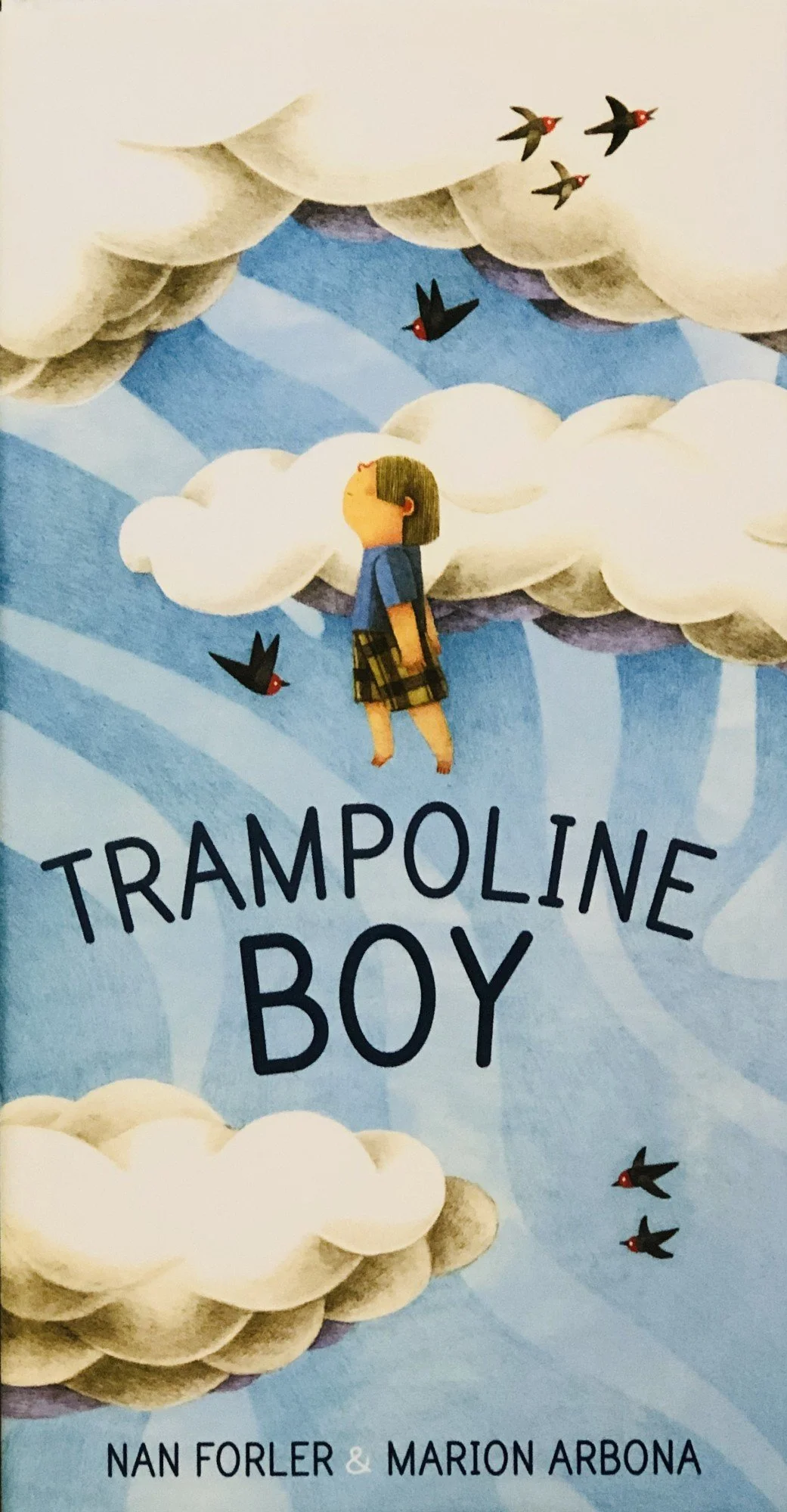
Trampoline Boy | by Nan Forler | illustrated by Marion Arbona
Through the eyes of a character we only know as Trampoline Boy, we are invited to understand how he sees the world. His favorite thing to do is jump up and down, up and down on his trampoline. Kids walk by and tease him, but he remains steadfast and calm. One day, a quietly exuberant girl, Peaches, is fascinated by his jumping. Trampoline Boy wordlessly invites her to jump with him, and by spending this time with him, Peaches and readers get to see how important and valuable different perspectives are.
Ideal for:
National Autism Awareness Month October,
World Autism Day April 2.
Trampoline Boy. Text © 2018 Nan Forler Illustrations © 2018 Marion Arbona. Reproduced by permission of Tundra Books, an imprint of Penguin Random House Canada Young Readers, a Penguin Random House Company, Toronto.

Trampoline Boy likes to bounce. Every day he bounces, in the morning, after school, and in the evening till the sky turns pink. As he bounces, he see things other people miss, like red-winged blackbirds, airplanes drawing curlicues, and wispy white clouds.
Why does he bounce? The text simply says he likes to and Marion Arbona’s illustrations offer no emotional clues. The child’s facial expression never changes; there is no clear evidence of joy or pleasure. Is this part of the reason other children do not understand him, and target him with their pointed questions and cruel remarks? “Hey, Trampoline Boy! Can’t you do anything else?” “What’s the matter with you, anyway?” “Can’t you hear?” “He is so weird.” Trampoline Boy just keeps bouncing, as though he hadn’t heard.
But one day, a little girl named Peaches stops, watches, and waits. Day after day she returns and wonders about his bouncing and what he sees. At last, she whispers, “Trampoline Boy, I wish I could see what you see up there in that blue, blue sky.” For the first time, Trampoline Boy stops bouncing. Can he trust Peaches? After peering carefully at her, he decides he can. They help each other up and start to bounce, up and up, to a place that is “deep and bright” and where the world is “clear and true.”
Simply and elegantly told, Trampoline Boy is a story about seeing and perceiving—how people see the world and each other from very different perspectives. Readers could wonder together about Trampoline Boy: Why does he like to bounce? How might it make him feel? How do you feel when you jump or bounce? Are there times when you move your body to make yourself feel better? Then wonder about the other children: Why are they so mean to Trampoline Boy? How does he seem to them? Why does Peaches see him differently? How does this affect how she treats him?
From a Christian perspective, it is particularly delightful that the little girl is called Peaches because in her words and actions she demonstrates the fruits of the Spirit: love, joy, peace, patience, kindness, goodness, faithfulness, gentleness, and self-control (Gal 5:22-23).
Biblical and Theological Themes: God’s care for our bodies, seeing and perceiving, benefits of different perspectives, not judging others, the fruits of the Spirit
Making Connections:
Good Fruit: In his letter to the Galatians, Paul compares a person whose life is full of the Spirit to a tree whose health and wholeness is displayed in the juicy fruit it produces. Good fruit—in the form of loving behaviour—is evidence that the Spirit is at work. In his letter, Paul says that the fruits of the Spirit are love, joy, peace, patience, kindness, goodness, faithfulness, gentleness, and self-control. Think about each word and what it really means. What does each “fruit” look like in practice? Go through the story again and look for examples of the fruits of the Spirit. Where have you seen the fruits of the Spirit?
Move Your Body: Try moving your body in different ways. Bounce, stretch, jump, skip, twirl, roll, spin, or hang upside-down. What feels good to you? What kind of movement do you like best, and why? In a group, try playing follow-the leader with different body movements. If your mobility is limited, you can do a seated version.
Pray With Your Body: Experiment with different postures of prayer. Try praying standing up, lying on your back, or sitting cross-legged. Or Hold your hands out with your palms facing up, or with your fingertips touching the ground. Try spinning or whirling around. Or make up simple movements (hand movements if mobility is an issue) representing the fruits of the Spirit and turn them into a prayer. How does it feel to pray in different ways? A good book to help with this is Sing, Wrestle, Spin: Prayer for Active Kids by Jennifer Grant (Morehouse, 2022).
Labyrinth Walk: If there is one near you, try walking a labyrinth. Many people find that walking clears their minds or helps them make decisions. How do you feel when you walk?
Cloud Gazing: On a clear day with puffy clouds, lie on your back and look at the sky. What do you notice? Can you see different shapes in the clouds? Do they change or stay the same? Pay attention to your own breath going in and out and imagine that it is your breath that is making the clouds move across the blue sky.