
When I Get Older: The Story Behind Wavin’ Flag
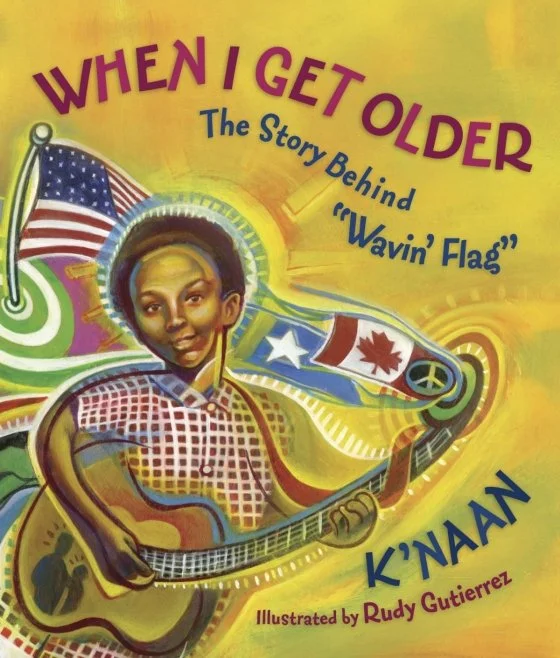
When I Get Older: The Story Behind Wavin’ Flag | by K'NAAN | illustrated by Rudy Gutierrez
In his first book for children, When I Get Older, Somali-Canadian poet, rapper, singer, and songwriter K’NAAN tells his own story. Born in Somalia, he grew up in Mogadishu. His grandfather was a renowned poet who passed on his love of words to his grandson. When the Somali Civil War began in 1991, K’NAAN was just thirteen. His mother made the difficult decision to move her family so that they could grow up in safety. Like so many other immigrants, he had to make a place for himself in a world of alien customs, clothes, and language. His road was a hard one: he lost many friends to violence. But K’NAAN’s love of music, and his enormous talent, became a way for him to connect with his past, with his classmates, and eventually, to millions of people around the world.
Ideal for:
International Day of Peace Sept. 21, International Day of Music October 1, World Kindness Day November 13, Human Rights Day Dec. 10, International Migrants Day December 18, Canadian Multiculturalism Day June 27.
When I Get Older: The Story Behind 'Wavin' Flag. Text © 2012 K'NAAN Illustrations © 2012 Rudy Gutierrez. Reproduced by permission of Tundra Books, an imprint of Penguin Random House Canada Young Readers, a Penguin Random House Company, Toronto.
When I Get Older is a story of home and family, war and loss, change and courage, and the experience of being a refugee. It begins in Somalia, where young K’Naan lives with his mother, his brother and sister, and his grandfather, a well-known Somali poet and storyteller. When the family wakes up to gunfire one morning, everyone is terrified. War has erupted and their city is consumed by violence.
Day after day, while the children huddle indoors, K’Naan’s mother ventures out into the dangerous streets to get the papers that will allow the family to leave Somalia and move to America. But K’Naan’s grandfather cannot get permission to go. They will need to leave him behind in Somalia. “Poems will be your courage,” he tells his grandson, and gives him the gift of these words:
When I get older, I will be stronger.
They’ll call me freedom, just like a waving flag.
The family makes the long journey to New York City, where K’Naan is cold, homesick, and out of place, then eventually to Toronto, where they are officially given the status of refugees. Canada feels calm and safe compared to where they have been, but K’Naan struggles with homesickness, the difficulty of learning English, and controlling his anger when people say cruel things about him and where he comes from.
His refuge is music class, where he meets other kids who had to leave a home far away and who are struggling to learn a new language. Singing together gives them pleasure and makes K’Naan feel “as if anything were possible.” For the assembly at end of the school year, K’Naan gathers together a group of his new friends and together they sing a song he has written based on his grandfather’s poem. “I wasn’t afraid anymore,” he recalls. “Grandfather was right. Music made me safe.”
NOTE: Originally written for the people of Somalia, the song Wavin’ Flag was rerecorded by a group of Canadian artists as a fundraiser after the 2010 earthquake in Haiti. A different version of the song became popular around the globe after it was chosen as the theme song for the 2010 FIFA World Cup in South Africa.
Biblical Themes: Home and belonging, leaving home and family, being a refugee, welcoming the stranger, war and its traumatic effects, the strengthening and healing power of music, self-control, unity, freedom, and safety
NOTE: The war, violence, and displacement suffered by K’Naan, his family, and some of his friends at school find resonance in scripture, where there are many horrific accounts of fighting and bloodshed, some of it attributed to the will of God. Responsible readers of the bible must face these hard texts honestly and consider carefully how to handle them.
With children, we might begin by explaining that warfare was a harsh part of life in the ancient Near East and that parts of the bible reflect the belief of many ancient peoples that their gods fought on their behalf and against their enemies. It took a long time for a different understanding to develop: God is one, loves all people, and does not choose violence.
We can point to parts of bible in which God’s people are urged to welcome and care for strangers, because they themselves have been strangers (Leviticus 19:33-34; Exodus 22:21; Deuteronomy 10:19; Matthew 25:35). Most of all, we look to the example of Jesus as an example of someone who welcomed strangers and rejected violence, even in a world filled with conflict.
Making Connections:
Coffee House. In many times and places, singing has been a source of strength and hope for people in hard circumstances. Plan an all-ages coffee house or jam session featuring songs of freedom, peace, and protest from around the world. For resources, check out some of the many songbooks published Wild Goose or search for Singing Resistance. Let your music be a prayer for people around the world working and hoping for freedom.
Movie Night. As a group, watch a movie about the power of music. The 2002 film Amandla! A Revolution in Four-Part Harmony, highlights the role of music in the struggle against apartheid in South Africa.
Singing Peace and Protest. Incorporate some peace and protest songs in worship. Tell the stories behind them. Or invite members of the congregation to suggest songs (not only hymns) that give them courage and hope. Sing them together.
People in Exile. Tell the story of the Babylonian exile, concluding with these words from Psalm 137:
By the rivers of Babylon, we sat and wept
when we remembered Zion.
2 There on the poplars
we hung our harps,
3 for there our captors asked us for songs,
our tormentors demanded songs of joy;
they said, “Sing us one of the songs of Zion!”4 How can we sing the songs of the Lord
while in a foreign land?Why are the exiles unable to sing in a strange place? Is it because they are choked by grief and homesickness? Is it because they feel it would be wrong to sing sacred songs in a place that feels unholy? Why do you think K’Naan and his fellow students find joy and consolation in singing?
Write a Song: Read the original lyrics to Wavin’ Flag. Then write your own lyrics, expressing hope for freedom and peace in specific times and places. Or write a completely different song or poem based on something important someone has taught you.
Family Gifts: Family is important to this K’Naan’s story. His grandfather gives him the gift of love and a poem that brings strength and comfort; his mother acts courageously to find a new home for their family; his uncle welcomes them to the United States. Invite people to bring photos or objects to worship and create a display based on these questions: Who in your family has given gifts to you? What are these gifts? What difference do they make, or have they made, in your life?
Stories of Displaced People: Structure a worship service around the theme of refugees: begin with a biblical story like that of Ruth and Naomi, who have to leave their homes behind more than once because of famine and loss, or Mary and Joseph, who have to flee to Egypt with their baby to get away from the violent King Herod. Then hear stories from modern refugees, either from books, or from people in your community who are willing to share their own experiences.
Refugee Support: Brainstorm what your church could do to help refugees. Some congregations sponsor refugees (individuals or families) to come to Canada. This can be a long process and is a big commitment, but it makes a huge difference to those involved. Other churches give financial support to organisations working with displaced people around the world. Others cooperate with local groups to offer hospitality and support to newcomers. What could you do?