
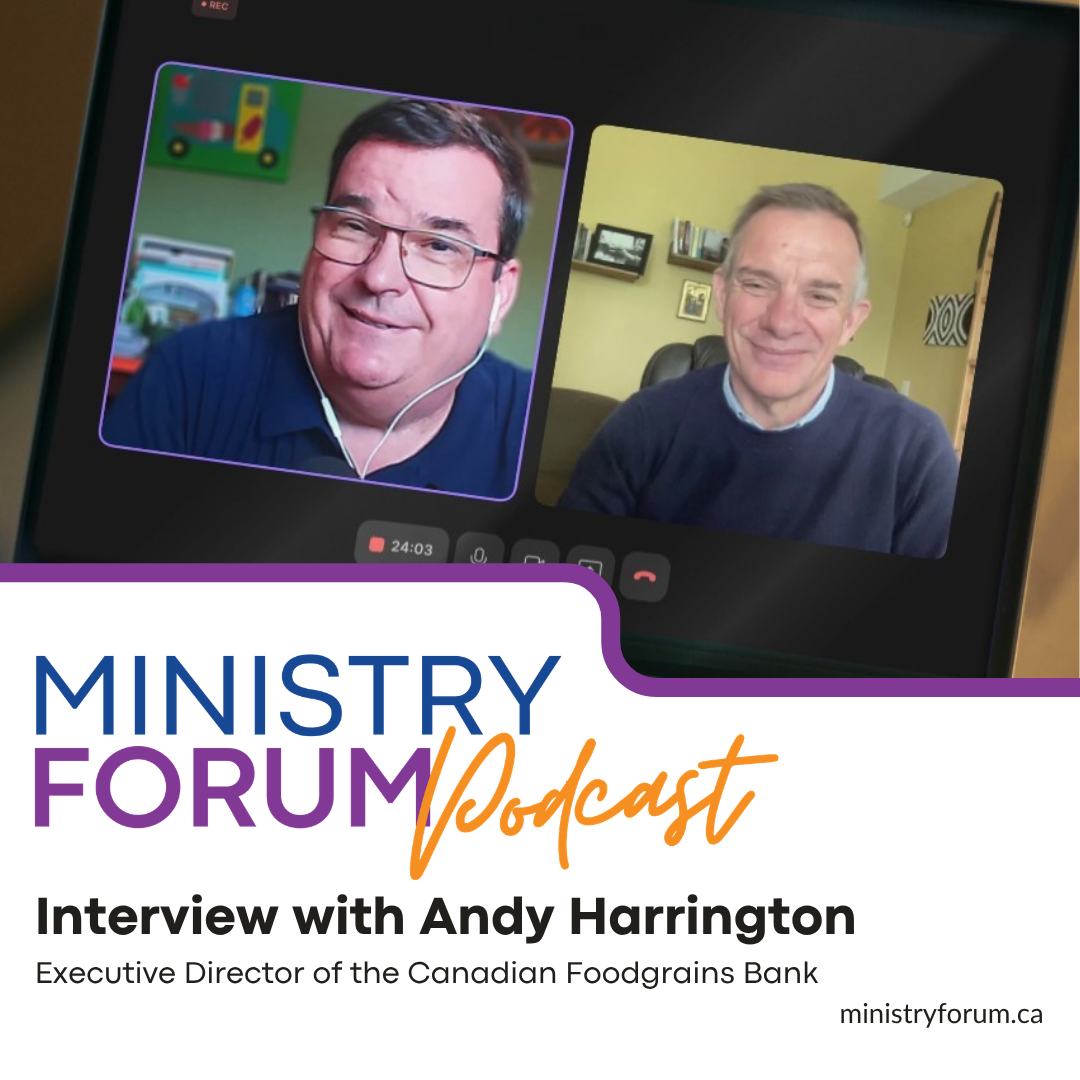
Interview with Andy Harrington, Executive Director of the Canadian Foodgrains Bank
As Executive Director of the Canadian Foodgrains Bank, Andy has worked alongside churches, governments, farmers, and local partners around the world to respond to hunger. Along the way, he's discovered that lasting change almost always begins with people who are willing to take the next faithful step, even when they can't see the whole path ahead. John and Andy talk about calling, collaboration, generosity, and why keeping your eyes on the mission matters. It's a hopeful conversation for anyone wondering whether the small things we do together can still make a difference.
Quotables
"Life... has been one step at a time in a direction that God has made possible."
"When we get distracted away from what our mission is, you know it's going to cause problems."
"When I go to these places, John, I don't just see the people huddled in corners. I see Jesus sitting with them, looking at me, saying, 'What are you going to do about this?'"
"There's always been a case of, 'Lord, what comes next?'"
About Andy Harrington
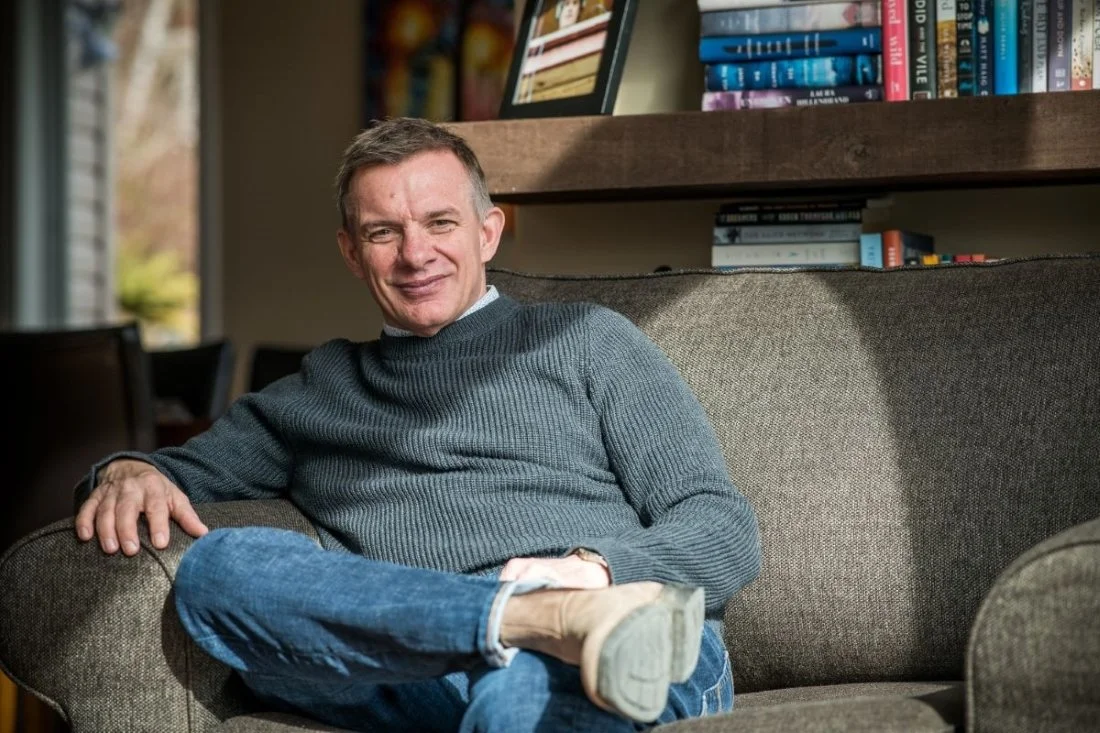
Andy Harrington is a leading Canadian voice in the fight against global hunger. As the Executive Director of Canadian Foodgrains Bank, he leads a powerful ecumenical coalition of 15 church-based agencies representing nearly 30 denominations, working together to end food insecurity. With over 30 years of frontline leadership, ranging from refugee support in war-torn Bosnia and Croatia to tsunami relief in Sri Lanka, Andy brings a rare blend of boots-on-the-ground experience and high-level strategic vision. Andy has spent his career at the intersection of faith and global service, including nearly a decade as CEO of The Wellspring Foundation. His expertise in the broader sector is reflected in his three-year term as co-chair of the Humanitarian Coalition (concluding May 2026), a partnership of Canada’s leading aid agencies. This professional breadth, combined with a Master’s in Missiology and Culture, makes Andy a uniquely qualified expert on how the Canadian Church can partner effectively to serve a broken world.
Show Notes
Canadian Foodgrains Bank: foodgrainsbank.ca
Follow us on Social:
Transcript
[Introduction]
Welcome to the Ministry Forum podcast, where we believe that you are not alone in your ministry journey. I'm the Reverend John Borthwick, your host, coming to you from the Center for Lifelong Learning at Knox College. Here we connect, encourage, and resource ministry leaders all across Canada, in the joys, the struggles, and everything in between. I love that I get to do this work, and most of all, that I get to share it with each and every one of you. So, thanks for giving us a listen today. Whether you're a seasoned leader or just starting out, this podcast is made with you in mind.
[John Borthwick]
Today on the Ministry Forum podcast, we're talking about some of the world's biggest problems and how you and your ministry context congregation may be able to do something tangible about it. Sounds impossible. Well, I'm hoping after you listen to our guests that you will come away with a little more hope and a little more of a sense of how you can do your part in the context, in your context to address the big things of our world, big things like global hunger. Maybe you're saying, John, we're having enough trouble just trying to keep the lights on in our congregation. I mean, we read the headlines, we pray the prayers of the people on Sundays, but what could a little church like ours actually do about ending something as big as global hunger? Well, my guest today has spent more than 30 years answering exactly that question, and from what I can tell from his bio, his answer is a little more hopeful and a little more practical than you might expect. Andy Harrington is the executive director of the Canadian Foodgrains Bank, a remarkable partnership of 15 church-based agencies representing nearly 30 denominations, all working together to end global hunger. It's the largest ecumenical organization in the country, and a living picture of the idea that while we may worship in different pews, we can all sit down at the same table. But Andy didn't come to this from behind a desk. He's done refugee work in war-torn Bosnia and Croatia. He has supported families affected by the 2024 tsunami in Sri Lanka, and he spent nearly a decade leading the Wellspring Foundation. And he recently wrapped up a three-year term co-chairing the humanitarian coalition, which brings together Canada's leading aid agencies. He holds a Master's in missiology and culture, and he carries both a strategist mind and what his colleagues describe as a genuine pastoral heart. What I most want to get at today isn't just what the Canadian Foodgrains Bank does; it's what Andy has learned about collaboration, about calling, about dignity, and about what faithful global engagement actually looks like for an ordinary Canadian congregation. Because I think there's good news here for every ministry leader who's ever felt too small to matter. Andy, welcome to the Ministry Forum podcast.
[Andy Harrington]
Oh well, thanks, John, and thanks for making me sound so much better than I actually am in real life. So, thank you for that.
[John Borthwick]
That's my job. I try to make everyone sound just a little better than they actually imagine themselves to be. But I think we'll discover that you've got something going for you, and they're lucky to have you at the Canadian Foodgrains Bank. I've tried to sum up in just a few sentences, it sounds like decades of service that you have offered. Is there anything that I didn't include that you would like to add as an introduction to yourself that might interest our audience?
[Andy Harrington]
Oh gosh. Well, what can I say? Well, I did spend - you summed it up really well. The 2005 tsunami, the time in Bosnia and Croatia, my time at Wellspring CFGB. I was also with Youth Unlimited, Youth for Christ, for over 20 years. Served around the world in both, but particularly in the UK and in Croatia, Bosnia, where I set it up, and also here in in Canada. So spent a lot of time, just a lifetime, really working with vulnerable people. That's where it's at. And also, one thing I would add is I'm a long-distance motor biker, and I regularly bike across places like Africa and up to Alaska. That's an important thing for people to know.
[John Borthwick]
Wow! You and Obi Wan Kenobi.
[Andy Harrington]
Well, yeah, that's right. Actually, I know exactly what you're saying because Ewan McGregor who plays Obi Wan Kenobi…
[John Borthwick]
He does.
[Andy Harrington]
…He inspired me. Him and his friend Charlie Borman, and when I was doing a trip up from Cape Down to Gigali at one point, it’s about 10,000 km. Charlie Borman was retweeting some of my stuff, which made me feel like really a proper biker for once. So.
[John Borthwick]
You are a celebrity, my friend.
[Andy Harrington]
Well, only for a short while.
[John Borthwick]
That’s amazing! Wow, what an interesting thing to be up to. What is it with people from the UK who want to get on bikes and just drive all across the world?
[Andy Harrington]
We are an adventurous people. That must be it, but not adventurous - Canadians are adventurous people as well. I'm a - I've been a Canadian for over well for nearly 25 years now. I'm very proud of that, which means I'm cheering for two teams currently in the World Cup.
[John Borthwick]
I can imagine. Yeah, torn, torn alliances. If it comes down to the end, who knows? Yeah. Well. We often talk about discerning our call on Ministry Forum, and I'm curious when you think about all these different paths that you've taken. When you look back on it, did you set out to do this, like what you're doing today, or did the calling find you piece by piece at a time? Maybe. What did you learn about discerning direction when the path ahead maybe wasn't 100% clear, and certainly if you're on a bike, you want a clear path.
[Andy Harrington]
Yeah, you want a very clear path. There's a lot of things I learned on that bike, actually. I would say definitely there's no way in my life that back in the 1980s, when I was just becoming a Christian and living in London, that I thought I'd be heading up an organization like the Canadian Foodgrains Bank in Canada. So, it's no time where you sit down 35-40 years ago and say, "Right, I will one day do that”. But there is a long walk of moving in the right direction towards this, and I think I would say a couple of things. It's piece by piece, but there's always an understanding that my heart was always for the vulnerable. I am - I was working in the city of London actually for a short while after I finished school and had a good job that would have made me a millionaire quite, quite quickly, but just really had great sense that I wasn't in the right place as I was doing that and so left it and went and got a degree but ended up working on the streets of Lincoln with detached doing detached youth work with young people who were in vulnerable situations, and that felt a lot more comfortable for me. And so, it kind of started from that. It moved into learning more about you know vulnerable people and their situations. That led me to, in a remarkable set of circumstances, actually that led me to working in Croatia and Bosnia during the war there with traumatized youth. That in turn led me to working in a little bit in Ethiopia with some great friends in the UK with an organization they'd set up, which in turn led me out to Canada in a long kind of roundabout route, working with an organization “Youth for Christ” in Vancouver, that was really fundamentally focused on vulnerable young people and had partnerships in 17 countries around the world through various staff and things, which led me to working in Rwanda because one of those big partnerships was with Rwanda, and I became very engaged in the work there, which has led me to Canadian Foodgrains Bank. So, I look on this as what Nelson Mandela called “a long walk of obedience” in the same direction. But there's never a time when I said one day I will head up one of the largest charities in Canada doing the kind of work we do. There's always been a case of Lord, what comes next? And actually, you know, if we talk about calling, that actually started on a beach in a place called Skegness, where one day God profoundly spoke to me. I've never worked out if it was in my head or if it was allowed, but I clearly heard God's words as I was watching the tide come up on a beach, and thinking, wondering if which wave will come up higher than the last one. I very clearly heard God say to me, “Andy, that's like you. We can do this. The tides - i'm trying to push you somewhere. You're trying to resist. We can do this the easy way or the hard way”, and that was the start of how this this kind of walked on.
[John Borthwick]
Wow, that's an amazing journey.
[Andy Harrington]
It's quite the journey. Yeah, with many, many, many, many pit stops along the way, and interruptions from God in a good way.
[John Borthwick]
Yeah, and being - I think there's a sense there of being open to what those opportunities are coming, like to as you say in that in that call that you sense there is a sense of somehow you were in a place, in the right place and were open to what's next, yeah. And that next came.
[Andy Harrington]
Yeah, and very much. And I think that is in no way would I want to portray myself as an ascetic man of God, or you know, in any way, shape, or form, but there's always been a sense of me that of wanting to find out what God wanted me to do and to try and pursue that. Never a sense that I always knew what was, you know, a long way down the path. But there was always a sense of a next step. I've often thought about stepping stones. I live right out in a rural area of Canada, and just on the bottom of our hill is a stream that's quite deserted, and it has stepping stones to get across to the other side. It's a creek, and I've often thought life is, you know, my walk with God has been a bit like standing on the edge of a, you know, raging rapids, which this has the Chilliwack River, and just God saying take a step, and me saying, well, there's nothing there to step into it, except water, and so just take a step. And as I do it, a stone rises out of nowhere, and you land on that, and then God says, you know, you're happy. You think this is it, but then after a while, God says, take another step, and you'd think you'd have learned that. Oh, I know this is going to be okay, but you don't. You still ask all the same questions. “I'm going to drown”. “I'm going to drown”. And I think for me, as I don't know how far I am across that river or that stream, but as I look back behind me, I can see all the stepping stones that are still in place that weren't there when I stepped out, did it in faith, and God was there for me. And I think that's a great analogy of how this life has been, one step at a time in a direction that God has made possible.
[John Borthwick]
Yeah, and I think that could be something that you could map even in organizations, in congregations that are feeling uncertain, not sure what they should do. It is about taking that leap of faith or that step, just that one step, and seeing what happens.
[Andy Harrington]
That's our faith. It's faith. It's literally - we talk about faith, but it means faith. You're exactly right.
[John Borthwick]
Absolutely. I'm picturing Indiana Jones in the Last Crusade, where he has to go across this thing that looks like there's nothing there, and he puts his foot out, and boom, yeah, the path is there.
[Andy Harrington]
I have watched that clip many times and thought, I resonate with that. Yeah.
[John Borthwick]
Amazing, amazing. Well, so one theme that Ministry Forum definitely embodies, and it seems to me that Canadian Foodgrains Bank does as well, is that you're not alone. You guys work in collaboration and partnership and are working. The nature of your work seems to be that way as well. When I look at ministry today, I see a lot of siloing and duplicated effort. We also see some ministry leaders a bit resistant to working together for a variety of reasons, but Andy at the Foodgrains Bank, you work with 15 distinct agencies and nearly 30 denominations who've chosen to all come together and partner, and it reads beautifully on a website. I wonder, I would imagine it's got to be challenging in practice at times. But - so how would you describe or how does it what does it take to move a group of churches from say good intentions and even siloed efforts to actually finding a way to work in a real collaborative making a difference coordinated kind of way? What's your experience with that?
[Andy Harrington]
It's a great question, John. And I look back - I mean, I've been very honored and blessed that I kind - I'm - as the executive director. My role in this is a stewardship role that builds on the shoulders of many people who went before me. We've been in existence for 43 years now, and it came to get the Canadian Foodgrains Bank. For those who don't know, we're one of Canada's leading agencies in ending hunger around the world. So, we work very closely with our 15, our 15 members actually make up the bank, but then they have hundreds of partners around the world that we work through the members with, and we're supported by the Canadian government. We're supported by farmers across the country that come to us, and many other institutions and donors as well, and so the place where we come together is literally around ending hunger. And so, when you have 15 organizations that are faith based that all represent over, as you say, 30 slightly over 30 denominations, you could find yourself in a place where you're having arguments about doctrine, or you're having an argument about well, our denomination believes this. You believe that. What we've done, I think, quite successfully is very much said, let's leave all those things at the door. And when you walk through the door, let's talk about hunger. And any time we kind of go off track, there'll be someone around the room that will say, "Is this going to end hunger”? And if we say “no”, then let's focus on that. So, we contain multitudes. There's a lot of different opinions amongst those members and partners, but we can all be united in the fact that God desires nobody to go hungry around the world, and so I think that's a great place where we can start. And I would say, within that, yes, there can be frictions. I think any time you bring in 15 organizations together, there can be places where things aren't quite working, or someone doesn't agree with something. But we have a genuine desire to move forward our mission of ending hunger around the world, and that trumps things. I think the other thing I'd say is, as an organization, there are some things that we do together that I think are quite unique that help build that unity. For example, kind of - I don't want to get too technical, but we we're called a bank for a reason. So, every one of those 15 members has kind of an account. They raise money into it. We match it. Projects happen, but what can often happen is that one of those members might say, "I want to work in this area”. This is a really critical area for say, let's take Afghanistan for example. I want to work in that area, but I don't have enough money to do the kind of level of project. It might be a $2 million project, and I've got half a million. Other members might say, "Well, we really believe in that project, but we can't work there because we don't have partners or whatever. So here, take our money”. Now that happens regularly. If you can tell me an organization that's doing that, where faith-based organizations are literally saying, "We've raised this money to end hunger, but we can't end hunger in Afghanistan. You can take our money”. That is a regular feature of life at the Canadian Foodgrains Bank. So, when you're kind of working with that level of communication, with unity, with desire to bless each other, and desire to end hunger, it really does cover over things that would be cracks in other organizations. So, no, it's not always easy, but there is a real unity there, and that unity is reflected back to the churches that those organizations represent. We've got Catholics, we've got Adventists, we've got Baptists, Lutherans, Pentecostals, Anglicans. You know, right across the scheme of things, and bringing all those people together, it's a great joy. For me, it's a great way to live your life, despite some of the you know the things that go on. You're quite right. We all understand how organizations work. That some of the little fractures that happen at times, the overarching good that this organization does, and the way we lean into each other, it makes it very special, very special indeed.
[John Borthwick]
Yeah, for sure, and an incredible trust. I think it sounds like between agencies and between denominations and organizations. Just to sort of say, since we're so committed, and it speaks to something that we do sometimes talk about at the Ministry Forum podcast, where if we're focused on the mission, you know, we're focused on this is our - the mission we're on, that people can get behind that and move in that direction, as opposed to getting distracted by other pieces and other things that might come along.
[Andy Harrington]
John, I think that's exactly right. And for us, that's an easy thing. We have you know our mission is to end hunger. I mean, it's a very, very simple mission. Not bad.
[John Borthwick]
It’s not bad. Well done. Just a few words. Seems simple.
[Andy Harrington]
It's not, but it seems at home. But my advice to anyone, and I've done a reasonable amount of sitting with other organizations and over the years, my advice is to anyone is to really have a very clear, very simple mission statement and do everything you can to stick to that. I think the world is tough enough as it is with so many distractions that when we get distracted away from what our mission is, you know it's going to cause problems. So, you know one of the things that I've - you know even in the churches that I've been part of over the years, whenever things don't go well, it's largely because we're focusing on the side issues rather than on the key issues that we were designed and created to, you know to represent and to be part of. So, I think that's critical. In our in our case, it's pretty easy to do. Sometimes it's harder to do if you're a congregation or a church. But we all have a fundamental mission as Christians, and that is to do what we can. You know, to love mercy, walk humbly, do justice. And so I think in in that sense, the more we can focus on those missions, the easier it is for us to maintain unity.
[John Borthwick]
For sure, and sometimes when you have a really clear mission, I think it's really helpful for folks because, like you said, you can pull people back in. Because no matter what you're doing, I'm sure in an organization like yours and many others, there will always be people who will say, "Well, well, can't we do something about this, or can't we do that? Or wouldn't it be nice to be helpful there and do this and that and everything else”? It's like, but that's not what we do. Someone's got to do that somewhere. Yeah. What we do is this, and so we'll continue to do that, and let's come on together and do that together.
[Andy Harrington]
That’s exactly right, John. We have regular conversations, and we do want to always be quite flexible, but we have very clear parameters on what our role is. You know, our role. you know, for example, we're often asked to get involved in domestic food insecurity. There is a lot of domestic food insecurity, and many of our members are involved in that. But the Canadian Foodgrains Bank was set up and established to end hunger internationally, and so there's many ways we can do that. And we're always trying innovative new solutions and techniques, but that's our job, and that's what we stay focused on. There are others, and we support them in doing that who do other thing.
[John Borthwick]
Yeah, and with congregations, I - one of the congregations I served for a couple of decades was involved in in sort of both and - you know, like you can when you're a congregation, you might be able to do that. So, it's like, what are we doing locally to support food insecurity in our own neighborhood? And then the congregation I did serve actually did have a partnership with one of the growing projects that that you all have.
[Andy Harrington]
It's great.
[John Borthwick]
Yeah, out in southwestern Ontario, they partnered with other churches that were doing - the other churches were doing the growing, and we were giving the financial contribution to support that growing, it seems like a model to me that's so deeply Canadian, maybe or deeply rural in its form of generosity. You know, farmers dedicating a portion of their land so that if they have a good harvest, it becomes security for someone facing hunger somewhere farther away, and so for my listeners that might be in farming communities, what can you say a little more about what makes this model so powerful, and how would a congregation actually get involved in that if they were curious about that? A rural congregation somewhere in Canada today.
[Andy Harrington]
Sure. So, we have these wonderful things called growing projects across the country, and the reason why we have them is that when, you know, the root of the Canadian Foodgrains Bank were farmers saying, you know, back in the late 70s there'd been a cyclone in Bangladesh. There were a few other disasters happening. Farmers saying we have surplus, let's get our food out and help people, which is a wonderful Canadian thing to do, right? And that was incredible. And so, they went to Mennonite Central Committee, who was one of the found or the founder, and it became big and big enough that MCC bought in five others, and that's now grown to 15. So those growing projects were growing food, and the Canadian Foodgrains Bank was taking that food, it was sticking it on rail cars with all the grains and stuff, taking it to places like Churchill and shipping out. That took a long time, and so it was hard to get the food there quickly. It would take months, and also, it wasn't always the culturally appropriate food. Sometimes it would be food that wasn't the right food for there, and sometimes it even undermined markets. So, it was a great thing to do. But as we've progressed and as we've understood better about how to do good international development, what we do now is with those growing projects, they're still engaged, but we now - that they grow those crops it could be canola, it could be wheat, it could be soy, whatever it might be. And communities come together, as you said, John. So, it can often be one community or five communities or seven communities. They'll grow. Some people will donate land. Some will donate seeds. Some will look after the crop, and often there's this amazing day on harvest day where I've seen up to 15 combines with bands playing, coming together, and people partying on the corners and having barbecues, and this incredible celebration of the grain being harvested. It's then taken to grain elevators and it's sold, and the proceeds of that comes to Canadian Foodgrains Bank. So that's a beautiful thing, and actually that really helps us when we talk to the government because we have thousands and thousands of farmers and their supporters behind us. So, for a congregation that wants to get involved in that, there's a couple of ways you can do it. For well, three actually. One is if you have farmers in your congregation, or that you know, talk to them about establishing this, and then talk to us. We will help make that happen. Secondly, there may be something that's already happening in your area. We got over 100 growing projects in Ontario, for example alone John. We got others in Alberta, in Manitoba, Saskatchewan. You know, right across the country, actually. And so there might be some that you can get engaged in, and you can go and can be part of and help that. But the other thing we've started is a thing called “Grow Hope”, where you can - actually even an urban congregation can get engaged and help support these growing projects. You can help rent land, you can help provide seed inputs. That money then comes back to the Canadian Foodgrains Bank for us to end hunger around the world. So, if you want to know more about that, you can go to our website at foodgrainsbank.ca. There's a whole page on Grow Hope, how you can be involved, and it really does engage congregations in the work that we do because we don't just grow food, we don't just help people to end hunger. We work to educate Canadians. We work really strongly to help Canadians have a real sense how they can make a difference in the world. So, there's a lot of resources there that you can use in your church. It's not like you're just making a donation. You can really be engaged in the work. We talk about give, learn, pray, advocate. We take Canadians to meet their elective representatives on Ottawa and regular occasions to talk about why Canada should be engaged in international aid, why we should be engaged in ending hunger, which at this time I should say is more important than ever before, as we're seeing aid cuts around the world. So, you can be very deeply engaged. We have whole mechanisms to engage people in, in what is I think one of the key critical issues of our time: ending hunger around the world at a time when hunger is getting a lot worse.
[John Borthwick]
For sure, yeah. And I can remember over the years that I was there that every so often we would have like maybe it was annually or something, we would try to do a service and we'd use the resources from Canadian Foodgrains Bank that you guys provided and just to bring a light to that we brought the ministers from the congregations that were involved to come and talk to the congregation about the Canadian Foodgrains Bank, and we had other people who had been farmers in their day but were retired and you know had moved on from that, who would talk about their experience with you know supporting, and we also had some curious folks who were a part of the Christian Gleaners, which…
[Andy Harrington]
All right, yeah.
[John Borthwick]
…kind of a - you know not Canadian Foodgrains Bank, but also another sort of a heart for that sort of generosity and that…
[Andy Harrington]
Great organization, yeah, yeah.
[John Borthwick]
Yeah, those kinds of things. And you've already mentioned it, but the issues that we're seeing across the globe related to cuts in environment and in international development, even as needs are rising, we're seeing so much of that. I assume part of your role is probably some form of advocating. You probably know some of these people that are in government. They probably see you and try to run away as fast as they can, or you know, you're just you're just getting into good trouble where you can, as they say. So, how are you all leading through that? Are there other partners at the table with you? And then, what would you say maybe for a church that's thinking - because some of the push/pull I hear in the church today, the institutional church today, is just sort of how I led with the intro. You know, so much of our churches are worried about themselves, and being generous beyond themselves is sometimes there's a bit of a barrier there. And so, I wonder if you might speak a little bit about Canadian Foodgrains Bank and how you're doing the advocacy, but also how you'd speak to maybe a local congregation who's thinking about pulling back a bit, even themselves, using even good biblical words like you know, take care of your own house first. It's some good words, but there's also something about loving your neighbor and doing justice and all those talks.
[Andy Harrington]
A lot about Samaritans and verses.
[John Borthwick]
Yeah, yeah.
[Andy Harrington]
There’s a lot in your question, John. So, and it's a great question, and it's one that comes up a lot. So, “good trouble” is a phrase I love. I love where it comes from. I love what it represents. It is something that I've - we do in the nicest sense. So, a lot of our work is around advocacy. I'll be flying to Ottawa next week. I'm in Ottawa regularly. We meet with MPs, with ministers, with the highest levels of Global Affairs Canada, as a lead partner for the government in food security around the world. A large part of my job is in representing Canadians to the government, and also working with the government to figure out how we can, you know, build the right policies in order for us to end hunger. So, that's a large part of our work. We engage other Canadians in that as well, and we work as part of coalitions, but yeah, I would say that that is a pretty key part of what we do. Why is that important? Well, it's important because hunger is growing around the world. We currently have nearly 300 million people at acute levels of severe food insecurity. That is three times, sorry, that's yeah, three times what we had just a few years ago. We have just over 720 million at the next level down that we would regard as really, really worrying levels of food insecurity. We're seeing crises around the world that are lasting longer than ever before. We talk about protracted crises. They can be a crisis that that will be a crisis that lasts for more than five years. So back ten years ago we had nine of those. Last year we had 29, and these could be these are often what we call poly crises. They can be made up of conflict, of climate change, of economic insecurity, and all those things are getting worse. You can only you only just have to look at the news, well, who suffers? The poor suffers. You know, more and more people are being driven from their land for various reasons around the world. So, in the midst of that, we've had massive aid cuts. It was started, you know, in the U.S. when USAID was dismantled, and I have strong opinions and feelings about how that was done, strong enough to give you an example that I stood outside a childhood malnutrition center in South Sudan. I was in South Sudan - I've just recently come back from there, but last year I was there as well. Just as those aid cuts were being fielded out from America, that childhood malnutrition center was supported by the UN that got its funding from USAID, and as I stood there the day before, they found out they were being shut the day after I was there, so 48 hours' notice, and I was surrounded by families trying to give me their babies, emaciated babies with bulging bellies, because their muscles have so atrophied they can't contain their insides. I found out later that day it was one of 1100 other childhood malnutrition centers in that country alone that was being cut shut at 24 hours notice. Those cuts were arbitrary; they were not - there was no reasonable reason for them to do them, and that has now been echoed across the world. Even here in Canada, we just cut 2.7 billion from our aid budget over the next four years. So, it's critical, particularly for us as Christians, but I think even as human beings, for us to say this is wrong. You know, at a time when we're creating the world's first trillionaire, at a time when the billionaires are getting richer and the poorer are getting poorer, at a time when we're saying to people you don't count because you're not like me you don't have the same color of skin or the same beliefs in a way that we haven't done for decades we really thought the West was on a trajectory towards equality. All these things I think have to come home to roost. They are coming home to the roost, in the fact that many people are dying. Do you know, John, that “The Lancet”, which is one of the most authoritative medical journals in the world, has forecast over 20 million deaths as a result of those aid cuts from USA alone by 2030. So anytime you hear people saying this doesn't make a difference, it's rubbish. So, I would say to Christians, I understand. I think everybody in our organization understands that there is a cost of living crisis here in Canada. That food banks are being utilized more than ever before. That there is a real need for us to care for the poor here. And many of us, our organizations, many of our member organizations, are very actively engaged in that. But I would also say we're Canadians. We're a rich country, and any time we say that the people outside our borders are less than us, that they're not quite as human as we are, I think as Christians we're actually not representing what Jesus taught us. You know, think of the parable of the Good Samaritan. Think of, you know, when he talks about, ‘What did you do for the least of these?’ We say, ‘Where were we when you asked us to feed people and when you asked us to visit? One day we're going to have to answer the question, “what did you do when I was hungry”? Because when I go to these places, John, I don't just see the people huddled in corners. I see Jesus sitting with them, looking at me, saying, "What are you going to do about this”? And so, I don't - I think the rise of that whole thing of look after yourself, which is often politically motivated, we're seeing more alignment with some wings of the church and some wings of political parties than we've ever seen before. I think that is dangerous. I think it's anti-scriptural. I think it's not what Jesus calls us to - to do. Whether we're talking about the Samaritan or the widow's mite, we do what we can, and I know that's hard. I recognize the pressures on Canadians today, but we transcend national politics, we transcend aid cuts, and we represent Jesus. And so, I think it's incumbent upon us as Canadians to live out our values, and incumbent upon us as Christians to live out what Scripture actually says about what you do for the least of these.
[John Borthwick]
That preaches, Andy. That preaches. I appreciate it. And I appreciate that you - because one of the one of the biases of Canadians, I think, is we often look to our southern neighbors, and have some thoughts about them, but we forget the ways in which our own government makes decisions that maybe we don't get as much press or something where people aren't aware that the Canadian government has also dropped aid and makes decisions like that every so often.
[Andy Harrignton]
And I recognize, I mean, I deal with the people who are making those decisions at the highest levels, and I recognize the pressures on them. I really get it, but I also recognize that - and I think, honestly, I want to say this, and I'm not saying this just because I think they might be listening. But I go to Global Affairs Canada. I talk to the people involved in international development there. They are good human beings doing the best they can in a tough subject, and it's really, really hard sometimes for those guys, but I also recognize that that for politicians in this country who are who are trying to say “we can only look after ourselves”, we're a global world whether we like it or not. The decisions we you know if you want to talk politics, the decisions we make about how we treat our global partners do come home to roost. You know, if you want to stop pandemics, invest in global health. If you want to, if you want to build trade, invest in building up the trade in other countries by investing in development. If you want to build peace and you don't want to have wars, don't abandon the countries that can be taken over by militias. I mean, its basic common sense, and we see it all the time in our world. So, there's enlightened self-interest, and there's also, I think, from a faith basis, a reason why we should be doing this right across the board. International aid and international development is a good idea, both from a faith perspective and a political perspective.
[John Borthwick]
Yeah, I can remember years and years ago, it might have it might have been just after 9/11. Where you know a little humble, humble bragger, humble pastor was preaching a sermon the Sunday after that, and I titled it "Bread, Not Bombs”…
[Andy Harrington]
Right.
[John Borthwick]
Because you could track the ways in which, like Afghanistan and Iraq and other places in our world, you know, if there'd been an investment and a support of the people living in those countries related to food insecurity and other kinds of things. It would be a much different kind of reality that that gets fostered in those spaces and places.
[Andy Harrington]
Yeah. I totally agree, and I think we can be very blinkered historically. We can look at just - that happened yesterday, and that's the first thing that happened. Man, when I was in Bosnia, when I was working in Croatia, I was hearing think about things that happened 600 years ago as if they happened yesterday, and they were very much why things happen. So, when we make political decisions now, when we decide to withdraw or bomb a country or whatever it might be, that is often what we see in the moment, but there are huge, huge, huge parts of history that have caused to bring us to that moment. And so, one of the things we advocate for is build good history. Start now. You know, build on the good history we have in the past. The actions we take now are not isolated; they are linked to the past and they will be linked to the future. So, if you want to build good, build good from now.
[John Borthwick]
For sure, yeah, and just to just to tease it out a little bit, just because of where you come from, my people are Scottish, and I'm married to an English girl, much occasionally to the disappointment of my parents, who are like, couldn't you have found a nice Scottish girl? But with my English family, every time I bring - I'm a bit of a historian, I enjoy history, and every time I bring up things about Scotland and the history between the English and the Scots, it doesn't go very far with my with relatives...
[Andy Harrington]
Why am I not surprised to hear that, John?
[John Borthwick]
…The folks from London, they sort of like, why are you - What are you even talking about? Like that was so old, and it's like this is why when the World Cup comes, Scottish people are cheering against England.
[Andy Harrington]
It’s history man, we talk about but it is very true. And yeah, and within the you know, as someone who was and raised in in London, I am familiar with that conversation, I have a very different perspective on that now, having lived away from the UK for nearly 30 years. But when you start talking about, you know, I'm going to name some places. When you start talking about Palestinians and Israelis, when you start talking about Iraq and Iran, when you start talking about some of the ethnic divides in Ethiopia, in Sudan, in South Sudan, you're into people who have a massive, massive history behind their current actions, and so you have to address that as part of what it is. And we have to address that even in the context of some of the places we work - very, very difficult places. I've just come back from Sudan; very, very difficult to work there, and you have to be very aware of the history that led to that place. And so, one of the things we have to do as we, as we work, as we work to build international support for the work we're doing, is you have to be aware of that history, and you have to do everything you can to build for the future. That's why, when I see governments in the world cutting aid, my first reaction is horror because I know that people are going to die. My second reaction is, I wonder what the impact will be of this in 50 years' time? What's the history that we're creating here? What if we want something why are we taking actions that will provide the absolute opposite result?
[John Borthwick]
For sure, for sure. Speaking historically and kind of going in a - it just came to mind as you were talking about some of the things that around the realities of global hunger today. I'm just - I don't know how you if you can respond to this, but as a Gen Xer, we just had the - what was it? The, A special anniversary of Live Aid, yeah. So, Bob Geldof and the concert and all those kind of things was that 40 years ago? 40? Yeah.
[Andy Harrington]
And I had a ticket and I didn't go, so I'm the one idiot that didn't make it. So yeah.
[John Borthwick]
Oh dear, but I'm just thinking from a global stance, if you know, and you may not - I may be putting too much pressure on you. Like what was going on in global hunger at Live Aid versus what the reality is today? I'm making an assumption, I'm making an assumption. It's gotten worse is my assumption.
[Andy Harrington]
Live Aid plays a role in me being here. Actually, I didn't go, but I watched it, and I remember watching the David Bowie set on Live AID, where he gave up one of his songs and he cut to the CBC. This is, you know, obviously I had no knowledge of the CBC at this time, but he cut to the CBC report from Ethiopia, which became the image of that famine. And I think at that time, what we were seeing at that time, around the mid 1980s, was hunger was on the rise. It wasn't at the levels it's at now, but it was on the rise, and we were seeing the first impacts of long-term droughts. We were seeing the impacts of bad practices. There had been, you know, we'd seen the impacts of proxy wars in the Horn of Africa, whether the Russians were on side, the U.S. were on the other, but they were fighting through proxies, and so we were seeing hunger getting worse. We didn't it was before the Green Revolution hit Africa, various other things were happening, but we weren't at the levels that we're at now. But the interesting thing that happened at Live Aid is that it twinged the world and it swung our attention in a mass media way, probably for the first real global mass media way, to say, “this is a problem”. And what Bob Geldof and Midge Ure and the other people who were behind Live Aid did was they focused the world's attention on it, and they did it in a very, very populist way, using some language that I won't repeat now. I remember watching Bob Geldof get really angry and saying, "Give us your so and so money”…
[John Borthwick]
Yes.
[Andy Harrington]
Well, people did, and so it showed two things to us: one, there is problems in the world, and number two, we can't fix them. And whilst many people have debated the impact of Live Aid, it did have a massive impact, and it caused a lot of people to actually swing their attention to this. Now, we - the trajectory is that led to a number of things, including what's called the Millennial Development Goals. And the Millennial Development Goals were built by the UN, and there were 15 goals, and one of them was an end to hunger. And so, for many years, particularly through the first decade of the 21st century, we saw hunger declining. You know, I can show you a chart where you see it going down like this. Bottomed out around 2015, so we were about 200 million less people in hunger then in 2015 than we are now, and then we had a spike, and that spike really spiked during COVID. Because economic systems just shut down. You know, I was in Rwanda when they actually brought the lockdown in in April, beginning of April in 2020, yeah, 2020, and literally that country moved into food insecurity, particularly the area I was in, from real food abundance in some areas in three days. You know, people couldn't harvest, they couldn't cross. Markets were closed. They couldn't cross the border to DRC where they sell a lot, and so, so there was a massive spike. And that spike wasn't just about COVID. It then echoed down for a couple of years because of the economic closures that happened. Then got worse with the Ukraine war. You know, 52 countries and territories, mostly in the Middle East and Sub-Saharan Africa, got their grain from Ukraine. Anyway, we could go on, but what that's meant is that as things have got worse, as crises have got longer, as climate change has got worse, and it really is hitting the developing - the majority world. As more economic mass disruptions happen, as we launch wars in the Middle East or whatever it might be. We have taken that Millennial Development Goal, which turned into a Sustainable Development Goal in 2015, and we've abandoned it. We have made one action after another that has caused that to get a lot worse. So, I look back to Live Aid as a gleaming moment, although many there are many critiques you can have in terms of how we view international development. I look at it as a gleaming moment in history when the world said “enough, this is not right, this this should stop”. I almost think we need another event, a national global event like that, where people can understand what it's like to be in a country like I've just been in, and to see the hunger, you know, to have kids run up to you in a refugee camp, as I did in at the end of March, no April actually it was, that has been abandoned by the UN because they have no more funds. They're just living there, kids running up to you as you come through the gates and “have you bought any food? Have you got any food”? With hunger in their eyes, why do we allow this to happen, John? You know, would we want this to happen in Canada? And if it did happen in Canada, wouldn't we want our friends around the world to come and say, “we are not going to let your children starve to death in front of your eyes”? You know, I get emotional when I talk about this because I've sat with parents trying to decide which one of their kids is going to eat this week. I could never allow my children to go through that. So, it has got worse, sadly, and it's got worse at a time when the world has got richer, and we could solve hunger if we just had the desire to do so. Instead, we have Elon Musk jumping up with a chainsaw, saying, "I'm going to cut, I'm going to cut this thing to pieces. I'm going to cut international aid”, and that makes me sick to the stomach. I'm not going to lie. I'm not going to be political about that. I just think that's inhuman and wrong.
[John Borthwick]
For sure, for sure. These are heavy and weighty matters on many a person as they listen and as they as they hear it. You started out this conversation by talking about stepping stones. What would you advise somebody, a pastor, a lay leader, somebody doing ministry today in some way, who wants to engage in these global issues in some way? What would be a concrete kind of stepping stone for them? What would you say would be a first step for any one of those people to take if they've not taken any quite yet and want to do something?
[Andy Harrington]
Yeah. Well, as I said, we talk about four things at Canadian Foodgrains Bank: give, learn, pray, and advocate. And so, obviously, an easy option is to find an organization that you believe in and get involved in them by donating. We're available, but there are many other organizations as well. I mean, we work with some wonderful organizations working to end hunger and to alleviate poverty around the world. So, the first thing I would say is find out about an organization you can trust. There are many websites out there that will give you good views on how efficient a charity is, but the second thing I'd say is, and perhaps even you could reverse these around. We need to learn. I think one of the things that we in our current society we live in echo chambers, and so we can all watch Fox News or CNN or we can all listen to one political commentator or one influencer, and they tell us what to think. Step outside our boxes and learn about what's really going on in the world. If I really hope, even in this podcast, John, we've been able to talk a little bit about the realities that people are facing around the world. So, take the time to learn. You can go to our if you want to learn about hunger, you can go to our website. There's a whole list of resources we have on there that really could be used by any agency or any church that don't really mention us but just talk about what's going on in the world and how you can how you can help end it. I think I would honestly say that we you know the old thing that I grew up with is prayer changes things. I think prayer changes us as well, and as we pray about things, as we focus on things, we become more open to what God wants to do in those things. I would say pray, and then I would say once you've done these things, and there again we can help on this, and others can as well. Advocate, get involved, write to your MPs. Talk, you know, come with us to Ottawa in October. We'll be taking a bunch of constituents to Ottawa. Apply online to come with us. Meet your MPs. You know, meet ministers. You'll meet senior government officials. They want to hear from Canadians. Canadians' voices do count, so I think there are numerous things we can do. And I wouldn't say just leave it up to a pastor. You're probably going to find people in your church, in most churches, who will say, "I'd like to be involved in this”. You know, one of the great things I've done this year is I did what's called our spring meetings. They happen in Ontario, where every April we meet with churches and congregations right across the country, and I went out for a week and just did four or five meetings a day, and left stunned with the passion that congregants had within their churches for the work that we're doing and for the work that other organizations are doing, our members in particular, to end hunger. So, find the people in your churches are passionate, who are passionate and build into them. I do not believe that churches need to be passive in the face of the great - I don't believe they need to be, they shouldn't be passive in the face of the great injustices we're seeing in this world. And may I also say, John? I think I think one of the greatest dangers that we face as a - this might be controversial, but I think the biggest dangers is the rise of Christian nationalism. A Christianity that equates itself with a political viewpoint. I fundamentally disagree with that. You know, whatever your political view is equating that with your faith to the level that I'm seeing happen, certainly in states and to a degree in places up here. I can find no biblical basis for that whatsoever. I think Jesus was not - he was not neutral about politics very clearly, but he took no sides in it other than God's side, and so I think any time we start to think about well, we can't get involved in this because of the political dimension what will people say? Jesus turned over them, you know, the tables in the temple, and he did a few other things as well. And so, I think it's really incumbent upon churches to engage in these issues, and to find the people that really want to lead in that.
[John Borthwick]
Yeah, and you make a really good point. One of my observations since coming into this role at the college that I've been doing for about three years now, I was in congregational ministry for like 26/27, years. Served a couple congregations, one for a really long time, but this role gives me a chance to check out lots of different congregations, and one of the things I've seen more and more, and certainly was the reality in the congregation I served, was when you talk about a church and you say, "Oh yeah, that church is really passionate about Canadian Foodgrains Bank”, you'll often find, yeah, they are. And this isn't disrespecting pastors. Pastors have a role that has to do all the things, but it's like, “yeah, because Mary's in that congregation”, and Mary is a great champion, advocate, pushing you know all the things. Without Mary, or there's a sense of without Mary or without Jim, this kind of stuff wouldn't happen. And so, it is finding a way of exposing or lighting a fire under some folks who are passionate about something and then seeing the ways in which they can bring that to life in a much more, much more able to do so because that might be their one thing.
[Andy Harrington]
You know not being disrespectful. I would say it's very respectful for pastors because I think pastors are leaders, and a good leader recognizes the talent in their group and brings that talent to the fore. A bad leader says, "I have to do it all myself”.
[John Borthwick]
Right.
[Andy Harrington]
So, you know, our organization is a highly complex organization with a million moving pieces. And if I had to be part of every one of those moving pieces, we would go nowhere. In fact, we'd go backwards really fast. So, I think a good leader, a good pastor, recognizes that passion and finds ways to help them direct it into very, very good and fruitful and flourishing things. So, find those people in the congregation, and as it says, as Paul said to Timothy, “fan into flames the gifts that are within you”.
[John Borthwick]
I love that. I love that, Andy. Is there anything that I haven't asked you that you'd hope that I would?
[Andy Harrington]
I think you've asked a lot of questions. I mean, one of the things I thought we might talk about is the difference between charity and justice.
[John Borthwick]
Yeah, absolutely. Please.
[Andy Harrington]
Because I think if we're not careful, we can we can we can slip into doing charity, which is a good thing, and think we're doing justice, which is sometimes interlink, but not always. I think charities are good things. There's moments, especially for us in a conflict or a flood or a drought, when people are in immediate need. So, as we're speaking, we just launched an appeal for the Venezuela earthquake. People need immediate support and assistance, and we're going to get that to them as fast as possible. But if that's all we do, I think we're missing something because we also have to recognize there is we need to promote dignity and justice. So, dignity is it's kind of when we're recognizing that people living with hunger, they're not passive recipients of our charity. They have skills, they have knowledge, they have resilience, they have aspirations, they have assets, and so our role is to come alongside them as partners and not simply be providers. And I think if I'm - if I was in a local church, I'd be looking that that can look surprisingly practical. It means it means building relationships before launching programs. It means examining what do people have that I don't know about. It means seeing our global neighbors as equal. So, we those local partners that I talk about that our members work with, they really understand their communities a lot better than we ever could, and they can propose solutions that move us way beyond, hey, we'll do this emergency relief thing to let's build incredible resilience, so that when the next emergency comes, we will have the ability to deal with it ourselves. So, I think what we're ultimately talking about is an ultimate restoration, and that's where justice comes in. We live in a fallen, broken world, and it started in the in the garden, and it will end in a new creation. And our job is to do everything to be ambassadors of reconciliation in between. So to do charity when it's needed to promote dignity and help people to really, really, really provide for themselves, and in that to challenge the systems that cause injustice, to really stand alongside those who are suffering, and to say we will do everything we can to help you not just fix the immediate problem, but to create a system that promotes dignity and promotes justice for you and the people that you represent. So, I would like to think that Canadian Foodgrains Bank is very much a part of that. That we're very much a part of not just meeting immediate needs, but of building long-term security and justice for people as we go forward. And I think that's part of the role of the church.
[John Borthwick]
Well, and I'm remembering a quote by Shane Clairborne. So, Shane Clairborne’s…
[Andy Harrington]
A hero of mine, yeah.
[John Borthwick]
There you go. And one of his classic lines was, "It's not that rich Christians haven't cared about the poor; it's that they haven't cared to get to know the poor or get to know the poor”. And what I've heard as a thread throughout this conversation with you, Andy, and this is a credit to you, but also for the many, many others who, as you say, work in partnership on the ground in a variety of places across the world. Is it's been about relationship. It's been about getting to know people. It's been about spending time with people in what they're dealing with, and that's an amazing piece of this whole story. It needs to be not just writing a check and sending it somewhere, but it's actually getting connected. Even the stories around the growing projects, where a whole community gets together and celebrates that. It's not just about you know we sent our check and we're done. It's like no, we're all together in this, and there's something about that.
[Andy Harrington]
We're all human beings. No human being is any more human than any other human being, and the more we get to know each other, you know, I wonder about some of those conversations that have happened at the World Cup between Iranians in the crowd and Americans in the crowd, and we realize, wait a minute, we're not that. We're all human beings, and that, and one of the great profound joys of my life has been sitting in some of the weirdest corners of the world, and at the moment that's often a … But in the past, it's been for years, and sitting and talking and getting to know people and thinking, my gosh, I know nothing. This I really admire, respect this person. I want them to be my friend. It doesn't matter what their race, what their colour, what their creed or anything else is, this is a human being that I can learn from, and so relationships, if we could just have more relationships, if we could just stop talking through social media and making quick declarations about how we feel the world is. If we could just get to know each other, the world would be a better place. And I think that's one of the things that Canadian Foodgrains Bank works really hard to do with our members and their partners and the local people that participate. You know, all of our projects have you know little, little governing councils that are made up of local community members. We have work that really seeks to benefit women and girls in terms of savings associations, so they can start businesses. And so, as you develop those relationships, and as we all develop those relationships, and I go wider than just hunger, John. I'd say the world would be a better place if we just took time to learn and listen about each other.
[John Borthwick]
What a beautiful place to end, Andy. Thank you so much for talking to me today. It's been an amazing conversation. I hope inspirational to folks that they might take that first step if they haven't taken some steps already and check out Canadian Foodgrains Bank and get involved in getting to know their neighbor a lot better. Thank you.
[Andy Harrington]
Thank you. It's been an absolute privilege to be with you, John. Thanks for asking such great questions and making such astute points. It's been really good to learn from you as well. So, thank you.
[John Borthwick]
Appreciate you.
Thanks for joining us on. Ministry Forum podcast. We hope today's episode encouraged you and reminded you that you are not alone in ministry. If this episode resonated, tell someone. Please don't keep us a secret. And if you can, subscribe, rate, or leave a review wherever you listen. It helps us reach more ministry leaders just like you. And honestly, it reminds us that we're not alone either. Find more resources and ways to connect at ministryforum.ca and follow us on social media at Ministry Forum. Until next time, may God's strength and courage be yours. May you be fearless, not reckless. May you be well in body, mind, and spirit, and may you be at peace.