
Rev. Kara Root on Letting Go in Parenting and Ministry
If you've ever felt responsible for holding a family together, saving a church, or making sure everyone else is okay, you'll probably hear a bit of yourself in this conversation. John welcomes pastor and author Rev. Kara Root to talk about The Pilgrimage of Letting Go, the book she co-authored with her husband, Andy Root. They reflect on control, anxiety, congregational leadership, Sabbath, pilgrimage, and the surprising freedom that comes when we stop believing everything depends on us.
Quotables
I think maybe the the best self talk for pastors is is exactly that; “This is not my church. This is God’s Church".”
One of the markers of that we've come to really rely on is joy. For example, when we ordain and install elders, we have added the question: will you serve out of joy and only as long as it gives you joy? and they answer yes. And I will tell you what a gift to have a leadership team that is only people who feel called to be there and feel a sense of investment and purpose.
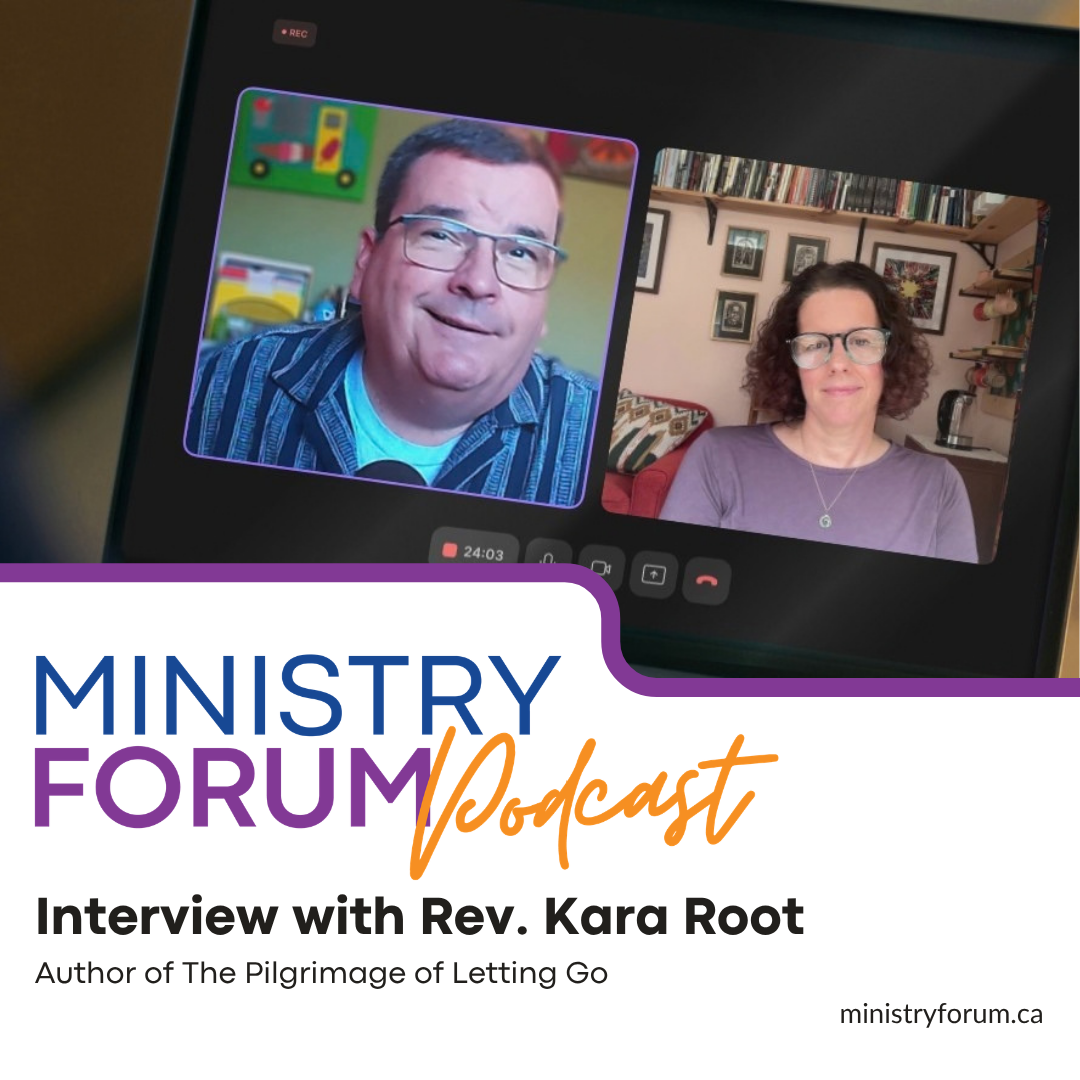

About Rev. Kara Root
Rev. Kara K. Root is the author of The Deepest Belonging (2021), Receiving This Life (2023), and A Pilgrimage Into Letting Go (2025, with husband, Andy). Pastor of Lake Nokomis Presbyterian Church in Minneapolis, MN, a Christian community that shapes its life around worship, hospitality and Sabbath rest, she is a trained Spiritual Director and Certified Educator in the PCUSA. Being mom to two intrepid young adults (and a goofy dog), and partner and proofreader to a wily theologian, spices up her vocational calling and keeps her fully immersed in life. She has written for Sparkhouse, Working Preacher, Christian Century, Christianity Today, Faith and Leadership, Patheos and more. Kara leads retreats and workshops on sabbath rest, prayer practices, and church leadership and transformation. Kara and her husband, Andy, speak and lead workshops together through Root Creative.
Show Notes
Buy the book A Pilgrimage Into Letting Go
And if you are interested in Kara's other books (without Andy), she is an amazing liturgist and writer of spiritual practices, check out:
Receiving this Life: Practicing the Deepest Belonging
The Deepest Belonging: A Story About Discovering Where God Meets Us
Find the hereFollow us on Social:
Transcript
[Introduction]
Welcome to the Ministry Forum podcast, where we believe that you are not alone in your ministry journey. I'm the Reverend John Borthwick, your host, coming to you from the Center for Lifelong Learning at Knox College. Here we connect, encourage, and resource ministry leaders all across Canada in the joys, the struggles, and everything in between. I love that I get to do this work, and most of all, that I get to share it with each and every one of you. So, thanks for giving us a listen today. Whether you're a seasoned leader or just starting out, this podcast is made with you in mind.
[John Borthwick]
Today on the Ministry Forum podcast, if you're a parent watching your kids grow up too fast in a world that you can't fence in, or maybe you're a ministry leader carrying a church you feel personally responsible for saving, then you already know the ache that this book names; the exhausting, sacred, impossible work of trying to control what was really never ours to control in the first place. I'm joined today by Reverend Kara K. Root, pastor, author, and co-author with her husband Andy Root of “A Pilgrimage into Letting Go”, helping parents and pastors embrace the uncomfortable. Andy will be joining us in a future episode of the Ministry Forum podcast for a discussion on his newest book, “Baal and the Gods of More”, so you'll get all sorts of roots over the next little while.
Today we're talking pilgrimage, something near and dear to my heart. The book began as the best books often do, with all sorts of anxiety. Anxious about their teenagers stepping into adulthood, anxious about their ministries in a season when the pews kept emptying and the pressure to fix landed squarely on its leaders. Rather than pave the road smoother for their kids and their congregations, the Roots did something stranger. They laced up their boots, and they walked a 63 mile, but really, it was like a squillion miles longer than that. At least if you read the book, you'll know what I'm talking about. A pilgrimage through England and Scotland, following the ancient way of Saint Cuthbert, in trying to learn how to let go. I'll be honest with you, I picked up this book expecting a bit of a parent's memoir, a family's long walk down a hard trail, and actually maybe a little intel on a pilgrimage that's been on my bucket list for it seems like forever, which the book did actually. I've got some really good intel on some things I'd like to check out if I ever get there. But what I also found was a parenting memoir plus a mirror held up to my own leadership in congregational leadership when I was there. Kara and Andy are in deep conversation throughout with the German sociologist Hartmut Rosa and his slim, but potent book, “The Uncontrollability of the World” which I actually read immediately after reading this book. So, Kara can tell Andy that he's finally got me reading Rosa. Yeah, and oh my gosh, that Andy-he's yes-and Rosa gave me some language that I didn't know I needed. That the whole modern project is a drive to make the world visible, reachable, manageable, and useful, and that the harder that we try to grasp on or hold on to it, the more the world goes mute and slips out of our hands. Rosa's alternative is a word that you'll hear a lot today, and it's this word called resonance. The uncontrollable goosebump and sometimes tears experience of being genuinely met by something outside of ourselves-and so this is a conversation about control and its costs, about parenting and pastoring as two forms of the same holy surrender, and about a church that it turns out was never as fragile as our anxiety told us she was. As always, I'd encourage you to read the book for yourself. There are prayers and practices in here that I've already started borrowing, and I plan to take them with me if I ever get there into that space and time to set out on a pilgrimage of my own.
I also discovered through this Kara's own great works for liturgy and worship and spiritual discipline and practice some other books that you should definitely check out if you've not learned of her great skill as an author and a liturgist and someone who talks some amazing ways of thinking about spiritual practice, do check those out as well. But for now, settle in, clench your hands a little as we get down that anxiety-provoking journey of parenting and parish ministry. Kara, welcome to the Ministry Forum podcast. It's amazing to have a chance to talk with you today.
[Kara Root]
Thank you. It's so nice to be with you.
[John Borthwick]
Yeah, it's great to talk to a different route. I've known Andy for a long, long time, intersected a few different ways, and I've always heard beautiful and wonderful things about yourself. But to get to meet you actually virtually in person is a wonderful thing. So, thanks for this gift.
[Kara Root]
Yeah, thank you.
[John Borthwick]
So, this book started with a kind of anxious sort of moment, not exactly clarity, but maybe take us back to that season that made you and Andy think that the answer to your worries about your kids and your ministry in particular in the church, but also Andy's sort of maybe surveillance of the church as a whole, how that might be the answer to that might be this 63 mile, and you're going to say it, I know it was much more than that kind of walk. Why a pilgrimage, and maybe why Cuthbert's way? Take it. Yeah.
[Kara Root]
So, this is funny to me because the marketing of the book and the framing of it actually reflects more our mindset in sort of being trapped in this modern way that Rosa is describing than the actual reality of the experience. We can't even really talk about or think about the experiences of our life without framing it in this way. So, we did not think, oh, we're so anxious, how are we going to have to take control and solve this? We're going to walk a pilgrimage and take care of that, right? I had wanted to walk a pilgrimage for a long time. I did not want to do the Camino. It sounded too hot and crowded. So, a Northern England/Scotland, you know, I'm a Minnesota girl. That just felt like a good fit. We have a family of four introverts that have found that the way we most connect is when we're not at home, when we're traveling together, when we're walking together. So, Andy said, "Hey, you know, what if we all, what if we all walked this pilgrimage?” And then, in God's gracious timing and the world's you know tragedy, it was postponed twice because of the pandemic. So, by the time we arrived at it, our kids were at that age of being. Our son was just on the cusp of his senior year, getting ready to leave the house. Our daughter was now a full-blown teenager, and we, you know, we had come through the pandemic to the other side, and we were in this sort of space. So, I think what happened, we had a Andy and I had a wonderful professor, Ray Anderson, in seminary who used to say, "You can only know God's will in hindsight”. So, I think as we look back and tell the story, we say, "Oh, wow! God had some plans to release us from some anxiety we didn't know we were seeing the world through”. So, it's more it's more that sort of experience that that as we gave ourselves over to this walk and to being present with one another, you know we prepared what it what was going to happen and then we were in the moment. It wasn't until late that time and as we were coming out of it, that the lessons of that kind of began to sink in, which start with highlighting, you know, your own anxiety. I mean, you know, we’ve spent a lifetime raising these kids, and all of a sudden we're, you know, we're at the end of a long, sweaty, gross day, and we're sitting in a restaurant, and I'm like, you know, trying to tell them what to eat, and make sure you take a shower and make sure you get sleep and it's like that that season's done. I mean, this was the realization that one more time of me reminding them to take their pill or eat some vegetables. Like I've hit the limit. This is their life now. So, it really felt like even just right out of the gate, it was kind of if I'm going to be with them, I have to be with them now, who they are, and not in these roles. And that's where the that's where it started to shift to realize, like, wow, I address so much with control. When what I'm really longing for is connection and for a full and joyful life for them. But I smother it by trying to force it to happen. So, it really was a self-restraint experiment for me for most of the time. You know, can I can I try to not say the things that are ready to be said? And the more I practice that, the more they came out of their shell, and the more connection we actually had. So, yeah, I guess that answers your question. The anxiety, the anxiety arises when you get into a situation where all of a sudden, it doesn't do any good, and it doesn't, you know, doesn't apply anymore and then you're like, "wow, I carry this all the time”.
[John Borthwick]
Yeah, and so much of what you've just shared in this just sort of just to pick on Rosa's word resonates. Sort of resonates with myself as well. So, I have two kids, boy and a girl, older boy, younger daughter, son is 25, daughter's 21. I've been down this kind of journey. I was in congregational ministry for 26 years before I took on this role three years ago. I would often say that what I learned in parenting, the parenting journey, and what I love about the way your book frames it as well, because I would have maybe your book gave me some words or connection to it, but I would have said that part of just our spiritual journey as being humans, and if we decide to, if we desire or are able to have children, is a journey towards surrender.
[Kara Root]
Yeah.
[John Borthwick]
And if you fight that, which I've fought my entire life, if you fight that, it just makes it harder and worse and can really impact relationships. So, I love the piece there where you say, you know, how do I restrain myself from offering input? You know, my discipline has been, there's times where I just don't need to say anything in this moment, just hear it, reflect it, be open to whatever comes my way. And then there are other times where you know, through therapy and all those good things, I've learned to also offer with a sort of sense of, would you like me to offer? I have some thoughts. I've been around a little longer than you in this universe. Would you like a thought? And do with it what you will, like there's no attachments to it, and I see that now. I would have said that you had said in our in our pre-conversation, you've been in the congregation that you're you've served for 18 years, and I was in a congregation for 21, and I would say that even that journey within that long space are the times when I probably started very much me thinking that I'm controlling this thing, and then having the opportunities and bearing witness to situations where it was very clear, friend, you are merely a visitor, despite the fact you've been there for 20 years or whatever. And there have been many times in my congregational ministry where it's like, you don't have to fix this, you don't have to say anything, let this thing happen. Bear witness. Be with. Be present along the way. And so, the fascinating ways in which you're connecting those two things.
[Kara Root]
Yeah, and that I think maybe the best self-talk for pastors is exactly that. Like, this is not my church. This is God's church. And so, the parenting connection too is like this is not my life I mean they our lives started super intertwined but this is their life and I'm becoming kind of the background in their story so how do I help. How do I sort of stand back and watch and celebrate their life unfolding and so that word surrender you used is there for both of those roles for sure.
[John Borthwick]
Yeah, and I don't know where I got this from, it was a long, long, long time ago, but similar again. I love how you parallel both. It was something along the lines of probably something I've read that said: “children are not ours; we are merely stewards of their lives along the way”, and same with parish ministry and stuff like that. But, that was a great in a way kind of liberating - it again allows you to let go a little bit of this notion of because you hear the language from our friends and colleagues and everybody else around there's this sort of controlling. I can remember a minister who used the phrase “They were working a lot at their church”, and I just said, "You know, what are you doing when you're there” And they said, "Well, I have to run the church”. And I'm like, "Oh my goodness, friend, what are you running? Like, what's going on there”? I don't run the church. In my 21 years, I never ran the church. That's not how I saw it. And so, yeah, it's a fascinating piece. But let's dive into again around the parenting thing. Another phrase you use that I hadn't heard of before, but I realized, oh my gosh, I think part of my journey has been this. You use a phrase called snow plowing. I've heard the helicopter one, helicopter parenting, but then this snow plowing thing. As I said, my kids are 25 and 21. Ouch!
I mean that word and just sort of gone a self-reflection for myself, there was this piece of oh my goodness, there's been a lot of snow plowing I've done, but that lens of as you were engaging on this pilgrimage, maybe you could speak a little bit about you know what snow plowing is, what it costs us when we do it as parents, and also what it costs our children as a part of it. You're definitely not judgy in this book, but you know for my own self as I read it, I thought, oh man, yeah, there's been a bit of snow plowing in this household for sure, yeah.
[Kara Root]
Yeah. Well, I think it's hard to escape. I mean, this is why Rosa's lens is so helpful. Just to say, this is the stage we're in as late modern people. It's how the entire society functions, you know. And now we have so many resources at our fingertips that you could spend every second of every day, you know, bolstering yourself on how to be a good parent, and yeah, so we're driven towards that. So, the idea of the snowplow as opposed to the helicopter, I mean, the helicopter is like hovering there. Snowplow is like I'm not going to work on preparing my kids for the road. I'm going to prepare the road for my kids. I'm going to get everything out of the way that could be an obstacle. I want them to have a smooth path. I mean, we really glorify ease and smoothness in our culture at the time. And the problem with that is that’s first of all that's not real life. And, wow, is there a level of arrogance there to think that I can create the world I want my kids to live in. I mean, that would be lovely, but it just doesn't happen. And it also is so driven by fear. I mean, what is it we're actually fearing? If my if my child runs into an obstacle, am I so afraid of their incapacity to deal with it, or of this obstacle's ability to utterly crush them, and what am I communicating to them by my behavior or by my emotions around the difficult struggles of life? I'm making it - I'm upping the antes so that when those moments of suffering or crisis arrive, they're going to be less capable of handling them and less resilient. It would be awesome to protect our kids from heartbreak and you know mistakes and all that sort of thing. The heartbreak and the mistakes are what it means to be human, and they're what deepen our capacity to really be alive and connected to other people and to God. So, we grieve with them. We share those experiences. We communicate that there's such a difference between suffering and suffering that's shared. It becomes a holy place where we really encounter God when we share suffering. And so, I think, what our kids need to see from us is people who are not afraid of the obstacles. Which actually we are. And so, there's something in there too that we say, you know, being brave is being scared and doing it anyway. We're not just not scared, but fear does not reflect accurately this life that we've been given. That's already completely connected to God and other people. And so, you know, when we begin, like my congregation, we have some sort of mantras or phrases that kind of help keep us in this in this space of trust. And the first one is that “worrying is practicing fear, and resting is practicing trust”. And so, we're Sabbath keeping congregation, and so that that helps us into that rest mindset, but boy, have I been called out on the worrying as practicing fear. I mean, it's just rehearsing a certain story about the world and about God that is not helpful and not true. So how do we how do we accompany our kids on the path that's laid out before them, rather than try to sort of go in front of them and clear the road for them to make it easy?
[John Borthwick]
For sure. And I'm sure you hear it, and I've heard it time and time again that you know when people want to pick on the most recent generations, the younger generation, it's often this piece of they have no resilience. And again, just a bit of a conviction, what part have parents who have tried to clear the way and make things easy or whatever played in that? I have family who are university professors, and they talk about parents contacting them on behalf of their young adult children and asking for this, that, or the other, and they're like, your child is 18 to 25. It's their time to do this for themselves now, and yet parents are still doing the work of snowplowing even into young adulthood. And I think, like you say, it feels connected definitely to fear, our own fears. So often our striving for control is often motivated by fear, and it's like, well, if I can't control this aspect, at least I can control this, and then I don't feel as afraid because my own life might be swirling. I think we're going to get to it, we are going to get to it where we're talking about you know often we're raising our kids in in the proximity to getting creeping towards our own midlife, and what's going on there, and what's going on with that as well. Let's talk a bit more about Rosa. For those who don't know him, this this book typically anything connected to Andy's got a bit of Rosa in it. Please don't tell him, but you know, as I will tell him, I've told him before. But when I've read his secular age series, there are times when I would just start to gloss over when he would go deep onto Rosa. You know, I love some bits and pieces, but then I go, “oh my gosh, what's - here we go”.
[Kara Root]
“What's he talking about?”
[John Borthwick]
“I don't know where he's going, but” - this one was really accessible. And actually, for anyone who's never read Rosa, the little book that you that you riff on, exceedingly accessible. I found that so helpful. One of the things he talks about is the modern project is about making the world visible, reachable, manageable, and useful until every relationship becomes what he calls a point of aggression. When did this framing from Rosa really put words into how you navigate the world as well? Maybe as a family or as just for yourself or whichever.
[Kara Root]
Yeah. Well, I have been for several years with a group of clergy, who have done some reading of Rosa together and have thought about resonance in our congregations. So, it's kind of been on my radar. Plus, I'm married to Andy, who's thinking about him all the time. So that is kind of hard to avoid. But I loved the unpacking of it. That actually that effort to make things controllable is the visible, manageable, reachable, and usable, and how much that does not help us as pastors to actually open up the mystery of encounter with God when we try to package it into such a usable, reachable, completely you know, insular sort of nugget that we hand to people. We've killed it. We've killed the capacity to really be moved. So that’s definitely a piece. So that the points of aggression have to do with the fact that like we run into those places of wanting control, and when we can't, you know, when we can't have it, everything becomes this like, well, it's the opposite of surrender. It's sort of the demand that the world surrender to my agenda. And oh my gosh, we see that everywhere. We tell some stories in the pilgrimage book about that. I mean, you know, a fight over an ice cream cone and an encounter, just sort of witnessing this happening between a pedestrian and a motorist, and realizing that we live in this mode all the time. Like it, we don't encounter the world as something that has something to say to us. We have this like drive, and this this also is a piece of Rosa. Just everything is going so fast, and it's speeding up. And there's not in our late modern consciousness the idea that actually if we if we just be here, we're gonna have the sort of humanity in life that we're made for. We just keep going, going, going. So yeah, if you're trying to squeeze all of the relevance and you're moving towards optimization and you know efficiency, then yeah, you're going to be an aggressive individual.
[John Borthwick]
Indeed, yeah, just pushing things through all the time, right? Yeah, wow, yeah, it was incredibly accessible and certainly framed helped me to frame a lot of things that I hadn't had words for in diving into Rosa and the ways in which you and you and Andy you know riff on it as a part of the of the journey through the pilgrimage was really, really helpful along the way. I didn't expect the - I mean I should have - but I didn't expect this theology of leadership that you talk about as a as a part of the book, and I will say the image that really undid me was describing the church as a “fragile great grandmother that we feel we have to take the car keys from”.
[Kara Root]
Yeah.
[John Borthwick]
That was a beautiful image when maybe she's the one to do the parenting, to be parenting us. Can you unpack that image a little bit for folks before they read it? Just a sense of that.
[Kara Root]
Yeah. Well, maybe partly to sort of describe the moment when the awe of the largeness and eternalness of the church kind of sunk in. And this is after we'd walked this whole pilgrimage. It ends on the Holy Island of Lindisfarne, which you have to go across the mud flats for like an hour and a half to get to. So, you wait for the tide to go out and you trudge through this sort of muddy muck, and every so often there's a platform because if you get caught out there in the tide, you're supposed to climb up the ladder and wait, or else pay a good fee to be picked up in a boat. But you might spend the night there. So there's this like sense of adventure and finality to the very end of this this event, and we get over to the island, and it clears out in the evening of all the tourists who have to make it back across the causeway before the road is covered by the water, and so then we're in this sort of holy silence of this place that was settled like in 400 by Saint Aidan, and so we make it to this little Chapel, some of which of this church, the stones have been there since then. And after we share evening worship with some strangers and other pilgrims, we're walking around looking in this space, and there's a plaque on the wall that lists every like vicar and bishop and pastor of this church, from literally Saint Aidan to the woman who's there currently. And it all fits on this little plaque, and we were just marveling at the centuries of the presence of the church in this place. But as we begin to look through it, we're scrolling back looking for Cuthbert, and we see this little gap of time. 300 years, where there's nobody listed - there's nobody on the island because the Viking raiders came and the monks dug up Cuthbert's body and fled. And for 300 years longer than my country's been around, there was nothing happening. So, was the church dead? I mean, that's what it was – just this is hilarious. The kind of myopic arrogance we have to think that the church is weak or the church is feeble or that we in some way are the generation that's going to save the church or redirect the church from its, failings, when in fact the church has been way before us, will be here way after us, and God is doing what God is doing, and like how amazing and humbling that we get to have a little piece of that story. our lives are part of that river, but we certainly don't direct the river. So, there was some lovely kind of humbling in that, and then just reflecting back on our experience in this time of being church in a secular age, in a culture that feels like it's really struggling to even identify what does church mean, and that urgent call from colleagues and other voices, particularly on social media. If you want to be good church, you should be doing it like this. And we just sort of looked at each other and laughed, and like, you know, God's going to do what God's going to do. And there's just freedom and in the participation of that that we're not in charge.
[John Borthwick]
Yeah, it's always been something serving as a pastor for a long time, you'll often hear the older generation sort of say, you know, “Pastor/Reverend, what's the future like? Will there be a church beyond me and everything else? And what about what will it look like?”
And it's like, I don't know. And I've tried to ground myself in that notion of I don't know what it'll look like. I don't know what it will be. I can only imagine it won't be exactly what we have when we're sitting in the ladies' parlor at this old stone church building. It may not look like that. Just the fact that you ladies are wearing pants and we're in the ladies' parlor that the people from like 100 years ago would be horrified by. There's probably something in the generations from now who won't even think of like that’s how they did church? Or what will it exist as? It's fluid. It's different, but yeah, like there's a sense of something of this will remain no matter what. And I love that you offer that as an opportunity for people to reflect on that, like, yeah, what happened for 300 years, and yet, you know, there's now someone still serving, and the iterations and the changes that have occurred over the years, right?
[Kara Root]
And that's a particular congregation that has been there that long. Most aren't. No church that Paul planted is still around. So, the idea also that we're meant to kind of preserve or bolster our own individual congregations is very unhelpful. You know, we will or we may not be here in years to come, but that doesn't say anything about the church. The church is going to remain, and the church is going to be who the church needs to be. So, let's try to be that faithfully for this chapter that we are stewarding it, and then otherwise, it's really not our show to run.
[John Borthwick]
Yeah, and think you name in the book a little bit, you know, and you've said it already a little bit of how it's kind of been drummed into us, perhaps in church culture, this idea of like you know, we need to work hard to control the church in some way to make it what it is, or to go to the conference, or do the things that are going to make it right or good. I found that when I was reading the book, there was this sense around a leader needing to really think through what is what is faithful action along the way, and what is really us taking on that anxious control? Like I'm going to this conference, I'm learning this new thing, and now I'm gonna, kind of force it down your throats because we must do this or we must do that. Can you can you speak a little bit about what faithful action looks like, despite as opposed to this anxious control?
[Kara Root]
Yeah, so it really for me has come around this sense of orienting my congregation to the question, "What is God doing now?” So, faithful action is listening and waiting for the Holy Spirit to move, and figuring out what does that look like, what does that feel like? How do we know when something's from God and something is, you know, from us or in digestion, as they would say? And one of the markers of that, is actually, that we've come to really rely on is joy. So, for example, when we ordain and install elders, we have added the question: “Will you serve out of joy and only as long as it gives you joy?” And they answer “yes”. And I will tell you what a gift to have a leadership team that is only people who feel called to be there and feel a sense of investment and purpose that comes not from them because the second that they don't, they're no longer a very fun person to be a leader with. If they're there out of obligation, or this is my turn, or someone's got to do the hard thing, and to have those people recognize, you know, oh, I might not be the person for this at this time, and step down and celebrate that decision as a way of being faithful church has been transformative for our congregation. So, recognizing that this is God's church and not ours, that means that when each person is living and participating out of joy, the ministry of this congregation at this time will happen. It's not something we have to make happen. And if you have a role then that you're trying to fill and nobody's stepping up, or the person who's filled it for 11 years, feels like they have to leave the church in order to get out of the job, you're keeping that role from someone who is being called to it, or this is a job that's done, and you guys are just propping that door open and trying to keep it going when God is doing something else. And so, when you start paying attention to what is God doing in the life of our church, you may find like, oh, the season of that ministry is over because look at all this beautiful stuff that's happening over here that we wouldn't have the energy to give to because we're trying so hard to keep doing this thing we've always been doing. And it's awkward, I mean that's a theoretical thing that then some people are like oh yeah that's fine you can believe that, but what happens when you don't have a clerk of session. Well, we didn't have a clerk of session for almost three years because we had shifted into this mindset, and every week I would put, if you're feeling called in the announcements. Nobody stepped up, and I was both like proud of them, also like, oh my gosh, somebody better step up! I could feel the control kind of coming back, but you know, somehow everything still happened. People all stepped in the roles that needed stepping in. It was, finally, a woman who was stuck in the nursery for years and had come back finally free to just participate. She sidled up to me one day and said, "I feel/I think called to be the clerk”, and she was a fantastic clerk. So, the church is going to church. The Holy Spirit is going to move. How do you do that? How do you join in and become practiced at watching for what God's already doing among you?
[John Borthwick]
Yeah, I found both in reading Andy's books and this one as well, I can hear ministry leaders, and I've had some of my own sort of arguments with the book a lot. Not arguments, but struggles with the book of like, yes, I see it. I want that to happen. But oh my gosh, don't you realize that when I go to my session or my leadership team or my board, and say, “you know what? We're only going to have people serve as long as they're experiencing the joy of serving”. My people will lose their minds because people will, but we know it's right, right? We know it's the way it should be. And I love that that line you use about, you know, we're essentially propping our foot in front of a door that God is trying to close, and oh my gosh, I mean I think that's the definition of so much of the institutional church right now, and the systems that we're a part of. Because even within our denominational systems, it's like, well, we have to have these things, and when we when we push back and say, well, why do we have to have these things, and there's no joy in this. It's like, yeah, but you must have it because I could I could hear in in my system, a church without that key leadership role, like a clerk of session, can't be a church anymore. Like you're in trouble. Like this must be fixed. And it's like you know what we're going to hold the line. There's also a piece that I'm hearing in this of Edwin Friedman's notion of that non-anxious presence. Like as a leader, I think what you're offering so beautifully is that you know not to say you aren't anxious behind the scenes, but that non-anxious presence to the congregation and to the community and the system that you're serving of, we're gonna hold this. It's gonna be okay. Like it's gonna be okay.
[Kara Root]
Yeah. And the parallel there with parenting too. Like, of course, behind the scenes, you're freaking out, you know, with your co-parent or whatever, but what you're projecting is, you know, you got this, I got you. So that's a piece of it. I heard a wonderful interview years ago with David Sindelrost and Krista Tippett. And David Sindelrost does gratefulness. He's really big about gratefulness and gratitude, and he's a Swiss monk, a former monk. But anyway, he was saying that the word anxiety, the word for anxious, it comes from the Latin root “to be squeezed”, and that we have this sense like we can't breathe, this anxiety. And the original anxiety or that original experience is our birth, like going through the birth canal and coming out on the other side to life. And that if at any point in that process the mother or the child were like, "No, this is right. I'm not doing this”, you know, it's death, right? But always we are made to live through these moments of anxiety, and that what will come out on the other side is new life. Ao there is a sense in the leader of trusting, like, oh my gosh, this feels awful, and It's okay to say this feels really hard, but also know that this actually means something's coming. There's new life on the other side of this. Whatever was - can't hold anymore. You know the wine skin image, so let's make ourselves ready then for what's coming. And that's even played a role for me in church conflict situations. Like when you want to know what the Holy Spirit might be up to in your congregation, look for the conflict because it means that there's a point of tension. There's a point there where the smoothness isn't working anymore. Whatever needs it was meeting may not be meeting, the people aren't connecting, but that means there's the possibility then that the Holy Spirit's going to act and bring something new and how do we listen and join in when that's ready to happen?
[John Borthwick]
Yeah. Wow. Yeah. For sure. For a lot of ministry leaders, I think a lot of us need to work on or find ways to work on and practice that that piece of being non-anxious, but that also that piece of opening ourselves to that awareness I think you're talking about. Like how do we become aware more deeply of what's going on. The one thing I do wonder in what I observe in the work that I get to do, the phrase that's used all the time, and this is where Rosa's work was so impactful as well to me, was this “frenetic busyness” that ministry leaders talk about all the time. I think that's where when you get caught up in it, it's like there's a bit of an adrenaline piece to it. It's like there's just so much going on that you can't slow down and get that spirit. And I sense that everything I'm hearing from you in your ministry-not to say you've got it all down and you're perfect and all that good stuff-but there's a sense that even from the congregation you're describing, the lived shared life you're describing embeds some of that into it.
This isn't my own personal confession time, but I will share a little personal confession. In my early days in the church, I served for 21 years, and over a few different occasions, I tried to get them into a place where we could do a thing of laying fallow stuff, like all the things of our church and laying them fallow. I'm curious as to whether-or-not you've tried something like that, or you have a practice of that. Maybe I was asking for too much from them, but we just had so much going on in the church that I served, where I just said to them at one point (we had 18 committees), and I said to them at one point, “you know, the Bible talks about this thing of like declaring a year of jubilee or something”. Like, what would it look like if we just shut it all off and just hung out together and then determined what we're going to pick up. I mean, that was my own personal practice, and what's helped me thrive in ministry. Every 5,6,7 years, I would take a sabbatical and have that rest, and then truly think about what am I picking up? There are things I have to, but what else am I picking up? What am I saying no to? What am I saying yes to? Is that a practice? You said your congregation is a Sabbath-keeping congregation, I am teasing out other things that go on in in your church there.
[Kara Root]
Yeah, it's become really very central for us. And it and it is this sense of like, okay, if we if the whole world and everyone in it belongs to God and to each other in Christ, that is a that is something we can't control. We don't have to make it happen. We can't break it, even when we lie and tell ourselves we're divided or whatever, we're choosing to believe something that's not true. God like commanded Sabbath, so it's actually pretty funny. We Protestants, we pick and choose which are the commands that apply to us, and that one we we've decided is no longer relevant. But the truth of the matter is that I mean, when you think about shifting a people of God whose life is meant to be centered on the person of God and in an obedient and trusting relationship with God, but they've lived 400 years in slavery and the mindset of slavery, the mindset that your life is only as valuable as what you can accomplish, what you can produce, and I would add for our era now, what you can consume. So, production and consumption is what it means to be a human being in the modern era. When God delivers them from slavery, you know, like I can't even remember where I first heard this phrase, but I just latched onto it. The other nine commandments take the people out of slavery, but the Sabbath command takes the slavery out of the people. And so, when we rest, what we're essentially doing, we're practicing trust by saying the world doesn't need me to keep running. You know, I am not God, which is like kind of counterculture. I mean, when you think about all of what Rosa’s is saying about control, we've been pretty good up to this point at being God. I mean, it's starting to slip. Our technologies are failing us. We've consumed and produced the heck out of the world. It's not sustainable to keep being God at the level that we keep being God, but so far, that's how we live, and we tell ourselves that.
And God says, if you don't stop on a regular basis, on a rhythm that isn't yours to pick and choose, and not for the purpose of increasing your efficiency and productivity. Just stop and surrender to being a human being loved already by God, already completely connected to every everyone else in this world, in the world that God is running and you are not. You're going to keep forgetting that you're going to just keep living in this sort of inhumane, unhuman way. So that is a mindset that has sunk deeply into my congregation over 18 years. When we first started practicing Sabbath and sort of did a lot of study around this, we did a year-long experiment of altering our worship services so that twice a month we meet on Saturdays and we take Sunday as a day of rest. And you know, my kids were three and one when we started that, and so their whole life has been in this rhythm of, there's days that we're not online. We are saying no to a lot. Sometimes it's I don't I'm not going to get together with friends. I'm not going to put on the hockey game. You know, whatever it is, to say we have to stop. We have to stop and receive this life that we have. Be present and available to what's coming. And what I love then about the Jewish practice of Sabbath is that as you exit the Sabbath day, there's this tradition of passing this bowl of spices and inhaling the odor and thinking, what is the sweetness and the gift of the rest that now I take into the rest of my week that will shape the rest of my week. So, when you believe as our Bible does, I mean as it's written that the day begins at sundown, everything starts in rest. And so, once we've rested and we know who we are and whose we are, we move into action in a participatory way that does not, you know, take control.
[Kara Root]
So, it's definitely a counter practice. There's a surrender to it, you know, to trying to make everything manageable and usable and reachable. And it is saying, “I actually can't do that, and so I need to stop”. So, we have canceled VBS a week beforehand because our leaders were burned out. You know we have had seasons where we've said, "Wow, we need to pay better attention to the capacity of people, and we need to do almost nothing right now”. And then we need to ask God, "What is it that's meant to arise in this time”? And when we've done that, some of the most powerful experiences and practices have come out of it. Like shortly after the pandemic, when we came back together, and you know everything had fallen apart, all of our committees had dissolved. Everybody's just exhausted from this like weird thing we've all lived through, and now you have this panic about like rebuilding the church structure or whatever. We took the opposite approach and just said no. We're just going to wait for God to tell us what's needed. And a few months in, we began to realize that every single one of our parents was in crisis. And you know, anything we would have asked them to do would have felt like a burden. But when we said what would it feel like to have a once a month gathering where we fed you, and then you had a spiritual director, and you could just be heard in where you're at. And every one of them said, "I want that”. And so, the next thing you know, we had holy listening groups. We trained people in group spiritual direction. We had a dad's group and a mom's group. The older folks in the congregation made meals for them. I took the kids, and you know, nine months in, the people who were not in these two groups said, "Hey, we want our group too”, and so they started a group. And this has been now going for several years, where once a month we share a meal together, and people practice holy listening. It's transformed our congregation. It's changed people's lives. But we would not have had the ability to see the need for that or the capacity to make that happen if we had been trying to keep going with all the things. We had to lie fallow, as you would say. We had to just wait and say, "Okay, God, what is it that you have for us”? But that involves trusting that God's real and that God will reveal it, and practicing listening together.
[John Borthwick]
Yeah, I mean that is the convicting statement I think that that I've heard Andy say as well, and you just said it as well, that I think some ministry leaders and people in the pews would be shocked to hear and to really profoundly think about that. You know, have we gotten to a place where we actually don't think God's real because we're running the show? I remember Eugene Peterson in one of his books, he talked about how we have this notion as pastors that when we walk into the room, everything gets started, and he reminds pastors something's been going on long before you ever walked in the room. It's not about you in that way, right? And I can remember coming out of the pandemic, and I bore witness to the curious thing that happened, which was how do we get everything back to the way it was? But the fascinating thing about human beings, and I'm sure there's been some research done on this, but I saw it, I saw it writ large in my leaders, and the bonus of being there for so long was I could actually tell them, no, we actually we've never done that. Because what they were referencing was we gotta get back to doing stuff. But then they were saying stuff like “we used to”, and I'm like, okay, so when was that? “Well, I'm sure you know before the pandemic”. “No”, “well you know maybe 10 years ago”. I've been here for 15, 16 years, and you've never done that in my 16 years. So, what are you really referencing? And the one day where it actually became fully uncovered was somebody referenced their son, and I had to say to the person, "Your son is 60. So, when your son was in church, that's a long time ago, friends”. But somehow this thing that the pandemic did to our brains was it reset it all and then said we've lost everything. How do we get it all back? And so, I love that sense of like, what are we choosing to get back and what do we really need in this moment and how are we going to trust and lead into that trusting? Wow, so profound and so beautiful the way in which you know what you describe in the book and again, I'm trying not to toot the Root family horn too much but just sort of the ways in which you're trying to put out there in a very vulnerable and real way, you know the ways in which you're practicing as a family, you're practicing as a pastor and a leader, and Andy practices in his world of teaching and all that. These integral pieces of what we are called to the story that we're called to embody in the world by our God, who we believe is real, and yet somewhere along the line, we only hear the whispers of that story, and aren't 100% sure, because surely, we can't just leave it up to God. Because I can remember even reading some of the other books that Andy has written that have been heavily influenced by the Rosa piece as well, of saying to people, you know, like “we need to actually just rest in this, we got to stop trying to do stuff”. And I can hear the people now saying, like, we can't do nothing. What are you talking about? It's like we could actually just sit with this. Like, it's not for us to do the next thing. Yeah.
[Kara Root]
Yeah. It's scary, and for the self-judgment that comes for not doing it right, or the sense that we need to sort of succeed at this other way of doing it. I mean, we're just so formed by our own sinful instincts and by the culture around us and the life of shared sin of thinking we're God, of dividing ourselves from each other. That we put on ourselves something that's not actually real. And you know what, where it comes to bear for people is when everything falls apart, and they find themselves with a terrible diagnosis, or you know a sudden loss, or some kind of crisis and suffering. And then it just all becomes real. What actually is the truth here, and how you know the belonging rises up because if you are in a congregation, hopefully people are surrounding you and they're sharing that experience with you, and you kind of come back down to what really matters. But boy, when we're in a moment of feeling our own success at you know being so productive and efficient and whatnot, it's really hard to keep track of what's real, and so it's a gift. It's a gift that the illusion is fading, that the church is losing its sense that we're so marvelous.
[John Borthwick]
Yeah, and certainly there's a lot of voices that want to tell us that that we're still marvelous, and I wonder if there's a piece of this generational piece. I'd said earlier that I was going to talk about how you had mentioned this piece around our own sort of midlife connections with raising kids, and some of that the existential stuff that's going on for people going through that journey. Those are kind of fused. I also think about leaders who are going through their own stuff, who are trying to lead in systems and in congregations. There is this sense of like, for an older generation, I often I have a heart for an older generation when I hear the tensions within the wider church. Conversations of like, you know, this kind of dismissal or this, you know, wanting to clear or push this aside or seeing it solely as a resource. You're a church that doesn't have a minister and you have 15, let's be generous, you have 15 people who are 80 and over. You are no longer viable. You are no longer worthy. You are no longer church. And I live in this sort of tension constantly of these conversations I have where the anxiety of the system is saying one of the reasons why we want to push that aside is because it's a drain on our resources, and so we just want to dismiss that. But who's to say that those 15 people aren't a space and place that is where resonance can happen and where encounter can happen, and it does, but we are so quick to dismiss that. And so, I wonder how you see this, the multiplicity of this generational engagement with the younger generation who you know we're constantly worried about because know they're not they're leaving the faith, they're not connecting to the faith, or they're not in churches, and then this older generation who already are feeling the senses of decline in themselves, and then it being reinforced by the very place where they found sanctuary and grace and love, and all that grief that plays into it, that's a huge question. Pick whatever you'd like to dabble in that that world of all that that I've just shared.
[Kara Root]
Yeah. So, I think first of all, the church is wherever we are sharing life with and for one another. I mean, Jesus Christ is concretely there. So, if it has the trappings of the system and the structures, that's great. But it it certainly doesn't need it. I mean, church can happen on the back porch in a summer when some, you know, your neighbor comes over and has a breakdown about their child. That's church. So, that's a piece of it. I feel like as a pastor that this understanding, especially as Protestants of the priesthood of all believers, you know, we are all ministers, and we are most human when we are caring for or being cared for. I mean, that is us fully living out our made in the image of God. That is us fully encountering the presence of Jesus there with us, and so that's church. If that is church, then, then the structures of church are just simply meant to enforce that. I mean, I think of the gift. Oh my gosh, the gift of worship of coming together to reorient ourselves to who's really God. To reorient ourselves to like, oh right, in all of our life, in every area that we are going to move in this week outside of this building, our people are like these beautiful, mysterious image bearers of God, and anything could happen at any moment between us. You know, I want to be available. I want to be ready. I want to counter the messages that we exist merely as an obstacle or a resource for other people. I want to counter the dehumanization that happens when I see others as an enemy or the other side or whatever it might be, and I can't do that by myself. This is not about just mustering myself out of this place. This is about coming together and saying I am incapable of resisting these messages and this way of life on my own, and I need to be reunited in this life of Christ that we have with each other, remembering what's really real, sent out to live in the real, and I'm going to need to be reminded again next week. So, that rhythm can happen, you know, with or without pastors, with or without a formal building and and title. Not to say that that pastors aren't important. I think they're vital, but we really have lost a sense of what it means to be church if it has to do with the institution and the structures. I think those are merely there to support it. So that brings it back to also again, like church is this thing that God started. It's going to go on, you know. It involves this great cloud of witnesses that have already been. It includes the people that haven't arrived yet, and what does it mean to live in that life that is shaped by grace for love? So that's the that's the call. And then people at different ages, you know, it just means we all have our different points of aggression. Some of us have been through the younger ones, and now we're facing the older ones. You know what a gift we are to each other to remind. When I first started pastoring my church with a three-year-old and a one-year-old, no, my kids were the only kids in the church because it was a church that had faced, you know, mainline decline, and my kids were not always very well behaved. And what a beautiful gift to have this congregation, essentially of extended grandparents who had raised and witnessed multiple generations of kids to say like we got you, yep, this stage is going to end. So, the way that they cared for and ministered to my children was being church to them, and I wouldn't have had that if I was just you know on my own reading devotions and trying to live a good life.
[John Borthwick]
Yeah. I mean, church still can be that space and place that has that intergenerational component. There's so much segregation, for lack of a better expression, in our culture and world of ages and stages, and yet there can still be this sense of this is a space where people of all ages and experiences and life that's what that's what the Bible describes as church to be like this gathering of people from a variety of different places and spaces who come together focused on that one thing that is Jesus.
[Kara Root]
That’s our baptismal covenant. I mean, we make baptismal promises over people, and some of us in there, either in that same space or in some iteration of the church in another place and time, has made promises that we're now fulfilling. And so, seeing too that we have this responsibility to one another to keep remembering together, and I think about that like as dismember too, remembering together that we are the body of Christ.
[John Borthwick]
Yeah, and I just really sense from what you're describing, there is our own anxiety that gets in the way of all that opportunity, both around parenting and about, pastoring in churches or being a part of a church community. How you describe the church you serve, you've served for 18 years, it sounds like a beautiful place. I've heard of a lot of church communities that would not be so beautiful with you know disruptive children or people wanting to rest or do different things or go in different ways. And I think what this conversation may be helpful for folks who are listening either as ministry leaders, as pastors, but also as lay people who might be listening to this, you know really thinking deeply about what is it about us ourselves around our own anxieties and worries about doing things right or getting it perfect or whatever that are impeding? It's that it's that door again. Maybe God is opening the door to grace and love in a moment, and somehow, we're closing that door, so we're pushing that door closed because of our own stuff. And I know as people that our own stuff gets in the way all the time. But I think about the church I served when I first got there. One really telling example one time was someone came up to me in the early days of the church and said “Did you see how the offering? Did you see how Kara did the offering today”? And I was like, “no”. “Well, you know, she didn't do it exactly the way it's supposed to be done, and everything else and I think I'll go and speak to her and tell her that you know she needs to do it this way”. And I said, “no, you're not. Did the offering get taken up?”, and he's like, "Oh yeah, yeah, yeah”. I said, "Then you're going to leave that alone. Like, just relax”. And I had to constantly say to my leadership, especially around worship. When I first started, I said, "Worship is this. I feel like worship is this beautiful, delicate, fragile glass, Christmas ornament kind of ball”, and what you've done to is put packing tape and packing material around it. You've put it in a box and then another box and another box because you don't want to break it. And I said, “I think I think our call as people of God and my call here as your leader is to rip up all that stuff away from it and then start juggling it in worship and see what happens”, and they were terrified by that. But there was a sense of like that's I think what we're called to be as ministry leaders. So much of it is structured and planned, and it's like oh my gosh, folks! Like how do you get out of the way of your own anxiety? And I sense that the pilgrimage that you were on was insightful for that. And hopefully, as people read the book; they'll catch some of that along the way, and certainly from this conversation.
[Kara Root]
Yeah. And I think that there's two pieces that can happen then is like we're very quick to turn even the practice of non-anxiety into a practice that we try to perfect and control. So, I am not a non-anxious person. I get anxious all the time, and I get called out by my friends and leaders and kids, and that's the piece of it too. We don't have to be afraid of the conflict, of the callouts, of the missing. One thing every single time our session meets that we start our conversation with is where did we see God this month? And where did we miss God? And the gift of that sort of the living into the grace is to say that whole project, that modern project of doing things right, of comparing ourselves to whatever it is we're comparing. That's false. We're just simply meant to see one another as human beings and be open to the presence of God that's going to encounter us when we do. And so, then it becomes that just sort of joyful anticipation of what might happen, and when those moments arise where we're like, “oh, I just got real concerned about how the offering is being taken”, like that’s where there's grace and compassion for that because the longing underneath of that is for a really wonderful worshipful experience for people. We just get caught up on the how too and the doing. And so, the self-compassion too really helps. And just saying like, oh, we're gonna keep getting off track on our thinking about this. And it's not about trying to perfect that. It's about just being with each other. And so, there's even an opportunity there. God can meet you in that moment where you just really shifted into control, and somebody called you out on it. Like, what a gift that is! I mean, that makes the next encounter more real and more filled with personhood.
[John Borthwick]
One of the themes we talk about at Ministry Forum all the time is that you're not alone as you serve, and I run into a lot of leaders who feel pretty isolated at times or close to burnout. I didn't even know what this guy was talking about the other day, but I was talking to somebody and they said, “you know, John, I was I was close to the B word”, and I was like, “what are you talking about”? Are we now not saying the word? And finally, we unpacked it and discovered, yeah, he was close to burnout. Oh, okay. Thanks, okay. But they're you know holding on so tightly to certain things. They talk about things of like, “there's no way could go on an intermission” (intermission is our sabbatical), “there's no way I could go on an intermission and go and do a Saint Cuthbert's way”, “there’s no way I could leave the congregation at any point. It's difficult to take vacation”. You know, “I'm so needed here. I'm so essential”. And these are conversations I'm having too often with ministry leaders and trying to remind them all the themes that you've already been touching on. But if you had like one or two thoughts of what you might invite them to let go of as a part of this journey of ministry that you've had for almost two decades or more? What do they need to release as a part of that journey? What would you say?
[Kara Root]
Yeah, I think for me, some of it that's helpful just to sort of disengage and put it out there is to say, I'm telling myself that if I leave, the church is going to fall apart. I'm telling myself that it cannot run without me. I'm telling myself that I'm central to this. I can't even take a vacation. That's just helpful reframing for opening up, because most of us don't believe that's true in the reason, we're in ministry is because we think this is God's church, and yet functionally we're atheists in the pulpit. And so those moments when I'm telling myself those stories that make myself so essential have become for me a red light. Like, ooh, I'm in trouble. This is a moment that if I don't step out, I'm gonna be taking the reins away from God on some things. So, that piece of it is important, and then also just the trust that actually, there is joy in this for you too. Like God has called you to this because your fullness as a human being is when you are serving in this way. So, if you have lost the joy, you've sort of lost a little bit of what your actual calling is. You're doing something that's not fully connected to who God has made you to be and called you to be in this context. So, joy is a helpful barometer. And the final thing is just on the positive side of it, like God's already doing all sorts of things in this congregation, with and without you. And the real practice for the church, I think, that would open a lot of this up, is to just start noticing and celebrating, what are we seeing God doing? Getting used to having those conversations together. Where is the resonance happening? How do we talk about that? We don't have forums to talk about that. One of Andy's books, he interviewed people about when's a kind of supernatural experience you've had, and every single person he interviewed said something along the lines of, "I've never told anybody this before”. Why aren't we telling those stories in our congregations? I mean, this is the place where we get to say together, “we're living in a beautiful, amazing world that God made alongside all these other mysterious people made in the image of God”, and life is happening all around, and we are called into it, and we're even tasting it, but then we're just racing past it and not letting it in. So, let's stop and let it in together. And I think once that happens, the grip starts to loosen a little bit. Once you realize you're walking alongside these people on this journey, and you're not paving the way, and you're not rushing them along, and you're not trying to do it all correctly. You're just being there. You will get better at being available to those moments and to the presence of God, and less anxious about trying to force things to happen.
[John Borthwick]
Yeah. And I think it's part of the culture of church that people have been trained for around the professionalization of clergy specifically. If I was to speak out for clergy specifically and those who are in the pews, that differentiation that has happened and continues, that gulf continues to get maybe larger or has gotten larger. But that sense of I feel bad, I'm picking on my previous congregation so much, but when I arrived, they had had three years of interim ministry. And I said one of my first questions to the leadership is, "What have you been up to in the past three years? What's been what's been good? What's been going on”? And they, the essential of the answer was, "We've been waiting for you to have things happen”. And it's like, oh my goodness, no, what have we done to each other? And I have another colleague who puts it beautifully because it's not how we think about searching for, say, the next minister or finding what a minister's role is in the church. This person describes it as a church should be able to define who it is, and invite a pastor, a minister, the professional paid people. And you’ve used the language beautifully, that's why I bring it up. The idea of how can you come alongside us to be a part of the ministering and missioning. He uses the “ing” words all the time. The ministering and missioning that we are already doing, and we would like you to become a part of that, as opposed to the pastor as the generalist who's going to do all the things and tell us all the things to do, or lead all the things. That that I think is one of the core pieces around church today that's become unsustainable because we have leaders who are feeling overwhelmed by that and maybe aren't living out their joy. Not that everybody should live out their bliss, but maybe they should in certain areas. But at least find the core joy of why and how you are answering that call each day in your life, as you say.
[Kara Root]
Yeah. And remembering too that joy is not the snowplow thing. Joy is not that everything is happy and easy. Joy is that there's a deep sense of connection to a groundedness in what is meant to be. And so, sometimes that's very painful. I mean, sometimes you're in a moment where it's hard and it's not. You know, you're not happy in the moment. But if you left that, you would have such a sense that I need to be there. I need to go back into that place because that's how I'm meant to be contributing. So, I guess my little tidbit then would be don't wait. Not that we have a whole bunch of congregations to pick and choose from, but don't only pick the ones that already seem to be doing this well, regardless of what it is they say they think they're hiring you to do. It's your job to go in there and watch right away for what's God already doing here. And help them practice noticing and telling those stories. Because once you start doing that, the Holy Spirit is who changes us. We don't change each other, but you do also need to come in then with that with that clarity in yourself as a leader. This isn't mine to run or fix or wreck. This is God's church, and I can't wait to see what God's already up to here.
[John Borthwick]
Kara, that I think we can end there. It's been a beautiful journey. I really hope people read the book and connect with it in a variety of different ways. I really think it's beautiful the way that you've, and for pastors who've served for long tenures in places, there is a sense not that the church is your children or any sort of weird imagery like that, but just that sort of notion of having journeyed with people for a significant season. There is that process of knowing that at some point you're going to step out of that situation at some point. In the same way, so regulating yourself as a part of that, just as you would with your own children, as they reach that age where they're going to be who they're going to be, and the greatest hope we would have is that there's a relationship that can continue to have that encounter, that meaning, that depth, that beauty that can continue to sustain us along the way. So, thank you for sharing your pilgrimage with us. I hope I get to Saint Cuthbert's Way someday. Who knows how it'll all work out. But yeah, any other final word, or no? This has been a great conversation.
[Kara Root]
No, this has been lovely. Thank you so much for having me.
[John Borthwick]
Yeah, appreciate it. Thank you so much, Kara.
Thanks for joining us on the Ministry Forum podcast. We hope today's episode encouraged you and reminded you that you are not alone in ministry. If this episode resonated, tell someone. Please don't keep us a secret. And if you can, subscribe, rate, or leave a review wherever you listen. It helps us reach more ministry leaders just like you. And honestly, it reminds us that we're not alone either. Find more resources and ways to connect at ministryforum.ca and follow us on social media at Ministry Forum. Until next time, may God's strength and courage be yours. May you be fearless, not reckless. May you be well in body, mind, and spirit, and may you be at peace.