Talk Treaty To Me
Over the summer I (John) read, Crystal Gail Fraser and Sara Komarnisky’s new book, Talk Treaty to Me: Understanding the Basics of Treaties and Land in Canada (Collins, 2026).
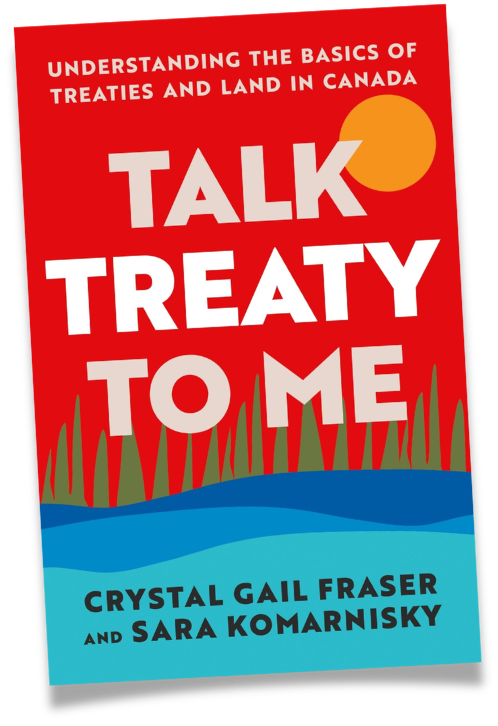
Fraser is Gwichyà Gwich'in (and of English-Scottish ancestry), originally from Inuvik, and teaches history and Indigenous studies at the University of Alberta. Her earlier book on residential schooling in Inuvik won the Canadian Historical Association's prize for best scholarly book in Canadian history. Komarnisky is a settler scholar of Ukrainian, Irish, and Italian ancestry, an anthropologist based in Yellowknife.
The pairing of these two is significant and the book is meant to be written with the very dialogue that their bios present.
I found it to be very accessible. It covers treaties made among Indigenous nations long before Europeans arrived, the arc of treaty-making with Britain and then Canada, Métis scrip, modern land claims, unceded territory, and Land Back. It also covers gendered and queer perspectives on treaty and Land. It has maps, a timeline, and photographs. It ends with very specific calls to action including rethinking land acknowledgements (as I have done here!). What was particularly meaningful to me was their reminder that treaty extends to the waters and the creatures and the land itself… it isn’t just about the humans - we are only one part of the whole. So not only is their historical damage and trauma from our human relationships to consider… but the troubling reality of the climate crisis and the ecological damage perpetrated in Canada adds another dimension to what is currently fractured and in need of healing.
The authors want to make clear that treaties are not historical artifacts that happened to Indigenous peoples. They are living agreements that make it possible for the rest of us to live, work, and worship where we do. Which means every one of us is a treaty person. WE ARE TREATY PEOPLE. But the question for the reader to reflect on is - are we keeping our end of it?That reframing, I think, is where a response might begin when one finds themselves in conversation with someone like the person I encountered one Sunday morning on the road that I shared in this week’s email. A treaty does not say the land was never yours. It says how you came to be here, and with whom, and on what terms. It does not erase the farm. It tells the truth about what made the farm possible, and about the promises attached to it that the other party perhaps has kept better than we have (or have been forced to do so!)
Fraser and Komarnisky inviting the reader to “acknowledge” how we all got here today and be mindful of what all parties thought they were agreeing to.
This book is a culmination or perhaps a formalization of a writing relationship that began for them back in 2017 when they published “150 Acts of Reconciliation for the Last 150 Days of Canada 150" on Active History. The date that they chose to share this list was intentional as there were only 150 days left to “celebrate” Canada 150… Fraser has said since that they were frustrated by the scale of the nationalism and the spending, coming barely eighteen months after the Truth and Reconciliation Commission had wrapped up its work.
Here is a PDF version of the list.
The list mixed small everyday acts that anyone could take up with more provocative ones meant to unsettle how people think about Indigenous-settler relationships. They also developed a poster series in collaboration with Lianne Marie Theda Charlie later that same year. The authors published a five-years-on reflection in 2022 asking what truth and reconciliation actually looked like by then.
This list could be a meaningful inspiration to those in ministry contexts. Maybe your community would want to take on a few specific ones to act on this coming year and revise the list next year. Ordering the posters themselves and sharing them with your context would be another important step.
Further Reading
Last month at Ministry Forum, I encouraged people to read another numbered list book… David A. Robertson’s 52 Ways to Reconcile. He is one of the featured authors of our Ministry Forum Book Walk Project! What a fantastic way to get an intergenerational conversation - OUTSIDE… on the land, among the creatures (maybe even a few squirrels!)
That same email, encouraged you to listen to the CBC podcast by Connie Walker, Missing and Murdered: Finding Cleo. This is a difficult, but essential, listen for all Canadians in my opinion.
The TRC's Calls to Action.
Read them
Advocate for Action.
Do Your Part where and when you can.